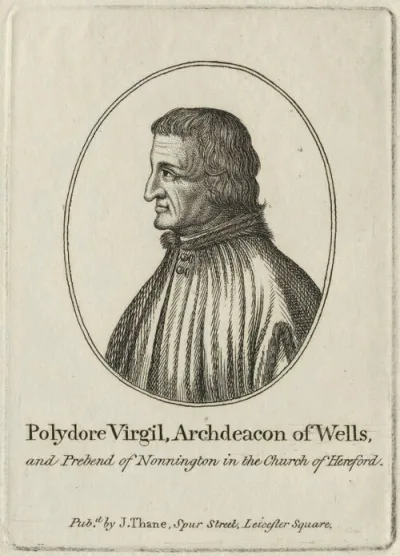
Antonio Virgili
Polydore Vergil was an Italian scholar and historian who spent much of his life in England, writing influential works on history and discoveries.
Polydore Vergil, born in Italy around 1470, was a humanist scholar, priest, and diplomat who spent a significant portion of his career in England. He held various ecclesiastical positions, including Archdeacon of Wells, and was known for his intellectual contributions. Vergil's early life involved education at Italian universities and service to Italian nobility before his move to England in 1502. His arrival in England was as an agent for Cardinal Adriano Castellesi, and he became a respected figure, even gaining favor with King Henry VII. This royal patronage led him to begin his major historical work on England. Vergil's life in England was not without its challenges; he faced imprisonment due to an intercepted letter. Despite this, he continued his scholarly pursuits and maintained connections with Italy, eventually returning to his homeland in his later years and dying in Urbino in 1555. His writings covered a wide range of subjects, from proverbs and the history of inventions to the history of England itself, leaving a lasting impact on historiography.
Scholarly Pursuits and Key Works
Polydore Vergil's prolific career produced several significant works that contributed to Renaissance scholarship. His early publications included the Proverbiorum libellus (1498), a collection of Latin proverbs that predated Erasmus's similar work, and De inventoribus rerum (1499). The latter, a history of discoveries and origins, explored the genesis of various human activities, from religious concepts and law to military science and the arts. This work was popular, translated into multiple languages, and later expanded to include the origins of Christian rites and institutions. Despite facing accusations of heresy and being placed on the Index Librorum Prohibitorum, its broad appeal and extensive research established its importance. Vergil also produced the first critical edition of a British historical text, Gildas's De Excidio et Conquestu Britanniae, and a treatise on natural and supernatural phenomena, Dialogus de Prodigiis.
The Anglica Historia and Historical Influence
Commissioned by King Henry VII, Vergil's Anglica Historia became one of his most influential works. This comprehensive history of England, drafted by 1513 and printed in 1534, aimed to legitimize the Tudor dynasty by recounting the history of the Wars of the Roses and culminating in Henry VII's reign. Vergil's approach, incorporating humanist scholarship and a critical examination of sources, earned him the moniker "Father of English History." His dedication to historical accuracy and narrative structure set a new standard for historical writing in England. The work's detailed account of the period, particularly the transition from the Plantagenet to the Tudor monarchy, provided a foundational text for subsequent historians and shaped the understanding of English medieval and early modern history.
Life in England and Italian Connections
Arriving in England in 1502 as an agent for Cardinal Adriano Castellesi, Polydore Vergil quickly integrated into English society, eventually becoming a naturalized English subject in 1510. He held several ecclesiastical positions, including Bishop of Bath and Wells (by proxy) and Archdeacon of Wells, though he spent little time in residence. His humanist learning and scholarly reputation gained him access to the royal court, where he was welcomed by Henry VII. Despite a period of imprisonment in the Tower of London around 1515 due to a misconstrued letter, Vergil maintained his scholarly activities and connections. He made several return visits to his native Italy throughout his life, ultimately retiring there in his final years, receiving noble status from the Duke of Urbino in 1534 before his death in 1555.
Books by Antonio Virgili
1 free public domain book · Read online or download