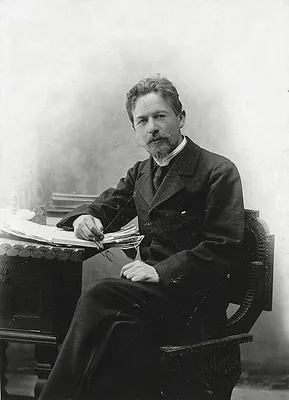
Anton Long
Anton Chekhov was a Russian physician and celebrated playwright whose works revolutionized modern theater.
Anton Pavlovich Chekhov, born in 1860, was a Russian playwright and short story writer renowned for his profound impact on modern literature and theater. Despite being a physician by profession, a role he famously described as his "lawful wife," literature was his "mistress." His career produced four classic plays and highly regarded short stories, influencing the development of the modern short story through his formal innovations. Chekhov's approach to drama, characterized by a "theatre of mood" and exploration of "submerged life in the text," challenged conventional theatrical norms and acting styles, laying groundwork for much of 20th-century acting.
Chekhov's early life was marked by a difficult childhood, including a physically abusive father and financial hardship that led his family to poverty. He supported his family and funded his education by writing numerous short, humorous sketches, often under pseudonyms. His literary career gained momentum through publications in various periodicals, eventually leading to recognition from established writers and critics. He received the Pushkin Prize for his short story collection "At Dusk," signifying a growing artistic ambition. His travels and experiences, including a trip to Ukraine, influenced his writing, notably in his novella "The Steppe," which demonstrated the qualities of his mature fiction.
Early Life and Influences
Born in Taganrog, Russia, Anton Pavlovich Chekhov was the third of six children. His father, a former serf who ran a grocery store, was a devout Christian and a physically abusive figure, whose tyranny was later recalled by Chekhov as a source of childhood suffering. His mother, a gifted storyteller, provided a contrasting influence. Chekhov attended the Greek School and Taganrog Boys Gymnasium, where his education was interrupted for a year due to failing an Ancient Greek exam. He participated in church and choir singing, which he later described as feeling like "little convicts." The family faced severe financial difficulties when his father went bankrupt, forcing him to flee to Moscow to avoid debtor's prison. Chekhov remained in Taganrog to finish his education, supporting himself through private tutoring, selling goldfinches, and writing sketches for newspapers, while sending money to his family. During this period, he developed a love for theater and read widely, including works by Cervantes and Schopenhauer. In 1879, he moved to Moscow to study medicine.
Literary Beginnings and Medical Career
Upon moving to Moscow, Chekhov took on the responsibility of supporting his family and paying for his medical studies. He wrote prolifically, producing short, humorous sketches and vignettes of Russian life under pseudonyms like "Antosha Chekhonte." This prolific output established him as a satirical observer of Russian street life. By 1882, he was contributing to "Oskolki" (Fragments), a publication by Nikolai Leykin. In 1884, Chekhov qualified as a physician, a profession he considered primary, though he often treated the poor without charge. Despite experiencing symptoms of tuberculosis from 1884 onwards, he concealed his illness from his family and friends. His writing continued to support the family, enabling them to move to better accommodations. A significant development occurred in 1886 when he began writing for "Novoye Vremya" (New Times), a popular St. Petersburg paper owned by Alexey Suvorin, who became a close friend. This association provided him with more space and a higher payment rate, enhancing his literary standing.
Artistic Development and Theatrical Innovation
Chekhov's literary career gained significant traction when veteran writer Dmitry Grigorovich praised his story "The Huntsman," recognizing his considerable talent and advising him to focus on quality over quantity. Grigorovich's encouragement spurred Chekhov to develop greater artistic ambition. His short story collection "At Dusk" (1888) earned him the Pushkin Prize, acknowledging its high artistic merit. A pivotal moment was his trip to Ukraine in 1887, which reignited his appreciation for the natural world and influenced his novella "The Steppe." This work, characterized by its drifting narrative and focus on character consciousness, marked a significant artistic leap, showcasing the depth of his mature fiction. In the same year, he wrote his first commissioned play, "Ivanov," which, despite his personal discomfort with the theatrical process, proved to be a successful and original work. Chekhov's later plays, including "The Seagull," "Uncle Vanya," "The Three Sisters," and "The Cherry Orchard," became foundational to modern theater, introducing a "theatre of mood" and exploring the complexities of human interaction and inner life, profoundly impacting acting and audience perception.
Key Ideas
- Theatre of mood
- Submerged life in the text
- Writers' duty is to state problems, not solve them
Notable Quotes
“Medicine is my lawful wife, and literature is my mistress.”
“When my brothers and I used to stand in the middle of the church and sing the trio "May my prayer be exalted", or "The Archangel's Voice", everyone looked at us with emotion and envied our parents, but we at that moment felt like little convicts.”
“Let me ask you to recall that it was despotism and lying that ruined your mother's youth. Despotism and lying so mutilated our childhood that it's sickening and frightening to think about it. Remember the horror and disgust we felt in those times when Father threw a tantrum at dinner over too much salt in the soup and called Mother a fool.”
“Our talents we got from our father, but our soul from our mother.”
“I have written my stories the way reporters write up their notes about fires—mechanically, half-consciously, caring nothing about either the reader or myself.”
Books by Anton Long
2 free public domain books · Read online or download