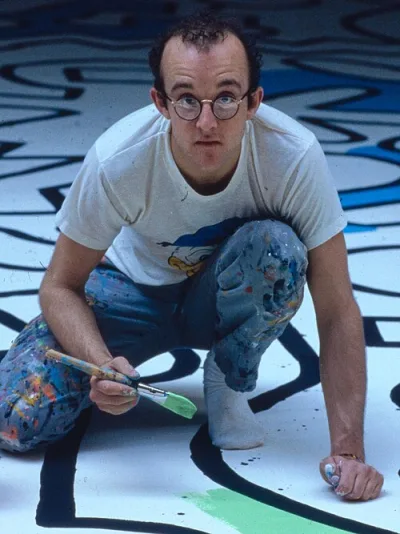
Keith Haring was an American artist and activist known for his bold, graphic style and socially conscious work.
Keith Haring emerged from New York City's downtown art and graffiti scenes in the early 1980s, transforming subway chalk drawings into an internationally recognized artistic career. His distinctive visual language, featuring symbols like the Radiant Baby and barking dogs, became widely known. Haring's work often addressed significant social and political issues, including anti-apartheid, the crack epidemic, and AIDS awareness, aiming to communicate urgent messages to a broad audience.
Beyond his street art origins, Haring gained gallery representation and created large-scale paintings and sculptures. He produced numerous public murals for various institutions and was featured in major international art exhibitions. In 1986, he opened the Pop Shop to make his art more accessible through merchandise. Haring's legacy extends to LGBTQ history, with recognitions in San Francisco and at the Stonewall Inn.
Early Life and Artistic Influences
Born in Reading, Pennsylvania, Keith Haring was raised in Kutztown by his parents, Joan and Allen Haring, who encouraged his early interest in art. His childhood influences included popular cartoon characters from Disney, Dr. Seuss, Charles Schulz, and Looney Tunes. After attending commercial art school in Pittsburgh, Haring became drawn to the work of artists like Jean Dubuffet, Jackson Pollock, and Mark Tobey, as well as the experimental approaches of Pierre Alechinsky and Christo. Moving to New York City in 1978, he studied at the School of Visual Arts, exploring semiotics, video, and performance art, and was notably influenced by author William Burroughs. His journal entries reveal an early awareness of the importance of movement and the fusion of art and performance.
Subway Art and Public Recognition
Haring first gained significant public attention through his spontaneous chalk drawings on unused advertising panels in New York City subway stations, beginning in 1980. He viewed the subway as a public 'laboratory' for his art, utilizing the black panels as a free canvas. His iconic symbol, the Radiant Baby, along with other recurring images like barking dogs and dancing figures, formed a recognizable visual vocabulary. These subway works, initially seen as street art, began to bridge the gap between underground expression and mainstream art, leading to gallery representation and increasing public awareness of his unique style.
Social Commentary and Mainstream Success
Haring's art consistently engaged with pressing social and political issues of his time. He addressed themes such as anti-apartheid, the crack epidemic, homosexuality, safe sex, and AIDS awareness, using his accessible iconography to convey powerful messages. His career rapidly progressed from subway drawings to gallery exhibitions, large-scale murals, and participation in major international art events like documenta and the Venice Biennale. In 1986, he opened the Pop Shop, a retail store designed to make his art widely available through affordable merchandise, reflecting his commitment to accessibility. His work was featured in prominent publications like Vanity Fair and Newsweek, cementing his status as an internationally celebrated artist.
Key Ideas
- Using art as a tool for social and political commentary.
- Making art accessible to a wide audience, bridging street art and Pop art.
- Developing a distinct visual language of symbols and characters.
- The importance of movement and performance in the artistic process.
Notable Quotes
“I am becoming much more aware of movement. The importance of movement is intensified when a painting becomes a performance. The performance (the act of painting) becomes as important as the resulting painting.”
“the perfect place to draw”
“laboratory”
Books by
2 free public domain books · Read online or download