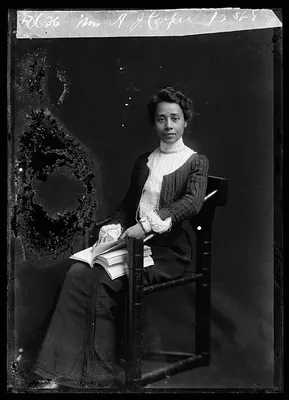
Anna Haywood
Anna Julia Cooper was an influential author, educator, and activist, a foundational figure in Black feminist thought.
Born into slavery in 1858, Anna Julia Cooper defied immense obstacles to become a prominent author, educator, and activist. She pursued higher education at Oberlin College, earning degrees in mathematics, and later completed her doctorate at the University of Paris at age sixty-six, becoming one of the first African American women to achieve this distinction. Cooper was a significant figure in Washington, D.C.'s African-American community and a member of Alpha Kappa Alpha sorority. Her intellectual contributions, particularly her first book, 'A Voice from the South,' are recognized as foundational to Black feminist philosophy, advocating for the uplift and self-determination of African American women through education and intellectual development. Cooper's work championed the idea that the advancement of Black women was crucial for the progress of the entire Black community.
Early Life and Education
Anna "Annie" Julia Haywood was born enslaved in Raleigh, North Carolina, in 1858. Despite her early circumstances, she was able to attend Saint Augustine's Normal School and Collegiate Institute, where she excelled academically for 14 years, demonstrating a strong aptitude for both liberal arts and sciences, including Latin, French, Greek, English literature, mathematics, and science. She fought for her right to pursue advanced courses typically reserved for men. Cooper later attended Oberlin College in Ohio, graduating in 1884, and earned a Master of Arts in mathematics in 1888, becoming one of the first two Black women to achieve this. Her academic pursuits were often balanced with teaching and, after her husband's early death, she took on the responsibility of raising her late half-brother's five children, which temporarily interrupted her doctoral studies.
Literary and Intellectual Contributions
Cooper's seminal work, 'A Voice from the South: By a Black Woman of the South,' published in 1892, is considered a cornerstone of Black feminist thought. In it, she argued for the critical role of educated Black women in advancing the entire African-American community. She posited that the intellectual and moral progress of Black women would elevate society as a whole, suggesting that a greater emphasis on female intellectuals would bring refinement and depth to education. While some viewed her ideas as aligning with the 19th-century "cult of true womanhood," others recognized them as a powerful early argument for Black feminism. Cooper also stressed the responsibility of successful Black women to support those less privileged. Her writings addressed the socioeconomic realities of Black families and offered critiques of educational policies.
Activism and Educational Leadership
Beyond her writings, Cooper was a dedicated activist and educator. She was a founding member of the Colored Women's League in Washington, D.C., an organization focused on promoting unity and social progress within the African-American community. As an educator, she taught at M Street High School in Washington, D.C., eventually becoming principal. Cooper advocated for a classical education model, aligning with W. E. B. Du Bois's vision for preparing students for higher education and leadership, which contrasted with the vocational approach promoted by Booker T. Washington. This stance led to a dispute with the D.C. School Board, which did not reappoint her in 1906, though she was later reinstated. She also delivered significant speeches, including the opening address at the World's Congress of Representative Women in Chicago in 1893.
Key Ideas
- The intellectual and moral advancement of Black women is essential for the progress of the entire African-American community.
- Advocacy for classical education as a means of preparing Black students for leadership and higher learning.
- The importance of self-determination and social uplift for African American women through education.
Notable Quotes
“A nation's greatness is not dependent upon the things it make and uses. Things without thots [sic] are mere vulgarities. America can boast her expanse of territory, her gilded domes, her paving stones of silver dollars; but the question of deepest moment in this nation today is its men and its women, the elevation at which it receives its "vision" into the firmament of eternal truth.”
Books by Anna Haywood
1 free public domain book · Read online or download