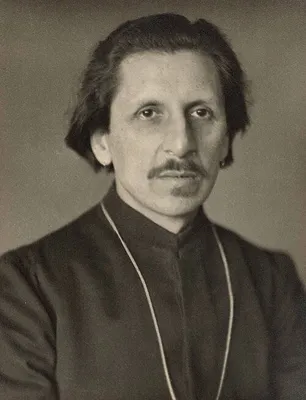
Ananda Coomaraswamy
Ananda Coomaraswamy was a Ceylonese scholar who introduced Indian art to the West and founded the Traditionalist School.
Ananda Coomaraswamy, born in British Ceylon in 1877, was a significant figure in interpreting Indian culture and art for the Western world. His early education took him to England, where he earned a degree in geology and botany. His fieldwork in Ceylon, focused on mineralogy and leading to the formation of the Geological Survey of Ceylon, also sparked his critical views on Westernization. Collaborating with his first wife, Ethel Mary Partridge, on "Mediaeval Sinhalese Art," he began his mission to educate the West about Indian aesthetics.
Returning to London, Coomaraswamy actively engaged with artists, believing artists, not just archaeologists, were best suited to appreciate Indian art. He influenced early Modernists like Jacob Epstein and Eric Gill, whose work incorporated Indian aesthetics. His life involved multiple marriages and travels, including periods in Kashmir and the United States. He served as the first Keeper of Indian art at the Boston Museum of Fine Arts in 1917, where he amassed a substantial collection. His later years were dedicated to scholarship, writing extensively on Indian art, culture, symbolism, and metaphysics, and co-founding the Traditionalist School.
Introducing Indian Art to the West
Ananda Coomaraswamy dedicated himself to bridging the cultural gap between East and West, particularly concerning Indian art. He believed that artists were the most qualified interpreters of art, rather than academics or archaeologists who might focus on historical context over aesthetic value. By the early 20th century, he was actively seeking to influence Western artists, including prominent figures in early British Modernism. His efforts led to the incorporation of Indian aesthetics into their work, contributing to the development of what is now recognized as British Modernism. Coomaraswamy's role was pivotal in establishing the West's understanding and appreciation of Indian artistic traditions.
Scholarly Contributions and the Traditionalist School
Coomaraswamy's intellectual contributions extended to philosophy, literature, and religion. He applied principles inspired by William Morris to Ceylonese culture and co-authored a significant study on its crafts. His engagement with the "Swadeshi" movement in India aligned with early independence efforts. He distinguished between Rajput and Moghul painting and built an extensive collection of these works for the Boston Museum of Fine Arts. Deeply influenced by René Guénon, Coomaraswamy became a key figure in establishing the Traditionalist School. His writings explored symbolism, metaphysics, scripture, and folklore, often drawing connections across diverse traditions and languages, including Sanskrit, Pali, Greek, and Latin.
Methodology and Cross-Cultural Understanding
A proponent of the comparative method, Coomaraswamy analyzed texts and symbols across various cultures and eras to uncover underlying universal traditions. He believed that "folk" traditions preserved ancient, often forgotten, meanings. His fluency in ancient languages enabled him to access primary sources, while his metaphysical understanding allowed him to perceive deeper meanings missed by others. He criticized Western academic traditions for their tendency to compartmentalize knowledge and over-rely on written documentation, arguing that much was lost in non-literate cultures. Coomaraswamy emphasized the continuity of culture, viewing historical change as a process where connecting elements could be obscured by an excessive focus on novelty.
Key Ideas
- Indian art's significance best understood by artists.
- Critique of Western academic specialization and bias.
- Universality of tradition through comparative analysis of symbols and texts.
- Importance of "folk" traditions as preservers of ancient meaning.
Notable Quotes
“The main difficulty so far seems to have been that Indian art has been studied so far only by archaeologists. It is not archaeologists, but artists ... who are the best qualified to judge of the significance of works of art considered as art.”
“I actually think in both Eastern and Christian terms—Greek, Latin, Sanskrit, Pali, and to some extent Persian and Chinese.”
“What the secular mind does is to assert that we (symbolists) are reading meaning into things that originally had none: our assertion is that they are reading out the meaning. The proof of our contention lies in the perfection, consistency and universality of the pattern in which these meanings are united.”
Books by Ananda Coomaraswamy
5 free public domain books · Read online or download