Amy Olberding
The Analects, attributed to Confucius, is a foundational text of East Asian thought, compiled over centuries.
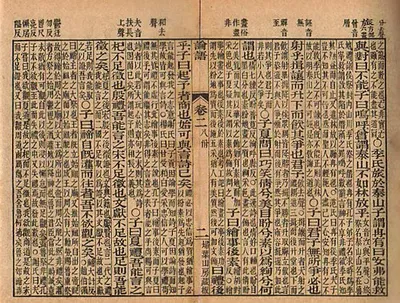
The Analects, also known as the Sayings of Confucius, is an ancient Chinese philosophical text comprising sayings and ideas attributed to Confucius and his contemporaries. Scholars generally agree that significant portions were written during the Warring States period and the text reached its final form by the mid-Han dynasty. Initially viewed as a commentary, it evolved into a central text of Confucianism, eventually surpassing the Five Classics in importance during the Song dynasty and becoming recognized as one of the "Four Books." Its profound influence on East Asian thought and values has persisted for over two millennia. Confucius emphasized moral cultivation for societal welfare, starting with leadership, and believed individuals could achieve virtue (ren) through practices like filial piety and adherence to rituals (li) to reconcile personal desires with social responsibilities. He also stressed a leader's virtue (de) as paramount. His educational aim was to cultivate ethically refined individuals.
Genesis and Compilation
The traditional account, dating back to Han dynasty scholar Ban Gu, suggests the Analects originated from disciples' individual records of conversations with Confucius, compiled and edited after his death. The title 'Lunyu' implies 'edited conversations' or 'selected speeches.' While this view was historically accepted, modern scholarship, including work by Cui Shu and Itō Jinsai, has challenged it, proposing linguistic and content-based distinctions within the text and suggesting later additions. Many scholars now believe the work was compiled over approximately two hundred years during the Warring States period. Recent manuscript discoveries dating to before 300 BCE confirm that the tradition of preserving Confucius' sayings existed by the mid-Warring States period. Regardless of the precise early origins, the Analects was widely known in a largely complete form by the early Han dynasty and finalized during that era. However, some scholars note that sayings cited by later figures like Mencius are not present in the received text, suggesting a larger body of teachings existed previously.
Textual Variants and Evolution
Early Han dynasty records indicate the existence of at least two versions of the Analects: the 'Lu version' and the 'Qi version,' differing in chapter count and content. A third 'Old Text' version, written in archaic characters, was later discovered, distinguished by its chapter order and significant textual differences from the Lu version. Over time, these versions were synthesized. During the Han dynasty, Zhang Yu created a composite text, the 'Zhang Hou Lun,' by prioritizing the Lu version and incorporating elements from the Qi version. This composite text became the recognized Analects. While complete versions of the Lu or Old Text versions no longer exist, fragments have been found. The Qi version was rediscovered in 2011. The oldest known physical copies prior to recent discoveries were stone inscriptions from around 175 AD. More recently, handwritten copies from approximately 50 BC, the 'Dingzhou Analects' and 'Pyongyang Analects,' have been unearthed, though their exact relationship to the known textual traditions remains debated and access to the Pyongyang Analects is restricted.
Philosophical Core
Confucius' philosophy, as presented in the Analects, centers on the idea that a nation's well-being is contingent upon the moral development of its populace, beginning with its leaders. He proposed that individuals could achieve a comprehensive virtue, termed 'ren,' with the foundational step being filial piety—respect and devotion towards parents and elder siblings. Confucius did not advocate for suppressing personal desires but rather for educating individuals to harmonize them through 'li,' which encompasses rituals and proper conduct. Engaging in 'li' allows people to show respect for others and understand their societal roles. For rulers, Confucius identified 'de,' or virtue, as the essential qualification for leadership. His primary educational objective was to cultivate individuals of high ethical standing, characterized by seriousness, articulate speech, and unwavering integrity in all aspects of life.
Key Ideas
- Ren (仁): An all-encompassing sense of virtue and humanity.
- Filial Piety (孝, xiào): Devotion to one's parents and elders, seen as a fundamental step in cultivating virtue.
- Li (禮): Rituals, propriety, and social forms that guide behavior and demonstrate respect.
- De (德): Virtue, particularly as possessed by a leader, considered a prerequisite for effective rule.
Books by Amy Olberding
1 free public domain book · Read online or download