Amy Blackthorn
Beth Chatto was an influential English plantswoman, garden designer, and author known for her innovative garden designs and writings on plant ecology.
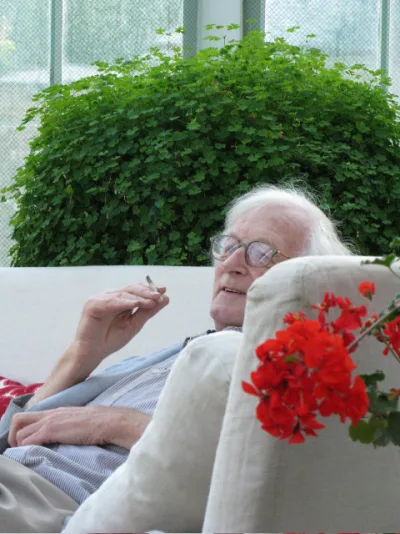
Beth Chatto, born Bessie Diana Little in 1923, was a renowned English plantswoman, garden designer, and author. She gained significant recognition for developing and describing the gardens that bear her name near Elmstead Market, Essex. Her approach to gardening was deeply influenced by her husband Andrew Chatto's research into plant origins, leading to her principle of placing the right plant in the right place. Chatto authored several books focused on gardening under specific conditions, drawing from her extensive experience and lectures delivered internationally. Her work often addressed what she termed "problem areas" in gardens, utilizing plants adapted to diverse environments.
Her career began after marrying Andrew Chatto in 1943. The couple moved to White Barn House in Elmstead Market in 1960, where they began developing the gardens. Chatto was also involved in flower arranging and was a founder member of a local flower arranging club. Her first book, 'The Dry Garden,' was published in 1978, followed by numerous other influential titles. She continued to be involved with her gardens until shortly before her death in 2018 at the age of 94. Her legacy includes the Beth Chatto Education Trust, which promotes ecological approaches to plants and gardens.
Early Life and Influences
Born Bessie Diana Little in Good Easter, Essex, Beth Chatto grew up in a family of keen gardeners. After attending Colchester County High School for Girls, she trained as a teacher. In her twenties, she adopted the name Beth. She met fruit farmer Andrew Chatto, a descendant of the publishing family, in the early 1940s. Their shared passion for plants led to their marriage in 1943. The couple settled in Colchester, where their daughters were born, before moving to White Barn House in Elmstead Market in 1960. During this period, Chatto formed friendships that influenced her horticultural development, including learning planting techniques from artist Sir Cedric Morris. She also became actively involved in the flower arranging movement, co-founding a club in Colchester.
The Beth Chatto Gardens and Publications
The development of the Beth Chatto Gardens commenced in 1960 on land adjacent to their home, previously part of their fruit farm. This land, characterized by challenging conditions such as dry, wet, and overgrown areas, was transformed into a diverse horticultural landscape. The 7-acre garden now features distinct zones including a gravel garden, woodland garden, water garden, and scree garden, each designed to showcase plants suited to specific environmental needs. This practical experience directly informed Chatto's writing, leading to her first book, 'The Dry Garden,' published in 1978. She authored numerous other books, such as 'The Damp Garden,' 'Plant Portraits,' and 'Beth Chatto's Gravel Garden,' often featuring her principle of matching plants to their environment. Her exhibitions, including those at the Chelsea Flower Show where she won numerous gold medals, further disseminated her expertise.
Philosophy and Legacy
Beth Chatto's gardening philosophy centered on the principle of "right plant, right place," a concept inspired by her husband's research into plant origins. This approach emphasized understanding a plant's natural habitat and replicating those conditions in the garden, particularly in challenging soil types or climates. Her work championed the use of drought-resistant and ecologically appropriate planting, advocating for a more sustainable and nature-aligned approach to garden design. This focus on plant ecology and adaptation earned her significant accolades, including an OBE and multiple honorary degrees. Her legacy continues through the Beth Chatto Education Trust, established to promote ecological gardening education, and the Society of Garden Designers' Beth Chatto Eco Garden Award, recognizing sustainable garden design.
Key Ideas
- The principle of placing the right plant in the right place, based on understanding plant origins and environmental conditions.
- Developing gardens in challenging "problem areas" by using plants naturally adapted to specific conditions (e.g., dry, wet, shade).
- Promoting ecological approaches to gardening and plant selection.
Books by Amy Blackthorn
2 free public domain books · Read online or download