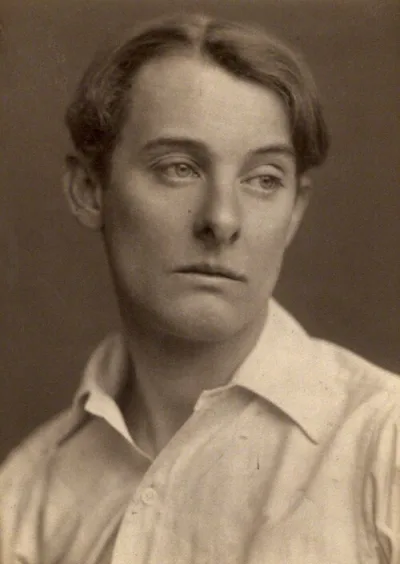
Lord Alfred Douglas was a poet and journalist known for his tempestuous relationship with Oscar Wilde and later embracing Catholicism.
Lord Alfred Douglas, also known as Bosie, was an English poet and journalist born in 1870, recognized primarily for his intense and turbulent relationship with Oscar Wilde. While at Oxford, Douglas edited an undergraduate journal, 'The Spirit Lamp,' which featured homoerotic undertones, and it was during this period that he met Wilde. Their association was a source of deep conflict with Douglas's father, the Marquess of Queensberry, who publicly denounced Wilde. This conflict escalated when Wilde sued the Marquess for libel, a case that ultimately led to Wilde's imprisonment. Following Wilde's release, they briefly reunited but separated before Wilde's death in 1900. Douglas later married Olive Custance, a bisexual poet, and they had a son. In 1911, Douglas converted to Catholicism, renounced homosexuality, and became known for his antisemitic views expressed in the publication 'Plain English.' He also faced imprisonment for libeling Winston Churchill. Douglas authored several poetry collections, some within the Uranian genre, and his 1894 poem 'Two Loves' famously contained the line 'The love that dare not speak its name.'
Early Life and Education
Born in 1870, Alfred Douglas was the third son of the 9th Marquess of Queensberry. His childhood nickname, 'Bosie,' originated from his mother's endearment. Douglas received his education at Wixenford School, Winchester College, and Magdalen College, Oxford, though he did not complete a degree. During his time at Oxford, he edited the undergraduate journal 'The Spirit Lamp,' a period marked by increasing friction with his father. His family history included notable figures, such as his grandmother's conversion to Catholicism and the tragic suicides of two uncles, highlighting a complex familial background.
Relationship with Oscar Wilde
Douglas's association with Oscar Wilde began in 1891, evolving into an intimate and famously tumultuous relationship. Douglas was often described as extravagant and demanding, relying on Wilde financially and emotionally, which led to frequent arguments and reconciliations. He was instrumental in translating Wilde's play 'Salome' into English, though his poor grasp of French resulted in a criticized translation, causing a rift between them. The relationship drew severe disapproval from Douglas's father, the Marquess of Queensberry, who publicly accused Wilde of homosexual conduct. This public accusation initiated a libel case brought by Wilde against the Marquess, which ultimately led to Wilde's downfall and imprisonment.
Later Life and Conversion
After Oscar Wilde's death in 1900, Douglas married the poet Olive Custance in 1902, with whom he had a son. A significant turning point in his life occurred in 1911 when he converted to Catholicism. Following his conversion, Douglas publicly repudiated his former homosexual lifestyle and became an outspoken critic of it. He also developed and expressed strong antisemitic views, notably in the publication 'Plain English.' His later years saw him imprisoned for libeling Winston Churchill. Douglas continued to write poetry, contributing works to the Uranian genre, and his poem 'Two Loves' is notable for containing the phrase 'The love that dare not speak its name.'
Notable Quotes
“The love that dare not speak its name”
Books by
2 free public domain books · Read online or download