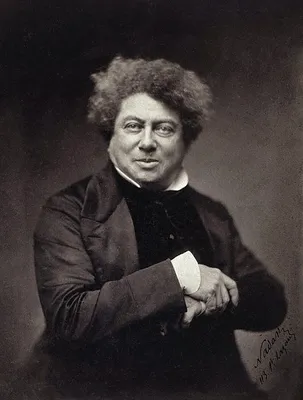
Alexandre Moret
Alexandre Dumas was a prolific French writer of adventure novels and plays, known for works like The Three Musketeers.
Alexandre Dumas, born Alexandre Dumas Davy de la Pailleterie in 1802, was a highly productive French novelist and playwright whose works achieved widespread international recognition. He began his literary career with successful plays before transitioning to serial novels, many of which became classics of adventure fiction. His most famous historical adventure novels, such as The Count of Monte Cristo and The Three Musketeers, were initially published in installments and have since been adapted into numerous films.
Dumas's background was notable; his father, General Thomas-Alexandre Dumas, was born in Saint-Domingue (now Haiti) to a French nobleman and an enslaved African woman. Thomas-Alexandre achieved high rank in the French military, becoming the first soldier of Afro-Caribbean origin to do so. Alexandre Dumas himself worked for Louis-Philippe, Duke of Orléans, early in his career. Despite immense popularity and earning significant sums, Dumas often faced financial difficulties due to his extravagant lifestyle and generosity. He founded a theater in Paris and, later in life, a newspaper supporting Italian unification, and travelled extensively, documenting his journeys in books.
Literary Career and Style
Alexandre Dumas launched his writing career with plays, achieving immediate success with 'Henry III and His Court' in 1829 and 'Christine' the following year. These theatrical triumphs provided him with the financial stability to pursue writing full-time. As the popularity of serial novels grew in newspapers, Dumas adapted his skills to this format, producing his first serial, 'La Comtesse de Salisbury; Édouard III,' in 1836. He further established his reputation by rewriting his play 'Le Capitaine Paul' into a successful serial historical novel. Dumas's prolific output extended to historical novels of adventure, with 'The Count of Monte Cristo' and 'The Three Musketeers' among his most enduring works. His novels were characterized by engaging plots and were widely translated, making him one of the most read French authors globally.
Family Background and Identity
Alexandre Dumas was the son of Thomas-Alexandre Dumas and Marie-Louise Élisabeth Labouret. His paternal grandfather, the Marquis Alexandre Antoine Davy de la Pailleterie, was a French nobleman who had a son, Thomas-Alexandre, with Marie-Cessette Dumas, an enslaved woman of African descent. Thomas-Alexandre was born in the French colony of Saint-Domingue (present-day Haiti). He was brought to France at age 14, granted his freedom, and went on to have a distinguished military career, becoming the first person of Afro-Caribbean origin to reach the rank of general in the French army. The surname 'Dumas' was adopted by Thomas-Alexandre, and subsequently by his son Alexandre, rather than the noble family name.
Later Life and Political Involvement
Following political shifts in France, including the election of Louis-Napoléon Bonaparte in 1851, Dumas fell out of favor and left the country. He resided for periods in Belgium, Russia, and Italy. During his time in Italy, he actively supported the movement for Italian unification, founding and leading the newspaper 'L'Indépendant.' He also befriended Giuseppe Garibaldi, with whom he shared ideals of liberal republicanism and was a fellow Freemason. Dumas returned to Paris in 1864. Throughout his life, he maintained a reputation for generosity, though his lavish spending often led to financial instability. His extensive travels, including to Russia, Spain, Germany, England, and French Algeria, also resulted in published travel books.
Notable Quotes
“the most generous, large-hearted being in the world. He also was the most delightfully amusing and egotistical creature on the face of the earth. His tongue was like a windmill – once set in motion, you would never know when he would stop, especially if the theme was himself.”
Books by Alexandre Moret
2 free public domain books · Read online or download