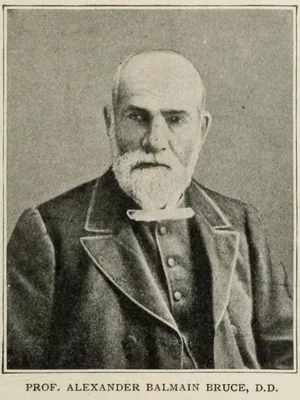
Alexander Balmain Bruce
Alexander Balmain Bruce was a Scottish theologian and Free Church minister known for his biblical scholarship and influential teaching.
Alexander Balmain Bruce, born in 1831, was a prominent Scottish theologian and minister within the Free Church of Scotland. His academic journey began at Edinburgh University, where he experienced significant spiritual doubts during his theological studies, which he ultimately overcame. Bruce entered the ministry, serving in various churches before being appointed to the Free Church Hall in Glasgow in 1875, where he held the chair of apologetics and New Testament exegesis for twenty-four years. During this time, he profoundly influenced his students through his extensive knowledge and intellectual charisma.
Bruce gained recognition as a biblical scholar through his published works, beginning with "The Training of the Twelve" in 1871. His writings, including "The Humiliation of Christ" and "St. Paul's Conception of Christianity," established his reputation among a wider audience and earned him respect from German biblical critics. While his theological views, particularly concerning "The Kingdom of God," generated some criticism and discussion within the church, he was ultimately deemed not to be at variance with its standards. Bruce also contributed significantly to the music of his church, serving on hymnal committees, and lectured at Glasgow University on providential and moral order. He passed away in 1899.
Theological Scholarship and Ministry
Alexander Balmain Bruce dedicated his career to theological scholarship and ministry within the Free Church of Scotland. After overcoming early spiritual trials during his studies, he embarked on a pastoral career, serving in several congregations. His academic prowess became evident with the publication of "The Training of the Twelve" in 1871, a work that solidified his standing as a biblical scholar. This was followed by his appointment to the chair of apologetics and New Testament exegesis at the Free Church Hall in Glasgow in 1875. For over two decades, Bruce significantly impacted students through his deep knowledge and intellectual presence, becoming a respected voice in biblical interpretation.
Key Works and Intellectual Influence
Bruce's extensive writings cemented his reputation as a significant theologian and biblical scholar. Works such as "The Humiliation of Christ" and "St. Paul's Conception of Christianity" were widely noted for their exegetical depth. His scholarship was recognized internationally, with his authority being respected among German biblical critics, placing him alongside figures like William Robertson Smith. Bruce's theological perspectives, particularly those expressed in "The Kingdom of God," sparked debate and scrutiny within his church, though the assembly ultimately found his writings not to contradict church standards. He also contributed to broader philosophical discussions through his Gifford Lectures on the providential and moral order of the world.
Contributions to Church Life and Hymnody
Beyond his academic and theological contributions, Alexander Balmain Bruce played a vital role in the practical life of his church, particularly in the realm of worship music. He served as the convener for the hymnal committees responsible for compiling significant collections of hymns. These efforts led to the publication of the "Free Church Hymn Book" in 1882 and, later, the "Church Hymnary" in 1898, which was adopted by all Scottish Presbyterian churches. This involvement underscores his commitment to enriching the congregational experience through carefully curated liturgical resources.
Books by Alexander Balmain Bruce
1 free public domain book · Read online or download