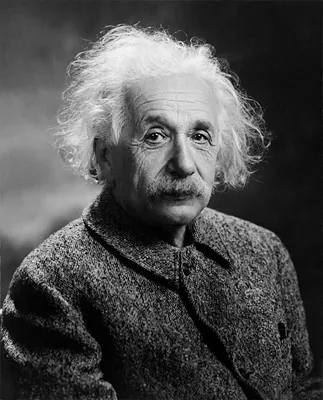
Albert Katz Weinberg
Albert Einstein was a German-born physicist renowned for relativity and quantum theory, whose work influenced cosmology and modern physics.
Albert Einstein was a theoretical physicist, born in Germany in 1879, who became world-famous for his development of the theory of relativity. He also made significant contributions to quantum theory, with his mass-energy equivalence formula E=mc² being particularly well-known. His work earned him the 1921 Nobel Prize in Physics for his explanations of the photoelectric effect.
Einstein's early life involved moving between Germany and Switzerland, where he pursued his education in mathematics and physics. He eventually became a Swiss citizen and later acquired German and then American citizenship. A pivotal year was 1905, often called his "miracle year," during which he published four seminal papers introducing his theories on the photoelectric effect, Brownian motion, special relativity, and mass-energy equivalence. He later expanded his theories with a general theory of relativity that incorporated gravitation and had implications for understanding the universe's structure and evolution.
Later in his career, Einstein focused on statistical mechanics and quantum physics, notably his ideas on light as particles (photons). He also engaged in pursuits that proved unsuccessful, such as his opposition to the probabilistic nature of quantum theory, famously stating "God does not play dice," and his attempt to create a unified field theory. Despite these later challenges, his intellectual legacy is vast, with many concepts and even an element named after him.
Early Life and Philosophical Inclinations
Born in Germany in 1879, Albert Einstein demonstrated exceptional aptitude in mathematics and physics from a young age. His early education included both Catholic and Gymnasium schooling. A pivotal moment occurred at age five when his father showed him a compass, sparking a lifelong fascination with electromagnetism and a sense that "Something deeply hidden had to be behind things." By age twelve, he was self-teaching advanced mathematics and had discovered an original proof of the Pythagorean theorem. A family tutor noted Einstein's profound grasp of geometry and higher mathematics, recognizing his "mathematical genius." His intellectual curiosity extended to philosophy, with Kant's "Critique of Pure Reason" becoming a significant influence by age thirteen.
Scientific Breakthroughs and Theories
Einstein's "miracle year" of 1905 saw the publication of four groundbreaking papers. These introduced his theory of the photoelectric effect, explained Brownian motion, presented his special theory of relativity, and established the equivalence of mass and energy. In 1915, he proposed his general theory of relativity, which offered a new framework for understanding gravitation and the structure of the universe. His 1917 paper on stimulated and spontaneous emission laid crucial groundwork for later developments in quantum physics, including lasers and masers. His contributions to statistical mechanics and quantum theory, particularly the concept of light as particles (photons), fundamentally reshaped physics.
Later Career and Philosophical Stance
In the latter part of his academic life, Einstein dedicated himself to two major areas of research. He famously expressed skepticism about the probabilistic nature of quantum theory, stating, "God does not play dice," indicating his philosophical discomfort with randomness as a fundamental aspect of reality. Concurrently, he pursued the development of a unified field theory, attempting to integrate gravity with electromagnetism. These efforts, while intellectually ambitious, ultimately led to his increasing isolation from the mainstream of contemporary physics. Despite these challenges, his influence endures, recognized by the naming of the element Einsteinium and his designation as Time's Person of the Century.
Key Ideas
- Theory of relativity (special and general)
- Mass–energy equivalence
- Photoelectric effect
- Brownian motion
- Spontaneous and stimulated emission
- Bose–Einstein statistics
- Unified field theory
Notable Quotes
“Something deeply hidden had to be behind things.”
“God does not play dice”
Books by Albert Katz Weinberg
1 free public domain book · Read online or download