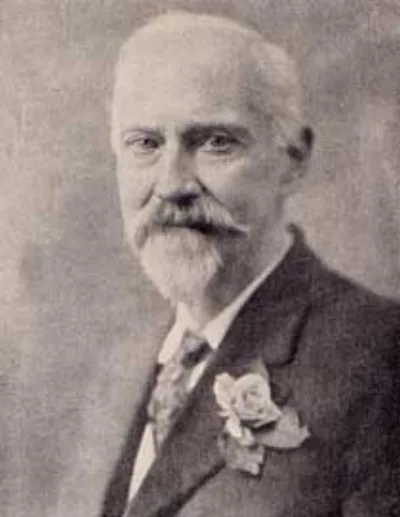
James Churchward, a British writer, proposed the existence of a lost Pacific continent named Mu, a theory considered pseudoscience.
James Churchward was a British writer, inventor, and engineer known for his theories about a lost continent called Mu, located in the Pacific Ocean. He claimed Mu was the "Motherland of Man" and the origin of many ancient civilizations. Churchward's ideas, presented in books like 'The Lost Continent of Mu,' are widely regarded as pseudoscience by scholars due to a lack of evidence and geological implausibility.
Born in Devon, England, Churchward later lived in Southeast Asia and immigrated to the United States. In the US, he patented NCV steel, used for armor plating, and after retiring, dedicated himself to his theories about Mu. He asserted that Mu was a highly advanced civilization that existed tens of thousands of years before his time and that its remnants influenced cultures in India, Babylon, Egypt, and among the Maya. His claims were based on ancient tablets he allegedly deciphered, though scholars have dismissed his translations and geological interpretations as flawed and his work as a hoax.
Theories on the Lost Continent of Mu
James Churchward posited the existence of a vast sunken continent named Mu, which he claimed once existed in the Pacific Ocean. According to his writings, Mu stretched from north of Hawaii to the Fiji Islands and Easter Island. He described it as the cradle of humanity, the "Motherland of Man," and the origin of the Garden of Eden. Churchward estimated that Mu was home to 64 million inhabitants known as the Naacals and that its civilization flourished 50,000 years prior to his own era, possessing a technology superior to his contemporary society. He believed that ancient civilizations in India, Babylon, Persia, Egypt, and those of the Maya were descendants of Mu's colonies.
Sources of Knowledge and Claims
Churchward asserted that his understanding of Mu came from befriending an Indian priest who taught him to read an ancient, nearly extinct language. Through this priest, he gained access to ancient tablets written by the Naacals. He stated that these tablets were fragmented, leaving his knowledge incomplete, but he claimed to find corroboration in the records of other ancient cultures. His detailed descriptions in books like 'The Lost Continent of Mu' covered the history, inhabitants, and profound influence of Mu on subsequent global civilizations. He also claimed that the ancient Egyptian sun-god Ra derived from the Naacal word "Rah" for sun, god, and ruler.
Scholarly Reception and Rebuttals
Churchward's theories about Mu have been consistently rejected by the scientific and academic communities. Researchers like Alfred Metraux, studying Easter Island, and advancements in oceanography and plate tectonics have provided no geological basis for such a lost continent. Scholars such as Martin Gardner and Stephen Williams have characterized Churchward's work as pseudoscience, citing significant geological and archaeological errors, absurd dating methods, and flawed interpretations of data. Gordon Stein and Brian M. Fagan have also noted the lack of scientific support, with Fagan pointing to Churchward's evidence as relying on personal testimonials, inaccurate translations, and spurious reconstructions, leading scholars to regard his books as a hoax or fiction.
Key Ideas
- The existence of a lost continent named Mu in the Pacific Ocean.
- Mu as the "Motherland of Man" and the origin of ancient civilizations.
- Mu was inhabited by the Naacals and possessed an advanced civilization.
- Mu's influence on ancient cultures such as those in India, Egypt, and among the Maya.
- Decipherment of ancient tablets as the source of knowledge about Mu.
Books by
3 free public domain books · Read online or download