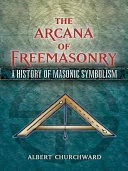
The Arcana of Freemasonry
 75
75

The Arcana of Freemasonry
Albert Churchward's "The Arcana of Freemasonry" is a dense, scholarly attempt to codify the visual language of a clandestine fraternity. Its primary strength lies in its exhaustive cataloging of symbols and their purported ancient antecedents, particularly its extensive referencing of Egyptian iconography. Churchward’s methodical approach offers a compelling argument for the depth of meaning embedded within Masonic emblems. However, the work suffers from a certain speculative quality; while tracing symbols to ancient Egypt is fascinating, the direct lineage often feels asserted rather than definitively proven. A particularly striking section details the symbolic significance of the number three and its geometric representation, the triangle, as a foundational element in Masonic cosmology. Despite its occasional leaps of faith, the book remains an indispensable resource for those seeking to understand the symbolic architecture of Freemasonry.
📝 Description
75
Albert Churchward's 1915 "The Arcana of Freemasonry" argues Masonic symbols are a sophisticated knowledge system tied to ancient sources.
Albert Churchward's "The Arcana of Freemasonry," first published in 1915, examines the symbolic language of the Masonic fraternity. Churchward posits that Masonic symbols function as a complex system for transmitting knowledge, not simply as decorative or arbitrary signs. He draws connections between Masonic iconography and the symbolic systems found in ancient Egyptian hieroglyphics, Mayan glyphs, and Greek mathematical principles.
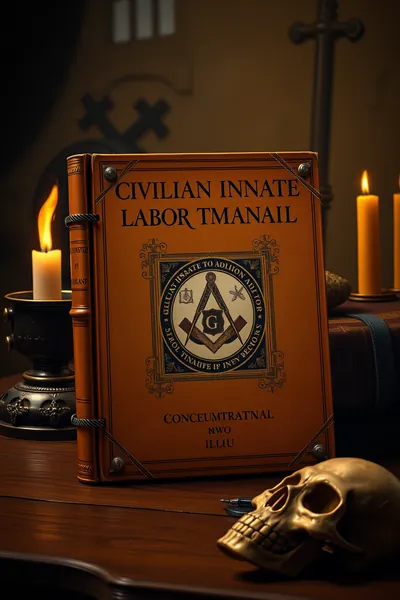
The book includes a detailed illustrated guide to Masonic symbols. Churchward analyzes common emblems like the Square and Compasses, the All-Seeing Eye, the Blazing Star, and the letter 'G.' He contends that a correct understanding of these symbols unlocks philosophical and spiritual concepts passed down through Masonic generations. The work encourages readers to perceive hidden meanings in architecture, art, and geometric forms.
Churchward situates Masonic symbolism within pre-Christian esoteric traditions, noting influences from ancient Egyptian mysteries, Kabbalah, and Gnostic thought. He suggests Freemasonry acts as a modern preserver of this ancient symbolic science, continuing a long lineage of spiritual inquiry. The book emphasizes geometry and mathematics as fundamental principles of the cosmos and the human soul, reflected in Masonic rituals and teachings.
This work places Freemasonry within a lineage of esoteric traditions that sought to preserve and transmit spiritual and philosophical knowledge through symbolic language. Churchward connects Masonic symbolism to ancient mystery schools, particularly those of Egypt, and to later mystical systems like Kabbalah and Gnosticism. The book suggests that these symbols are not mere historical artifacts but a living system intended to convey deep truths about the cosmos and the human condition, a common aim in esoteric thought across cultures and eras.
💡 Why Read This Book?
• Gain a structured understanding of over 100 Masonic symbols, as Churchward systematically deciphers their meanings derived from ancient Egyptian and Greek traditions. • Explore the intricate connection between geometry and spiritual development, as presented in Chapter VI, which details how mathematical principles inform Masonic moral instruction. • Understand the historical argument for Freemasonry as a preserver of ancient esoteric knowledge, with Churchward referencing the early 20th-century context of his research.
⭐ Reader Reviews
Honest opinions from readers who have explored this book.
❓ Frequently Asked Questions
What ancient cultures does "The Arcana of Freemasonry" draw parallels with?
The book extensively draws parallels with ancient Egyptian hieroglyphics and Mayan carvings, suggesting a deep historical root for Masonic symbolism. It also touches upon Greek mathematical notations and philosophical concepts.
Is "The Arcana of Freemasonry" primarily a historical text or a symbolic guide?
It functions as both. While providing historical context for Masonic symbols, its core purpose is to act as a symbolic guide, offering illustrated explanations of their meanings.
Who is Albert Churchward and what is his background?
Albert Churchward was a prominent researcher and author in the early 20th century, known for his extensive work on comparative religion, mythology, and ancient symbolism, particularly with an Egyptian focus.
When was "The Arcana of Freemasonry" first published?
The book was first published on April 21, 2008, though its content reflects research and theories from Albert Churchward's earlier period of study.
What kind of explanations does the book offer for Masonic symbols?
It offers illustrated explanations, revealing messages hidden within works of art, architecture, geometry, and literature, linking them to philosophical and spiritual concepts.
Does the book require prior knowledge of Freemasonry?
While helpful, prior knowledge is not strictly required. The book aims to explain the meanings behind Masonic symbols, making it accessible to those curious about the subject.
🔮 Key Themes & Symbolism
Symbolic Language of the Craft
This work posits Freemasonry as a keeper of an ancient symbolic language, deeply rooted in esoteric traditions predating Christianity. Churchward meticulously dissects iconic Masonic symbols, such as the Square and Compasses, the All-Seeing Eye, and the Blazing Star, arguing they are not mere decorative elements but carriers of profound philosophical and spiritual teachings. The book illustrates how these symbols serve as a visual lexicon, enabling the transmission of complex ideas across generations, echoing the methods found in Egyptian hieroglyphics and Mayan carvings.
The Esoteric Geometry of Creation
A significant theme is the intrinsic link between geometry, mathematics, and the underlying order of the cosmos as understood through Masonic teachings. Churchward explores how geometric principles are employed within Masonic rituals and symbolism to represent spiritual truths, moral development, and the interconnectedness of existence. The book highlights how abstract concepts are made tangible through geometric forms, suggesting that understanding these forms offers a path to comprehending universal laws and the nature of the divine architect.
Ancient Egyptian Roots of Masonry
Churchward places considerable emphasis on the Egyptian mystery schools as a primary source for Masonic symbolism and philosophy. He presents detailed analyses of Egyptian hieroglyphics and religious iconography, drawing direct connections to symbols and concepts found within Freemasonry. This perspective frames Masonry not as a medieval invention, but as a modern iteration of ancient wisdom traditions, particularly those originating from the Nile Valley, preserved and adapted over millennia.
Hidden Meanings in Art and Architecture
The book argues that Masonic symbolism is not confined to lodge rooms but is subtly embedded within broader cultural expressions, including art, architecture, and literature. Churchward provides examples of how Masonic principles and symbols can be identified in significant structures and artistic works, often overlooked by the uninitiated. This suggests a pervasive influence of Masonic thought on Western culture and provides a framework for readers to discover these hidden messages in their surroundings.
💬 Memorable Quotes
Direct passages from the work, attributed to the author.
“The symbols of Freemasonry are not arbitrary signs, but a language conveying ancient wisdom.”
— This core idea suggests that Masonic emblems are a deliberate and sophisticated system for transmitting profound knowledge, echoing the symbolic practices of ancient civilizations.
“The geometrical figures in Masonry represent the fundamental principles of the universe.”
— This interpretation highlights the book's emphasis on the sacredness of geometry within Freemasonry, viewing it as a key to understanding cosmic order and divine creation.
“Masonic symbols can be traced to the ancient Egyptians and their mystery traditions.”
— This statement underscores Churchward's central thesis linking Freemasonry directly to ancient Egyptian esoteric practices, positioning it as a continuation of that lineage.
“The Letter 'G' signifies God and Geometry.”
— This interpretation captures a specific example from the book, illustrating how a single Masonic symbol can hold multiple layers of meaning, linking the divine with universal principles.
💡 Key Ideas
Editorial paraphrase of the work's core concepts — not direct quotes.
Hidden messages are concealed within the art, architecture, and literature of the world.
This paraphrase points to the book's assertion that Masonic symbolism is not exclusive to fraternal orders but is subtly present in various forms of human creative expression.
🌙 Esoteric Significance
Tradition
This work is firmly situated within the Western Esoteric Tradition, specifically drawing heavily from Hermeticism and comparative mythology with an Egyptian focus. It aligns with the Theosophical inclination of its era, which sought to find universal truths underlying all religions and secret traditions. Churchward attempts to demonstrate that Freemasonry is not an isolated phenomenon but a modern manifestation of ancient mystery school teachings, particularly those he believed originated in pre-dynastic Egypt, thus linking it to a primordial, universal spiritual science.
Symbolism
Central to the book's symbolism is the Square and Compasses, representing the earthly and the divine, or the material and spiritual realms, in harmonious balance. The All-Seeing Eye is interpreted as the divine providence or consciousness overseeing creation, a concept with roots in ancient Egyptian solar deities. Churchward also explores the significance of geometric forms, such as the triangle, as representations of the divine triad and fundamental cosmic principles, linking them to Pythagorean and Platonic thought.
Modern Relevance
Contemporary esoteric researchers and students of Western Mystery traditions continue to reference Churchward's work for its detailed symbol catalog and its ambitious linking of Masonic lore to ancient Egyptian religion. While modern scholarship may critique some of his direct historical claims, his framework for understanding symbols as a universal language remains influential. Practitioners of ceremonial magic and comparative religion scholars exploring the development of esoteric thought in the late 19th and early 20th centuries find value in his comprehensive approach.
👥 Who Should Read This Book
• Students of comparative religion and ancient symbolism seeking to understand the cross-cultural influences on Western esoteric traditions. • Freemasons and individuals interested in the symbolic and philosophical underpinnings of Masonic rituals and teachings. • Researchers of Western Esotericism looking for detailed analyses of symbols and their purported connections to ancient Egyptian and Greek thought.
📜 Historical Context
Albert Churchward's "The Arcana of Freemasonry," first published in the early 20th century, emerged during a period of intense interest in comparative mythology, ancient religions, and esoteric societies. The era saw figures like Helena Blavatsky and the Theosophical Society popularizing ancient wisdom traditions, and a general fascination with uncovering hidden spiritual lineages. Churchward's work positioned itself within this intellectual current, seeking to demonstrate the profound antiquity and universalism of Masonic symbolism, particularly by linking it to ancient Egypt. This was a departure from earlier Masonic interpretations that often focused more on medieval guilds or Rosicrucianism. While not directly engaging in public debates, Churchward's theories implicitly challenged more secular or purely fraternal interpretations of Masonry, aligning with a broader occult revival. His extensive referencing of Egyptian iconography was a distinctive feature, setting his work apart from contemporaries who might have focused more on Kabbalah or Christian mysticism.
📔 Journal Prompts
The Square and Compasses as symbols of balance: how does this duality manifest in your own life?
Reflect on the concept of the 'divine architect' as presented through Masonic geometry.
Analyze a piece of art or architecture you encounter, searching for potential hidden symbolic meanings.
Consider the historical argument for Masonic symbolism originating in ancient Egypt.
Explore the idea of a universal symbolic language across different cultures and eras.
🗂️ Glossary
All-Seeing Eye
A symbol within Freemasonry often interpreted as the eye of God, representing divine providence, omniscience, and spiritual awareness watching over humanity.
Blazing Star
A prominent Masonic symbol, often depicted as a pentagram, representing divine light, knowledge, and the human soul's connection to the celestial realm.
Letter 'G'
A significant symbol in Masonic lodges, generally understood to represent God (the Great Architect) and Geometry, emphasizing the divine and mathematical principles of creation.
Square and Compasses
The principal symbol of Freemasonry, representing the tools of the operative stonemason used metaphorically to guide the speculative Mason in moral and spiritual conduct.
Hieroglyphics
The formal writing system used in ancient Egypt, employing a combination of logographic, syllabic, and alphabetic elements. Churchward uses them as a source for symbolic parallels.
Mayan Carvings
Inscriptions and art found on stone monuments created by the Maya civilization, which Churchward references for their complex symbolic systems.
Great Architect of the Universe
A term used in Freemasonry to refer to a supreme being or deity, without specific denominational affiliation, acknowledging a divine creator.