Adena Tryon
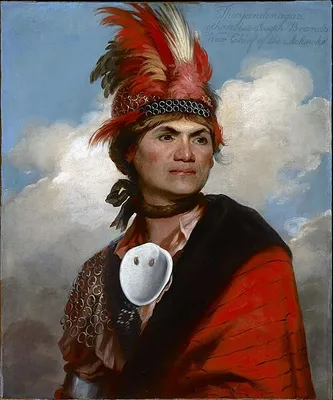
Thayendanegea, known as Joseph Brant, was a prominent Mohawk leader who allied with Great Britain during the American Revolution.
Thayendanegea, more commonly known as Joseph Brant, was a significant Mohawk military and political figure of the late 18th century. Born in 1743, he rose to prominence through his education and connections, particularly through his sister Molly Brant, who was married to Sir William Johnson, the British Superintendent of Indian Affairs. Brant was a staunch ally of Great Britain during and after the American Revolution, leading Mohawk warriors and Loyalist militias in partisan warfare on the New York frontier. Despite facing accusations of atrocities from American forces, he played a crucial role in the conflict.
Following the war, Brant was instrumental in securing land for his followers in what is now Ontario, Canada. He led many Iroquois to settle along the Grand River, establishing a new community. Brant maintained his leadership until his death in 1807, leaving a legacy as one of the most recognized Indigenous figures of his era. He interacted with prominent American and British figures of his time, including George Washington and King George III.
Early Life and Education
Born Thayendanegea in March 1743 in the Ohio Country, Joseph Brant was named for a Mohawk custom of betting. He belonged to the Wolf Clan, a matrilineal lineage within the Haudenosaunee League. His parents were Christian, and his father died when he was young. Brant's mother remarried a man whose surname, when Anglicized, became Brant. He grew up in Canajoharie, a Mohawk village in present-day upstate New York, in a multicultural environment that included Palatine German and English settlers. This upbringing allowed him to be comfortable with aspects of European culture while still identifying as Mohawk. His mother was a successful businesswoman involved in the ginseng trade, through which she met Sir William Johnson, a powerful British official.
Association with Sir William Johnson
Brant's family had significant connections to Sir William Johnson, the influential British Superintendent of Indian Affairs. Johnson was highly respected by the Mohawk and lived among them, taking Mohawk women as common-law wives. Brant's half-sister, Molly Brant, became Johnson's wife. This connection proved pivotal for young Brant. Johnson took an interest in him, supporting his English-style education and introducing him to influential figures in the New York colony. Brant was described as an affable and charming young man who enjoyed hunting and fishing, often interacting with both Indigenous and European settlers. He was impressed by Johnson's estate, Johnson Hall, and chose to live with Molly and Johnson for a period.
Role in the American Revolution and Aftermath
During the American Revolutionary War, Brant emerged as a formidable Mohawk military leader, commanding Mohawk warriors and Loyalist militias known as Brant's Volunteers. He engaged in intense partisan warfare against American rebels along the New York frontier. The Americans, viewing him as an enemy, falsely accused him of atrocities and nicknamed him "Monster Brant." After the war, recognizing the losses suffered by his people, Brant worked to secure new lands. In 1784, Quebec Governor Frederick Haldimand granted Brant and his followers a large tract of land along the Grand River in present-day Ontario, Canada, to compensate for their lost territories in New York. Brant led many Iroquois to relocate to this area, where he continued to be a prominent leader until his death in 1807.
Books by Adena Tryon
1 free public domain book · Read online or download