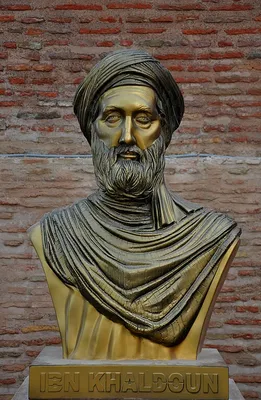
Abdelmajid Hannoum
Ibn Khaldun was a pioneering Arab scholar and social scientist of the Middle Ages, known for his foundational work on historiography and sociology.
Ibn Khaldun (1332–1406) was an influential Arab scholar, historian, philosopher, and sociologist, widely recognized as a significant figure in the development of social sciences. His most celebrated work, the Muqaddimah, served as an introduction to his planned history of the world and profoundly impacted later thinkers, including Ottoman historians and even European philosophers like Machiavelli and Hume. His life, extensively documented in his autobiography, was marked by a dynamic political career across North Africa and Granada, involving periods of high office, imprisonment, and exile.
Born into an aristocratic Andalusian family in Tunis, Ibn Khaldun received a comprehensive classical Islamic education. His family's background provided him access to prominent teachers, and he mastered subjects like the Quran, Arabic linguistics, Hadith, Sharia, and Fiqh. Despite his family's eventual withdrawal from politics and embrace of mysticism, Ibn Khaldun pursued a political career, navigating the complex political landscape of the Maghreb. His journey involved serving various rulers, undertaking diplomatic missions, and experiencing the rise and fall of regimes, which likely informed his later sociological and historical analyses.
Intellectual Legacy and Influences
Ibn Khaldun is considered a foundational figure in multiple academic disciplines, including historiography, sociology, economics, and demography. His intellectual contributions have drawn comparisons to prominent European thinkers such as Niccolò Machiavelli, David Hume, G.W.F. Hegel, and Karl Marx, suggesting that his ideas anticipated or paralleled theirs, though not through direct influence. He also left a mark on modern Islamic scholars, particularly within the traditionalist school. His seminal work, the Muqaddimah, written in a six-month period of seclusion, explored theories of social cohesion, group dynamics, and the cyclical rise and fall of civilizations. This work was later utilized by Ottoman historians to understand the trajectory of their own empire.
Early Life and Education
Born in Tunis in 1332 to an Andalusian Arab family of high standing, Ibn Khaldun received a thorough classical Islamic education. He studied under distinguished scholars, mastering subjects like the Quran (which he memorized), Arabic grammar, Hadith, and Islamic law (Sharia and Fiqh). His education was further enriched by exposure to mathematics, logic, and philosophy, influenced by thinkers such as Averroes and Avicenna. A significant turning point in his youth was the devastating plague of 1348, which claimed the lives of his parents and several teachers. This personal tragedy, coupled with the turbulent political environment of North Africa, shaped his worldview and career path.
Political Career and Sociological Insights
Ibn Khaldun embarked on a multifaceted political career at a young age, holding various positions in the administrations of rulers in Tunis, Fez, Granada, and Tlemcen. His life was characterized by shifting alliances, periods of influence, imprisonment, and exile, experiences that provided rich material for his analyses of power, governance, and social change. His autobiography details a life of adventure, marked by both reaching high offices and facing downfall. His ability to interact with diverse groups, including Berber tribes, proved crucial. It was during a period of enforced seclusion with a Berber tribe that he wrote the Muqaddimah, leveraging his unique experiences to develop his theories on the dynamics of human societies.
Key Ideas
- Historiography
- Sociology
- Economics
- Demography
- Theories on the rise and fall of civilizations
- Social cohesion and group dynamics
Notable Quotes
“And our ancestry is from Hadhramaut, from the Arabs of Arabian Peninsula, via Wa'il ibn Hujr also known as Hujr ibn 'Adi, from the best of the Arabs, well-known and respected.”
Books by Abdelmajid Hannoum
1 free public domain book · Read online or download