Abbey Reel
Abbey Road, the Beatles' final recorded album, blended diverse genres and innovative production, achieving commercial success despite initial mixed reviews.
Released in September 1969, Abbey Road was the eleventh and final studio album recorded by The Beatles, though 'Let It Be' was completed later. The album was primarily recorded in the spring and summer of 1969, and quickly climbed to the top of the charts in both the United States and the United Kingdom. A notable double A-side single, "Something" / "Come Together", also achieved chart success in the US.
Abbey Road showcased a variety of musical styles, including rock, pop, blues, and progressive rock, and notably featured the Moog synthesiser and guitars processed through a Leslie speaker. A significant aspect of the album is the extended medley of songs featured on its second side, which has since been recognized as a cohesive suite by other artists. While the recording atmosphere was generally more amicable than previous sessions, tensions still arose, particularly concerning Paul McCartney's song "Maxwell's Silver Hammer." John Lennon's departure from the group occurred before the album's release, though it was not publicly announced until the following year.
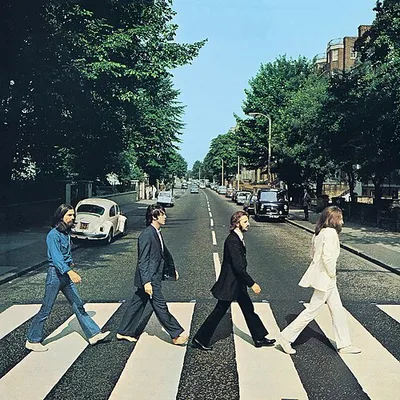
Commercially, Abbey Road was a significant success, selling over 30 million copies worldwide and becoming one of the best-selling albums of all time. Initial critical reception was mixed, with some critics finding the production artificial. However, critical opinion evolved over time, and the album is now widely considered one of The Beatles' finest works and a landmark in popular music history. The album's iconic cover, depicting the band crossing the street outside Abbey Road Studios, remains one of music's most recognizable images.
Background and Creative Direction
Following the challenging recording sessions for the 'Get Back' album, Paul McCartney proposed to producer George Martin that The Beatles create an album in their earlier, more collaborative style, free from the conflicts that had emerged during the 'White Album' sessions. Martin agreed, but with the stipulation that he would have full production control, and that all band members, especially John Lennon, would adhere to a disciplined approach. While the band was not certain this would be their final project, George Harrison later reflected that it felt like they were nearing an end.
Production and Technical Innovation
Abbey Road's recording sessions commenced in February 1969, with initial work on "I Want You (She's So Heavy)" at Trident Studios, featuring Billy Preston on Hammond organ. Further recording was delayed until April due to Ringo Starr's film commitments. After a brief period of work and a session for "You Never Give Me Your Money" in May, the band took an eight-week break before resuming in July. Recording concluded in August with the final backing track for "Because." Overdubs continued throughout August, with the album's final arrangement finalized on August 20, marking the last time all four Beatles were together in a studio. The album was recorded using eight-track reel-to-reel machines and the TG12345 Mk I solid-state transistor mixing desk, a departure from earlier tube-based equipment. This facilitated extensive overdubbing and contributed to a clearer, warmer sound. The prominent use of the Moog synthesiser, introduced by Harrison, and guitars through a Leslie speaker were key technical elements that distinguished the album's sonic landscape.
Songwriting and Interpersonal Dynamics
Despite a generally more positive recording atmosphere compared to earlier sessions, significant tensions persisted within the band. John Lennon proposed dedicating one side of the album to his songs and the other to McCartney's. The final album represented a compromise, with McCartney and Martin favoring a thematic approach featuring a medley, while Lennon preferred a more traditional structure of distinct songs. Lennon later expressed dissatisfaction with the album, deeming it inauthentic and criticizing the medley as a collection of unfinished ideas. George Harrison's contributions, "Something" and "Here Comes the Sun," are now considered among his best work for the group. "Come Together" originated from a song Lennon wrote for Timothy Leary's political campaign, with its lyrics evolving during a 'bed-in' event. "Something" was inspired by James Taylor's music and was initially offered to Joe Cocker before being recorded by the band. It became the Beatles' first number-one single not credited to Lennon-McCartney.
Key Ideas
- The evolution of The Beatles' sound through innovative production techniques and instrumentation.
- The interplay between individual creative visions and group dynamics during the band's final recording period.
- The lasting impact of an album's musical content and iconic imagery on popular culture.
Notable Quotes
“it felt as if we were reaching the end of the line”
“we did actually perform like musicians again”
“a simple song but it stands out because of the sheer brilliance of the performers”
“the greatest love song ever written”
Books by Abbey Reel
1 free public domain book · Read online or download