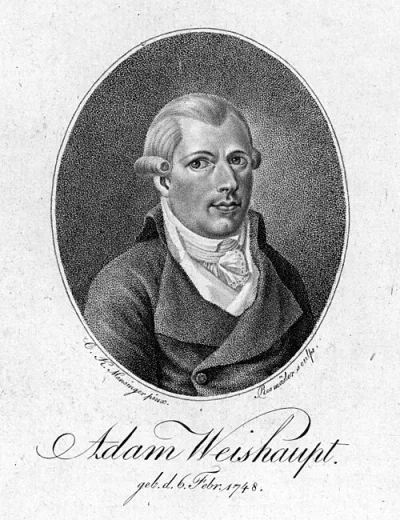
Johann Adam Weishaupt founded the Bavarian Illuminati, an order focused on reason and enlightenment that was later suppressed.
Johann Adam Weishaupt, born in 1748, was a German philosopher and professor of law who established the Order of the Illuminati in Bavaria on May 1, 1776. Initially, the term 'Illumination' signified a select group of enlightened individuals, drawing from the Latin 'illuminatus.' Weishaupt aimed to liberate humanity from religious constraints and challenge established governments, promoting rationalism and equality. The organization operated as a network of cells with superiors unknown to subordinates, a structure later adopted by other groups. Weishaupt also infiltrated Masonic lodges to recruit members for his society, intending to perfect human nature through re-education towards a communal state free from government and organized religion.
Despite Weishaupt's stated goals, the Order's methods, which involved detailed directives on members' reading and thinking, were criticized as a perversion of Enlightenment principles. Intercepted writings in 1784 were deemed seditious, leading to the Order's ban by the Bavarian government and Weishaupt's exile. During his exile, he wrote extensively on illuminism. While some contemporaries like Augustin Barruel viewed Weishaupt's ambitions negatively, others, such as Thomas Jefferson, saw him as a philanthropist. Weishaupt died in 1830, and his Order left no lasting influence.
Founding of the Illuminati
Johann Adam Weishaupt established the Order of the Illuminati in Bavaria on May 1, 1776, driven by a desire to improve society through enlightenment. The name 'Illuminati' derived from the Latin 'illuminatus,' meaning 'enlightened,' referring to a select group of exceptional individuals. Weishaupt's vision was to free people from religious oppression and undermine corrupt authorities, advocating for equality and liberty. The organization employed a hierarchical structure with isolated cells and unknown superiors, a model later emulated. Weishaupt also sought to use Freemasonry as a vehicle for recruitment, aiming to perfect human nature through rational re-education towards a communal existence independent of state and church.
Ideological Principles and Criticisms
The Illuminati's core tenets centered on the supremacy of reason and the pursuit of enlightenment, aiming to dispel superstition and prejudice. However, the Order's structured approach, dictating what members should read and think, drew criticism. Dr. Wolfgang Riedel noted that this method contradicted Immanuel Kant's emphasis on independent thought, suggesting the Order's enlightenment occurred under the direction of its superiors. Writings intercepted in 1784 were interpreted as subversive, leading to the Order's prohibition by the Bavarian government. Weishaupt's radical rationalism and specific vocabulary were deemed problematic.
Exile and Later Life
Following the suppression of the Illuminati in Bavaria, Weishaupt fled and found refuge with Duke Ernest II of Saxe-Gotha-Altenburg. During his exile in Gotha, he authored several works concerning illuminism, including 'A Complete History of the Persecutions of the Illuminati in Bavaria' and 'An Apology for the Illuminati.' Weishaupt continued his philosophical pursuits until his death in Gotha on November 18, 1830. Despite the Order's dissolution and the dispersal of its members, Weishaupt's writings from this period reflect his continued engagement with his philosophical ideas.
Interpretations of Weishaupt's Intentions
Assessments of Johann Adam Weishaupt's character and intentions have varied significantly. Critics like Augustin Barruel and John Robison viewed him with suspicion, portraying his goals as destructive. Conversely, figures like Thomas Jefferson saw Weishaupt as a well-intentioned philanthropist who believed in human perfectibility and the reinstatement of natural religion. Author Tony Page suggests Weishaupt intended to foster virtue and social justice through education, aiming for his followers to exert a positive influence in positions of power. Page characterizes Weishaupt's project as utopian and optimistic, arguing that neither he nor his plan were inherently evil or violent, despite his later notoriety in conspiracy theories.
Key Ideas
- Illumination as a process of rational enlightenment to dispel superstition and prejudice.
- The pursuit of equality, liberty, and the liberation of humanity from religious and governmental control.
- The concept of perfecting human nature through re-education towards a communal state.
- The use of secret societies and structured hierarchies for disseminating ideas and influence.
Notable Quotes
“At a time, however, when there was no end of making game of and abusing secret societies, I planned to make use of this human foible for a real and worthy goal, for the benefit of people. I wished to do what the heads of the ecclesiastical and secular authorities ought to have done by virtue of their offices ...”
“The independence of thought and judgment required by Kant ... was specifically prevented by the Order of the Illuminati's rules and regulations. Enlightenment takes place here, if it takes place at all, precisely under the direction of another, namely under that of the "Superiors" [of the Order].”
“Barruel's own parts of the book are perfectly the ravings of a Bedlamite”
“enthusiastic Philanthropist”
Books by
0 free public domain books · Read online or download