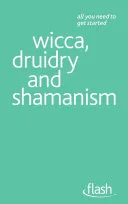
Wicca, Druidry and Shamanism: Flash
 74
74

Wicca, Druidry and Shamanism: Flash
Teresa Moorey’s *Wicca, Druidry and Shamanism: Flash* succeeds admirably in its stated goal: to offer a swift, uncomplicated introduction to these distinct spiritual paths. Its strength lies in its brevity and clarity, stripping away jargon to present core tenets in a manner that is genuinely accessible. The section on Wicca, for instance, effectively distills the essence of the Craft without getting bogged down in complex ritualistic minutiae. However, this very conciseness is also its primary limitation. The book’s treatment of shamanism, while present, feels somewhat superficial, lacking the depth required to convey the profound, often challenging, nature of true shamanic practice. A passage discussing the cyclical nature of the Wheel of the Year in Wicca is a good example of the book’s successful simplification of complex ideas. For the absolute beginner seeking a quick overview, it's a functional primer, but it offers little for those seeking deeper engagement or nuance. It serves its purpose as a brief primer, nothing more.
📝 Description
74
Teresa Moorey's 2011 book, Wicca, Druidry and Shamanism: Flash, distills three pagan paths for the hurried seeker.
This book, published in 2011, offers a quick introduction to Wicca, Druidry, and Shamanism for readers with limited time. It avoids complex rituals and obscure materials, focusing instead on core beliefs and practices in an easy-to-understand format. The author aims to make these traditions accessible to those new to paganism or alternative spiritualities. It is specifically written for busy individuals or those simply curious about these paths, serving as a primer rather than an in-depth academic study. Readers seeking extensive practical guidance or scholarly analysis will find this volume a starting point, not a destination.
Published in 2011, this work reflects a growing public interest in paganism and earth-centered spirituality. It acknowledges the popularization efforts for traditions like Wicca and the revival of Druidry. By simplifying these paths, the book aligns with a cultural trend making esoteric subjects more mainstream. It moves these practices from niche subcultures toward wider understanding, a contrast to more secretive historical forms.
💡 Why Read This Book?
• Gain a foundational understanding of Wicca's Wheel of the Year and covens, distinguishing it from other pagan paths, as explored in the book's Wicca section. • Grasp the core principles of nature reverence and symbolic practices central to Druidry, providing a clear contrast to shamanic traditions. • Understand the basic concept of spirit journeys and connection to the spirit world within shamanism, as briefly outlined in the book's dedicated section.
⭐ Reader Reviews
Honest opinions from readers who have explored this book.
❓ Frequently Asked Questions
What makes Teresa Moorey's book different from other introductions to Wicca, Druidry, and Shamanism?
This book, first published in 2011, is part of a 'Flash' series designed for extreme brevity. It avoids complex techniques and materials, offering a quick, 96-page overview rather than an exhaustive exploration.
Is Wicca, Druidry and Shamanism suitable for someone with no prior knowledge of these topics?
Yes, the book is specifically designed for the 'merely curious' and those with limited time. It aims to be a simple, to-the-point guide that requires no prior experience.
Does the book offer practical exercises for practicing Wicca, Druidry, or Shamanism?
The book focuses on introducing concepts rather than providing detailed practical exercises. Its aim is informational, serving as a quick entry point to understanding the basics of these traditions.
What is the historical period covered by the book's discussion of these traditions?
While not explicitly dated within the text, the book discusses modern interpretations of Wicca, Druidry, and Shamanism, reflecting their presence in contemporary spiritual landscapes since the latter half of the 20th century.
How does the book differentiate between Wicca, Druidry, and Shamanism?
It presents each tradition separately, highlighting their unique core beliefs and practices. For example, it distinguishes Wicca's Wheel of the Year from Druidry's focus on nature and Shamanism's spirit journeys.
Is this book a comprehensive guide to paganism?
No, it is a brief introduction covering three specific pagan paths. It provides a foundational overview within 96 pages, ideal for gaining a quick understanding rather than in-depth knowledge.
🔮 Key Themes & Symbolism
Pagan Paths Overview
This work functions as a comparative primer, introducing the reader to three distinct yet often overlapping spiritual traditions: Wicca, Druidry, and Shamanism. It highlights their common threads, such as reverence for nature and cyclical time, while also delineating their unique characteristics. For Wicca, it touches upon concepts like the Wheel of the Year and covens. Druidry is presented through its connection to ancient wisdom and the natural world. Shamanism is explored via its focus on spirit communication and healing practices. The book aims to provide a clear, foundational understanding for those new to these paths.
Accessibility in Esotericism
A central theme is making esoteric knowledge accessible. The 'Flash' series, to which this book belongs, prioritizes brevity and simplicity, eschewing complicated techniques or rare materials. Published in 2011, it reflects a trend of clarifying spiritual practices that were previously considered niche or obscure. The author's approach is designed to lower the barrier to entry, appealing to a broader audience interested in alternative spiritualities but perhaps intimidated by more dense or demanding texts.
Nature and Cyclical Time
Across the traditions discussed, a profound connection to the natural world and an understanding of cyclical time emerge as significant unifying elements. Wicca's celebration of the Wheel of the Year, marking solstices and equinoxes, exemplifies this. Druidry's deep reverence for trees, seasons, and the land further underscores this theme. Shamanism, often involving journeys into spirit realms that mirror natural cycles, also implicitly connects practitioners to the rhythms of the earth. This shared emphasis on nature provides a core perspective distinguishing these paths.
Spiritual Exploration
The book encourages personal spiritual exploration by presenting these traditions as viable alternatives to mainstream religious frameworks. It frames Wicca, Druidry, and Shamanism not just as historical or anthropological subjects, but as living spiritual paths that individuals can engage with. By offering brief introductions, it serves as a catalyst, prompting readers to investigate further and potentially discover a path that aligns with their own worldview and spiritual needs, fostering a sense of agency in one's belief system.
💬 Memorable Quotes
Direct passages from the work, attributed to the author.
“Wicca, Druidry, and Shamanism is a short, simple and to-the-point guide.”
— This statement directly addresses the book's core design philosophy. It emphasizes conciseness and clarity, positioning the work as an introductory text rather than an exhaustive treatise, making it suitable for quick learning.
“The books in this bite-sized new series contain no complicated techniques or tricky materials.”
— This highlights the series' commitment to accessibility. It signals to potential readers that the content is designed for ease of understanding and engagement, removing potential barriers often associated with spiritual or occult studies.
“Ideal for the busy, the time-pressured or the merely curious.”
— This phrase clearly defines the target audience. It acknowledges the demands of modern life and caters to individuals seeking introductory knowledge without a significant time investment or deep prior commitment.
“In just 96 pages, the reader will discover everything about paganism.”
— While hyperbolic, this suggests the book aims to cover the essential breadth of paganism through its focus on these three key traditions, providing a comprehensive yet brief overview.
“a quick, no-effort way to break into this fascinating topic.”
— This reinforces the book's low barrier to entry. It frames the reading experience as effortless, encouraging those who might feel intimidated by the subject matter to explore it.
🌙 Esoteric Significance
Tradition
This work does not align strictly with a single esoteric lineage like Hermeticism or Gnosticism. Instead, it functions as an introductory overview of distinct, nature-based spiritual paths often categorized under the umbrella of Neo-Paganism. It bridges the gap between popular interest and esoteric practice by presenting core concepts without demanding adherence to a specific, formalized esoteric school. Its approach is more syncretic and descriptive, offering glimpses into traditions that themselves draw from diverse historical and animistic roots.
Symbolism
The book likely touches upon symbols central to its featured traditions. For Wicca, this would include the Pentacle (representing the elements and spirit) and the Triple Moon (symbolizing the Goddess in her maiden, mother, and crone aspects). Druidry might feature the Ogham (ancient Celtic alphabet with symbolic tree meanings) or symbols of the natural world like acorns and trees themselves, representing connection and growth. Shamanism often utilizes animal totems or spirit guides, representing aspects of the psyche or spiritual assistance.
Modern Relevance
Contemporary practitioners and enthusiasts of Neo-Paganism, particularly those seeking concise introductions, continue to find value in works like this. Thinkers and groups focused on Earth-based spirituality, ecological activism, and comparative religion studies may use it as a foundational text. Its relevance lies in its ability to quickly orient newcomers to the field of modern paganism, influencing how individuals first encounter and understand traditions like Wicca, Druidry, and Shamanism in the digital age.
👥 Who Should Read This Book
• Individuals exploring alternative spiritual paths for the first time who need a quick, non-intimidating overview of major Neo-Pagan traditions. • Busy professionals or students seeking to understand core concepts of Wicca, Druidry, and Shamanism without committing to extensive reading. • Comparative religion students or researchers needing a brief primer on these specific traditions to contextualize broader studies of spirituality.
📜 Historical Context
Teresa Moorey's *Wicca, Druidry and Shamanism: Flash*, published in 2011, arrived during a period of significant growth and diversification within Neo-Paganism. The late 20th and early 21st centuries saw a marked increase in public awareness and academic interest in these traditions, moving them from the fringes towards greater visibility. The book's accessible, 'bite-sized' format reflects a broader trend of simplifying complex spiritual systems for a wider audience, a departure from the more esoteric or initiation-focused approaches prevalent in earlier decades. It implicitly engages with the legacy of figures like Gerald Gardner, who played a key role in the modern formulation of Wicca, and the resurgence of Druidry championed by figures like Philip Carr-Gomm. While not directly engaging with specific criticisms or censorship, the book's existence speaks to a cultural landscape more open to exploring alternative spiritualities than, for example, the mid-20th century, when Wicca faced more significant societal suspicion.
📔 Journal Prompts
Reflect on the concept of the Wheel of the Year and its potential personal significance.
Consider the Druidic reverence for nature: what specific natural elements hold symbolic weight for you?
Explore the idea of spirit journeys presented in the shamanism section; what might this entail metaphorically?
Compare the core tenets of Wicca, Druidry, and Shamanism as outlined in the book.
Identify one aspect of paganism introduced that sparks your curiosity for further learning.
🗂️ Glossary
Wicca
A contemporary Pagan religious movement based on Wiccan beliefs and practices, often involving reverence for nature, the Goddess and God, and the celebration of seasonal festivals.
Druidry
A spiritual or religious movement drawing inspiration from the ancient Druids of Britain, Ireland, and Gaul. Modern Druidry often emphasizes reverence for nature, wisdom, and creativity.
Shamanism
A practice that involves a practitioner reaching altered states of consciousness in order to interact with the spirit world. Shamans are often seen as intermediaries between the human and spirit realms.
Paganism
A broad term referring to polytheistic, nature-based, or indigenous religions originating from antiquity, particularly in Europe. Modern Paganism encompasses various traditions, including Wicca and Druidry.
Wheel of the Year
In Wicca and some other Neo-Pagan traditions, this refers to the cycle of eight seasonal festivals (sabbats) celebrated throughout the year, marking the solstices, equinoxes, and cross-quarter days.
Coven
A traditional gathering or group of Wiccans, typically consisting of a high priestess and high priest, and often numbering around thirteen members.
Spirit Journeys
A practice in shamanism where the shaman travels to the spirit world, often in an altered state of consciousness, to gain knowledge, healing, or guidance.