Why mosquitoes buzz in people's ears
 84
84

Why mosquitoes buzz in people's ears
Verna Aardema’s *Why Mosquitoes Buzz in People’s Ears*, first published in 1985, offers a charmingly structured explanation for a common auditory annoyance. The book employs a chain-reaction narrative, where a small act of inconsideration by a mosquito escalates through a series of animal encounters, ultimately leading to the mosquito's buzzing explanation. Its strength lies in its elegant simplicity and the satisfying, cyclical nature of the plot, which feels inherently true to the spirit of folklore. A minor limitation, however, is that the explanatory power is purely narrative; it doesn't engage with the biological realities of insect behavior, which is to be expected but worth noting for some readers. The passage detailing the iguana’s fear and subsequent actions after the mosquito’s buzzing is a particularly strong example of how each character’s reaction drives the escalating conflict. It is a well-crafted folktale that effectively uses a simple premise to explain a natural phenomenon.
📝 Description
84
Verna Aardema retold African folktales in 1985, explaining natural phenomena through animal fables.
This collection gathers stories originating from the oral traditions of various African ethnic groups. Aardema retells these narratives, many of which have been passed down through generations. They frequently explain natural occurrences or social customs using allegorical tales. The focus is on how these stories function within their original cultural contexts, often attributing earthly events to animal actions and their social dynamics. The book examines the use of anthropomorphism as a means of understanding the world and underscores the significance of social order and its repercussions.
Readers interested in folklore, mythology, and the origins of storytelling will find value in this work. It is particularly suited for those examining non-Western narrative structures and the cultural foundations of myth. Educators looking for diverse classroom materials will also benefit from its inclusion of distinct storytelling traditions.
While not strictly esoteric in the sense of occultism, this book sits within a broader tradition of preserving and understanding indigenous knowledge systems. It highlights how oral traditions function as complex symbolic frameworks for explaining the universe and human society. These narratives represent a form of 'folk cosmology,' where natural laws and social ethics are intertwined and transmitted through engaging stories. The collection thus offers insight into how different cultures construct meaning and order from their observations of the world, a pursuit common to many esoteric traditions aiming to uncover deeper truths.
💡 Why Read This Book?
• Understand the narrative causality inherent in many African folktales, as demonstrated by the escalating actions following the mosquito's initial mistake. • Appreciate the anthropomorphic storytelling technique Verna Aardema uses to explain natural phenomena, mirroring ancient methods of understanding the world. • Gain insight into the structure of chain-reaction narratives, where each event directly triggers the next, a common feature in oral traditions like those presented from 1985 onward.
⭐ Reader Reviews
Honest opinions from readers who have explored this book.
❓ Frequently Asked Questions
What is the origin of the story 'Why Mosquitoes Buzz in People's Ears'?
The story is an adaptation of West African folktales, compiled and retold by Verna Aardema. It was first published in 1985, drawing from oral traditions passed down through generations.
What is the main lesson or moral in 'Why Mosquitoes Buzz in People's Ears'?
The core lesson revolves around the consequences of one's actions. The mosquito's thoughtless behavior causes a chain reaction of fear and disruption, illustrating that even small deeds can have significant repercussions.
Who illustrated the original 1985 edition of 'Why Mosquitoes Buzz in People's Ears'?
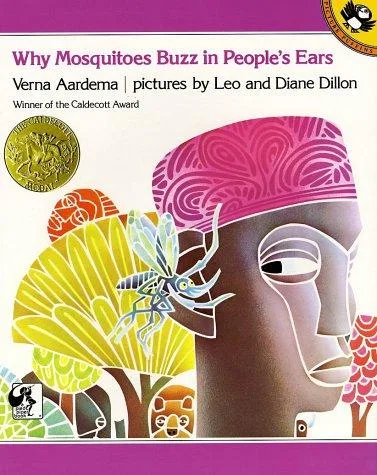
The original 1985 edition was illustrated by Leo and Diane Dillon, whose distinctive artwork brought the characters and their escalating drama to life.
Is 'Why Mosquitoes Buzz in People's Ears' based on a specific African tribe's folklore?
Yes, the story is attributed to the West African tradition, though it draws from a broader tapestry of similar folktales found across various ethnic groups in the region.
What is the significance of the mosquito's buzzing in the story?
In the narrative, the buzzing is the mosquito's apology and explanation for the chaos it caused. It's a symbol of its attempt to reintegrate into the natural order after disrupting it.
How does Verna Aardema adapt traditional folktales?
Aardema is known for her meticulous research and respectful adaptation of oral traditions. She carefully retells stories, often providing notes on their origins and variations, as seen in her work from the 1980s.
🔮 Key Themes & Symbolism
Consequence and Responsibility
The narrative intricately details how an individual's action, however small, can trigger a cascade of unintended consequences. The mosquito's initial slight – failing to answer the iguana – leads to a series of escalating events, from the lion's roar to the owl's fear. This chain reaction underscores a fundamental principle found in many oral traditions: accountability for one's deeds and the interconnectedness of all beings within an ecosystem or community.
Anthropomorphism in Myth-Making
The book masterfully employs anthropomorphism, giving human-like qualities and motivations to animals. This technique is central to how many cultures have historically explained natural phenomena. By attributing the mosquito's buzzing to an apology and the animals' reactions to human-like emotions, the story provides a framework for understanding the world through relatable social dynamics, a hallmark of storytelling since ancient times.
The Power of Oral Tradition
As a reteller of West African folktales, Verna Aardema highlights the enduring power and structure of oral traditions. The story's cyclical nature, where the ending directly explains the initial premise (the buzzing), is characteristic of narratives designed for memorization and repeated telling. The book serves as a proof of the cultural significance of these stories, preserved and shared across generations since before its 1985 publication.
Explanation of Natural Phenomena
The primary function of this folktale is to provide a mythical explanation for why mosquitoes buzz. It moves beyond a simple biological answer to offer a culturally imbued narrative that satisfies curiosity through storytelling. This approach reflects a common human need to find meaning and order in the natural world, a practice evident in folklore worldwide.
💬 Memorable Quotes
Direct passages from the work, attributed to the author.
“And from that day on, the mosquito told everyone one more lie, that *he* was the one who had started the whole big to-do!”
— This concluding statement directly links the mosquito's ongoing behavior to the narrative's explanation. It highlights the persistent nature of the 'lie' or excuse, which becomes the very reason for its characteristic buzz, thereby fulfilling the story's premise.
“The iguana was so startled that he fell into the stream and got his mouth all full of water.”
— This exemplifies the chain reaction. The iguana's fear, a direct result of the mosquito's buzzing, causes a physical mishap. This illustrates how a single, seemingly minor event can propagate through a sequence of escalating physical and emotional responses.
“The mosquito, whose name was Ajuba, had been feeling very sorry for himself.”
— This introduces the protagonist and its initial emotional state. It sets up the mosquito's internal motivation and establishes it as a character capable of feeling regret or self-pity, which drives its subsequent actions and explanations.
💡 Key Ideas
Editorial paraphrase of the work's core concepts — not direct quotes.
That evening, the lion was so hungry he could hardly sleep.
This line shows the ripple effect of the day's events. The lion's hunger and inability to sleep are presented as consequences of the earlier disruptions, demonstrating how the initial incident impacts even the most powerful creatures in the ecosystem.
The owl, who had been listening to everything, thought, 'Oh dear! Oh dear! The sky is falling!'
This quote captures the escalating fear and misinterpretation within the animal community. The owl's reaction, a primal fear response, shows how quickly panic can spread and distort reality based on incomplete information.
🌙 Esoteric Significance
Tradition
While not overtly esoteric in the Western occult sense, this work draws heavily from the animistic and shamanistic underpinnings of many African traditional religions. These traditions often see the natural world as imbued with spirit and agency, a perspective that aligns with certain esoteric philosophies that view the universe as a living, interconnected entity. The story's focus on animal spirits and their interactions echoes a worldview where the lines between the physical and spiritual realms are fluid.
Symbolism
The mosquito itself, despite its annoyance, becomes a potent symbol of consequence and the often-unseen forces that disrupt order. Its buzzing is a sonic manifestation of guilt and apology, a constant reminder of how a small act can echo through a community. The various animals—the lion, the python, the monkey—represent different facets of the natural order and the social hierarchy, each reacting according to their perceived place and instincts when that order is threatened.
Modern Relevance
In contemporary discussions about ecological balance and the impact of even minor environmental changes, the mosquito's story offers a powerful, albeit allegorical, framework. It speaks to the interconnectedness of ecosystems and the idea that disrupting one element can have unforeseen consequences, a concept relevant to modern environmental ethics and systems thinking. The narrative's emphasis on clear cause-and-effect also appeals to fields like behavioral psychology and communication theory.
👥 Who Should Read This Book
['• Children and educators seeking engaging, culturally diverse stories that explain natural phenomena through imaginative narratives.', "• Folklore enthusiasts interested in the structure and themes of West African oral traditions and their adaptation into children's literature.", '• Readers who appreciate allegorical storytelling and the exploration of cause-and-effect relationships within a mythological context.']
📜 Historical Context
Verna Aardema's *Why Mosquitoes Buzz in People's Ears*, first published in 1985, arrived during a flourishing period for children's literature that embraced global folklore. This era saw a growing awareness and appreciation for non-Western storytelling traditions, moving beyond Eurocentric narratives. Aardema's work fits within this trend, alongside contemporaries who also adapted myths and legends from diverse cultures for young readers. The book's success and its subsequent accolades, including a Caldecott Medal for its illustrators Leo and Diane Dillon, marked a significant moment in the recognition of international children's literature. While not facing explicit censorship, the increasing demand for diverse voices and stories meant works like Aardema's were crucial in broadening the literary landscape, offering alternatives to the dominant narrative traditions.
📔 Journal Prompts
The mosquito's buzzing as an apology and explanation.
Iguana's startled fall into the stream.
The owl's misinterpretation of the situation.
The lion's hunger as a consequence.
Ajuba the mosquito's initial self-pity.
🗂️ Glossary
Folktale
A story originating in popular culture, typically passed on by word of mouth and often explaining natural or social phenomena through narrative.
Anthropomorphism
The attribution of human characteristics or behavior to a god, animal, or object. In this book, animals are given human-like emotions and motivations.
Oral Tradition
The passing down of cultural knowledge, history, and stories through spoken language from one generation to the next, rather than through written records.
Cause and Effect
The relationship between events or things, where one event (the cause) makes another event happen (the effect). The book uses this to structure its plot.
West African Folklore
The traditional beliefs, customs, and stories of the people of West Africa, often characterized by rich oral traditions and explanations for the natural world.
Allegory
A story, poem, or picture that can be interpreted to reveal a hidden meaning, typically a moral or political one. This book uses animal interactions to teach a lesson.
Myth
A traditional story, especially one concerning the early history of a people or explaining some natural or social phenomenon, and typically involving supernatural beings or events.
🔮 Readers Also Liked
Browse all →









More by Verna Aardema
All books →
More Free Occult Philosophy Books
View all →