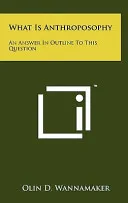
What Is Anthroposophy
 78
78

What Is Anthroposophy
Olin D. Wannamaker’s "What Is Anthroposophy" attempts the Herculean task of distilling Rudolf Steiner’s vast opus into a comprehensible introduction. The strength of this work lies in its methodical approach, breaking down Steiner’s complex ideas into digestible sections. Wannamaker avoids the hagiography that often plagues introductory texts, presenting the material with a degree of critical distance. A passage discussing the 'etheric body' offers a clear, if necessarily simplified, explanation of a concept that can otherwise seem abstract. However, the book’s primary limitation is its inherent brevity; attempting to cover such a sprawling philosophy inevitably leads to generalizations that may not satisfy seasoned researchers. The work provides a competent overview, but it is not a substitute for engaging directly with Steiner’s own extensive lectures and writings. It serves best as a well-organized gateway for the uninitiated.
📝 Description
78
Olin D. Wannamaker's 2011 book, "What Is Anthroposophy," clarifies Rudolf Steiner's philosophy.
Published in 2011, Olin D. Wannamaker's "What Is Anthroposophy" aims to explain the philosophical system Rudolf Steiner developed. The book breaks down the core ideas of Anthroposophy so readers can understand them. It also works to separate Anthroposophy from other spiritual or philosophical systems it might be confused with.
Wannamaker addresses the difficulties in understanding Steiner's broad ideas, which cover topics like the cosmos, human development, and practical uses in farming and teaching. This book is primarily for people interested in Steiner's work in Western esotericism but who might find his extensive writings daunting. It is also useful for students of philosophy, education, and spirituality who want a clear explanation of Anthroposophical principles. Those working in Waldorf education, biodynamic farming, or anthroposophical medicine will find it helps explain the ideas behind their practices.
Anthroposophy began in the early 20th century through Rudolf Steiner, who initially worked with the Theosophical Society before forming his own movement. He sought a spiritual science that built upon Goethe's work and traditions like Rosicrucianism. Wannamaker's book places Anthroposophy within this lineage of Western esotericism, showing its connections and distinctions from earlier mystical and philosophical currents.
💡 Why Read This Book?
• Gain a structured understanding of Anthroposophy's core principles, such as the four human bodies (physical, etheric, astral, ego), which offers a unique framework for human development distinct from purely materialist or traditional religious views. • Grasp the historical lineage of Anthroposophy by understanding its roots in the work of Rudolf Steiner and its divergence from the Theosophical Society, providing crucial context for its philosophical evolution. • Explore the practical applications stemming from Anthroposophical thought, like biodynamic farming principles, which demonstrate how spiritual scientific insights can be applied to contemporary ecological challenges.
⭐ Reader Reviews
Honest opinions from readers who have explored this book.
❓ Frequently Asked Questions
What is the primary goal of Anthroposophy as presented in the book?
The book explains that Anthroposophy aims to provide a path for spiritual development and understanding through a rigorous, research-based approach to the supersensible world, as envisioned by Rudolf Steiner.
How does "What Is Anthroposophy" differentiate Steiner's ideas from Theosophy?
Wannamaker's work clarifies that while Steiner was initially involved with the Theosophical Society, Anthroposophy represents his independent development of a spiritual science with a distinct focus on individual human consciousness and evolution.
What role does spiritual research play in Anthroposophy according to this book?
The book portrays spiritual research, or clairvoyance, as a cognitive capacity that can be cultivated through disciplined practice, allowing for direct experience and understanding of spiritual realities, analogous to scientific observation.
Does the book discuss the practical applications of Anthroposophy?
Yes, "What Is Anthroposophy" touches upon practical fields influenced by Steiner's ideas, including Waldorf education, biodynamic agriculture, and anthroposophical medicine, illustrating the philosophy's expansive reach.
Who was Rudolf Steiner and why is he central to this book?
Rudolf Steiner (1861-1925) was an Austrian philosopher and esotericist who founded Anthroposophy. The book is dedicated to explaining his philosophical system and spiritual scientific worldview.
Is this book suitable for someone with no prior knowledge of esoteric philosophy?
Yes, the book is designed as an introductory guide, aiming to demystify Anthroposophy for newcomers while providing a clear overview of its fundamental concepts and historical context.
🔮 Key Themes & Symbolism
The Human Being as a Spiritual Entity
The work explores the Anthroposophical view of the human being not merely as a physical organism but as a composite of interconnected bodies: the physical, etheric (life forces), astral (consciousness and feeling), and the developing ego (individuality). This multi-layered understanding is crucial for grasping concepts of karma, reincarnation, and spiritual evolution. Wannamaker presents this framework as foundational to Steiner's spiritual science, offering a distinct perspective on human nature that informs all aspects of Anthroposophical practice and philosophy.
Spiritual Evolution and Cosmic History
A significant theme is Anthroposophy's perspective on the evolution of consciousness, both of humanity and the cosmos. The book outlines Steiner's concept of recurring stages of planetary existence and human development, moving from ancient Saturnic, Solar, and Lunar phases to Earth and future states. This cosmic narrative provides a grand evolutionary context for understanding individual human life, karma, and the purpose of earthly incarnation, positioning human consciousness as a vital element in a dynamic universal process.
Anthroposophy as a 'Spiritual Science'
The book emphasizes Rudolf Steiner's intention to establish Anthroposophy as a rigorous discipline akin to natural science, but applied to the spiritual realm. Wannamaker explains the concept of 'spiritual research,' which involves cultivating higher cognitive faculties through specific meditative and contemplative practices. This approach seeks to provide verifiable, experiential knowledge of spiritual realities, moving beyond mere belief or dogma and positioning Anthroposophy as a path of conscious spiritual investigation.
Practical Manifestations of Anthroposophy
Beyond theoretical concepts, the work touches upon the practical outworkings of Anthroposophical principles in various fields. This includes a discussion of Waldorf education, which seeks to educate the whole child through artistic and imaginative approaches, and biodynamic agriculture, which views the farm as a living organism guided by cosmic forces. These applications demonstrate how Anthroposophy is intended to inform and transform earthly activities, bridging the spiritual and material worlds.
💬 Memorable Quotes
Direct passages from the work, attributed to the author.
“Anthroposophy seeks to study the spiritual world with the same exactness as the natural sciences study the physical world.”
— This highlights the core methodological claim of Anthroposophy: that the supersensible can be investigated through disciplined, conscious awareness, aiming for objective knowledge rather than subjective mysticism.
“Evolutionary stages of consciousness are integral to understanding human destiny.”
— This interpretation points to the book's exploration of cosmic and human evolution as presented by Steiner, framing individual lives within a vast, unfolding historical and spiritual process.
“Practical applications like Waldorf education stem from spiritual insights.”
— This reflects the book's coverage of how Anthroposophical principles are applied in fields such as pedagogy, demonstrating a connection between esoteric understanding and tangible, real-world initiatives.
“The etheric body carries life forces and formative impulses.”
— This concise statement introduces a key concept of the subtle bodies in Anthroposophy, defining the etheric body's role in vitality and biological organization, a fundamental element of Steiner's understanding of living systems.
💡 Key Ideas
Editorial paraphrase of the work's core concepts — not direct quotes.
The human being is a being of spirit, soul, and body.
This paraphrase captures the Anthroposophical essence of humanity as a composite entity, extending beyond purely biological or psychological definitions to include a spiritual dimension central to Steiner's worldview.
🌙 Esoteric Significance
Tradition
Anthroposophy occupies a unique position within Western esotericism, drawing from Hermeticism, Gnosticism, Kabbalah, and Rosicrucianism, yet forging its own path. Rudolf Steiner presented it not as a religion but as a 'spiritual science,' emphasizing disciplined cognitive development for perceiving higher realities. It departs from Theosophy by focusing more on individual human consciousness and its evolutionary journey, rather than a fixed cosmology dictated by esoteric hierarchies. This makes it a distinctly modern esoteric system aiming for empirical validation of spiritual experience.
Symbolism
While Anthroposophy is rich in conceptual frameworks, specific overt symbols are less central than in some other traditions. However, the 'Anthropos' (human-being) itself becomes a primary symbol of divine-human evolution. The cycle of reincarnation and karma can be seen as symbolic representations of spiritual justice and learning. Furthermore, the cross and circle motif, representing the intersection of the spiritual (vertical) and the material/temporal (horizontal) or the earthly and cosmic, subtly pervades its understanding of existence.
Modern Relevance
Contemporary thinkers and practitioners in fields like integral psychology, consciousness studies, and holistic education often engage with Anthroposophical concepts. Figures influenced by Steiner's ideas continue to develop Waldorf pedagogy and biodynamic farming. Modern spiritual movements that emphasize personal transformation through disciplined inner work and a non-dualistic worldview may also find resonance with Anthroposophy's emphasis on developing higher perception and understanding the human being as a spiritual entity.
👥 Who Should Read This Book
• Students of Western Esotericism: Those seeking to understand a major 20th-century esoteric philosophical system that bridges scientific inquiry with spiritual exploration. • Educators and Parents: Individuals interested in the pedagogical principles of Waldorf education will find the foundational Anthroposophical worldview explained clearly. • Comparative Religion Scholars: Researchers examining the range of modern spiritual movements will benefit from a concise overview of Anthroposophy's unique position and claims.
📜 Historical Context
Emerging in the early 20th century, Anthroposophy arose from the intellectual ferment of a Europe grappling with industrialization, scientific materialism, and a renewed interest in esoteric traditions. Rudolf Steiner (1861-1925), its founder, initially engaged with the Theosophical Society, a movement influenced by Helena Blavatsky's writings. However, by 1913, Steiner had established the Anthroposophical Society, seeking to develop his own 'spiritual science' independent of Theosophy's particular cosmological framework. This period also saw figures like Carl Jung exploring the psyche through a lens that, while distinct, shared an interest in archetypes and the unconscious. Anthroposophy's reception was complex; it gained adherents in various fields, leading to movements like Waldorf education founded in 1919, but also faced critiques from religious institutions and scientific circles for its non-materialistic claims.
📔 Journal Prompts
The concept of the four human bodies: How might understanding the etheric and astral bodies alter your perception of physical health and emotions?
Rudolf Steiner's 'spiritual science': What parallels or divergences do you observe between this approach and your own methods of seeking knowledge?
The evolutionary path of consciousness: Reflect on a personal experience that felt like a significant step in your own consciousness evolution.
Karma and reincarnation: Consider a recurring challenge in your life; how might an Anthroposophical perspective reframe its meaning?
Practical applications like biodynamic farming: How can principles of holistic integration be applied beyond agriculture to other areas of life?
🗂️ Glossary
Anthroposophy
A spiritual philosophy founded by Rudolf Steiner, positing that spiritual development can be achieved through a disciplined, scientific approach to understanding the supersensible realms and the nature of human consciousness.
Rudolf Steiner
The Austrian philosopher (1861-1925) who developed Anthroposophy, presenting it as a 'spiritual science' accessible through trained spiritual perception and cognitive development.
Etheric Body
In Anthroposophy, the 'life body' or 'formative forces' body, responsible for biological processes, growth, and vitality, distinct from the physical body and the astral body.
Astral Body
The 'soul body' or 'feeling body,' associated with consciousness, emotions, instincts, and the capacity for subjective experience and perception of the spiritual world.
Ego
The principle of individuality, self-awareness, and spiritual identity in Anthroposophy, seen as the highest aspect of the human being, which needs to be consciously developed.
Spiritual Research
The Anthroposophical term for the disciplined cultivation of higher faculties of perception, enabling direct, verifiable experience of spiritual realities, analogous to scientific observation.
Waldorf Education
An educational philosophy based on Anthroposophical principles, aiming to educate the whole child—head, heart, and hands—through an integrated curriculum emphasizing creativity and holistic development.