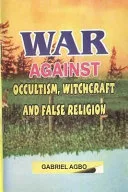
War Against Occultism, Witchcraft and False Religion
 78
78

War Against Occultism, Witchcraft and False Religion
Gabriel Agbo’s *War Against Occultism, Witchcraft and False Religion* presents a stark, unvarnished perspective on spiritual conflict. The author’s conviction regarding the interconnectedness of occultism, witchcraft, and false religion as Satanic tools is palpable throughout the text. He asserts, for example, that these forces operate in tandem, a concept he labels the "evil trinity." This directness is a strength, offering clarity to readers who share this specific theological outlook. However, the work’s primary limitation lies in its lack of engagement with alternative interpretations or scholarly analyses of these subjects. Agbo confines his critique to a singular, often polemical, framework, which may alienate those seeking a nuanced understanding or comparative religious perspective. A passage detailing the alleged convergence of occult rituals with the doctrines of "false religion" highlights this all-encompassing approach. Ultimately, Agbo delivers a forceful, albeit narrowly focused, argument for spiritual vigilance against perceived dark influences.
📝 Description
78
Gabriel Agbo's 2012 book argues occultism, witchcraft, and false religion form Satan's 'evil trinity'.
Gabriel Agbo's *War Against Occultism, Witchcraft and False Religion*, published in 2012, identifies what the author calls the 'evil trinity': occultism, witchcraft, and false religion. Agbo presents these as primary tools of Satan, actively opposing humanity and divine plans. The book contends these three are not separate but work together under Satan's direction.
This work offers a theological perspective for understanding and countering perceived adversarial spiritual forces. It will interest readers of Christian eschatology and spiritual warfare, particularly those examining non-Abrahamic religious and occult practices through a specific Christian lens. Those concerned about the presence of these elements in contemporary society may find Agbo's analysis relevant.
Agbo's text emerges from a tradition of Christian spiritual warfare discourse, which saw renewed emphasis in certain circles from the late 20th century. While it does not engage directly with academic occult studies, it addresses popular anxieties about witchcraft and occultism. This perspective is particularly notable within pentecostal and charismatic Christianity, where concerns about spiritual opposition are often prominent.
💡 Why Read This Book?
• Understand the "evil trinity" concept as defined by Agbo, learning how occultism, witchcraft, and false religion are presented as unified adversarial forces acting against divine will, as detailed in the book’s initial chapters. • Gain insight into Agbo’s specific theological framework for spiritual warfare, particularly how he interprets the synergistic operation of these perceived negative forces to oppose the kingdom of God. • Examine a particular critique of non-Abrahamic or occult belief systems through the lens of Christian eschatology, as Agbo frames these as direct instruments of Satanic opposition.
⭐ Reader Reviews
Honest opinions from readers who have explored this book.
❓ Frequently Asked Questions
What is the "evil trinity" as described by Gabriel Agbo?
The "evil trinity" refers to the author's classification of occultism, witchcraft, and false religion as interconnected agencies through which Satan operates against God's kingdom and humanity.
When was Gabriel Agbo's 'War Against Occultism, Witchcraft and False Religion' first published?
The book was first published on June 28, 2012, reflecting contemporary concerns within certain religious communities about spiritual influences.
Does the book offer practical advice for countering occultism?
Yes, the book is framed as providing a spiritual understanding and equipping readers to identify and oppose what it terms "agencies of darkness."
What is the author's perspective on false religion?
Agbo views "false religion" as a partner to occultism and witchcraft, serving Satan's agenda by misleading individuals and hindering spiritual progress, thereby forming part of the "evil trinity."
Is this book suitable for academic study of occultism?
While it discusses occultism, the book presents a theological critique rather than an objective academic analysis, making it more suited for those within a specific faith perspective.
What is the primary goal of the "evil trinity" according to Agbo?
The primary goal, as per Agbo's analysis, is to thwart the advancement of God's kingdom and humanity by operating in harmony under Satan's leadership.
🔮 Key Themes & Symbolism
The Evil Trinity
The central concept is the "evil trinity," comprising occultism, witchcraft, and false religion. Agbo argues these are not disparate phenomena but a unified front orchestrated by Satan. He posits they work in tandem to subvert spiritual growth and the establishment of divine order. This trinity is presented as the primary mechanism through which adversarial spiritual forces manifest and operate in the world, aiming to corrupt humanity and impede spiritual progress, as detailed in the book’s foundational arguments.
Spiritual Warfare Framework
Agbo presents a distinct framework for understanding spiritual warfare. The book equips readers with a theological lens to identify and confront what are perceived as Satanic influences. It emphasizes the need for discernment and active opposition to these forces, particularly occultism and witchcraft, viewing them as direct assaults on Christian faith and the divine plan for humanity.
Critique of Non-Abrahamic Beliefs
A significant theme is the author's critique of various religious and occult practices, categorizing them under "false religion" and aligning them with occultism and witchcraft. This perspective frames such beliefs as inherently opposed to divine truth, serving as tools for spiritual deception and control. The work aims to dismantle these systems from a specific theological viewpoint.
Satanic Agency
The book consistently attributes the initiation and direction of occultism, witchcraft, and false religion to Satan. He is depicted as the ultimate architect and leader of this "evil trinity." This attribution forms the basis for Agbo's argument, emphasizing the malevolent, organized nature of these perceived spiritual threats and their singular purpose: to undermine divine authority and human well-being.
💬 Memorable Quotes
Direct passages from the work, attributed to the author.
“These three branches of the kingdom of darkness work in harmony to achieve the above objectives.”
— This statement captures Agbo's core argument about the "evil trinity." It highlights his belief that occultism, witchcraft, and false religion are not isolated issues but coordinated efforts orchestrated by adversarial forces.
“And you will always find the rest when any is in operation.”
— This interpretation suggests that the interconnectedness of occultism, witchcraft, and false religion is so profound that the presence of one implies the operation of the others, reinforcing the "trinity" concept.
“This book is a work on what I call the evil trinity - occultism, witchcraft and false religion.”
— This direct statement from the author clearly defines the book's central subject matter and introduces the key concept around which the entire argument is structured.
💡 Key Ideas
Editorial paraphrase of the work's core concepts — not direct quotes.
Satan is the initiator and at the head each of them.
This quote emphasizes the singular leadership Agbo attributes to Satan over the "evil trinity." It positions these phenomena as extensions of a central, malevolent will rather than independent practices.
These are the agencies through which Satan carries out his wicked plans against the advancement of the kingdom of God and humanity.
This quote articulates the author's view of the purpose behind the "evil trinity," framing them as instruments of cosmic opposition aimed at hindering spiritual progress and human welfare.
🌙 Esoteric Significance
Tradition
While the book engages with concepts often discussed in esoteric circles like occultism and witchcraft, its primary framework is theological, rooted in a specific Christian interpretation of spiritual warfare. It departs from traditional esoteric lineages (like Hermeticism or Gnosticism) by framing these practices not as paths to knowledge or transformation, but as direct instruments of a singular malevolent entity, Satan, opposing divine order.
Symbolism
The primary symbolic concept is the "evil trinity" itself, representing unity in opposition. Within this, individual elements like "occultism" and "witchcraft" can be seen as symbolic representations of forbidden knowledge and manipulation of unseen forces, while "false religion" symbolizes deviation from perceived divine truth and order. These are not explored for their inherent symbolic value but as components of a larger, destructive force.
Modern Relevance
Agbo's work speaks to contemporary anxieties about the influence of various spiritual and religious movements perceived as non-Christian or harmful. It speaks to a segment of evangelical and Pentecostal Christianity that actively engages in spiritual warfare discourse, seeking to understand and counter perceived negative spiritual influences in society and personal lives.
👥 Who Should Read This Book
• Believers within Christian traditions, particularly those engaged with or interested in spiritual warfare, seeking a theological framework to understand and confront perceived adversarial spiritual forces. • Individuals concerned with the author's specific critique of occultism, witchcraft, and various religious practices, who wish to understand this perspective as presented within a particular Christian worldview. • Readers looking for a direct, assertive argument about the interconnectedness of perceived negative spiritual agencies, framed within a context of divine opposition.
📜 Historical Context
Gabriel Agbo’s *War Against Occultism, Witchcraft and False Religion*, published in 2012, arrives within a continuing global discourse on spiritual warfare, particularly prominent in Pentecostal and Charismatic Christian circles since the late 20th century. This period saw increased focus on identifying and countering perceived demonic influences, often framed in opposition to New Age movements, occult practices, and non-Christian religions. Agbo’s work echoes sentiments found in earlier influential texts on spiritual warfare, though it presents its arguments with a directness that eschews academic nuance. Unlike scholarly works such as those by scholars examining the history of Western Esotericism, Agbo’s approach is polemical, aiming to equip believers with a specific theological framework for spiritual conflict. His critique positions occultism, witchcraft, and "false religion" as unified, Satanic fronts, a perspective that, while not unique in certain theological streams, offers a distinct articulation of these concerns for his readership.
📔 Journal Prompts
The "evil trinity" as presented by Agbo: occultism, witchcraft, and false religion.
Satan's alleged role as initiator and head of the "evil trinity."
The concept of "agencies through which Satan carries out his wicked plans."
The notion of "branches of the kingdom of darkness" working in harmony.
Identifying perceived "false religion" in relation to occultism and witchcraft.
🗂️ Glossary
Evil Trinity
The author's term for the interconnected forces of occultism, witchcraft, and false religion, which he posits are orchestrated by Satan to oppose divine will and humanity.
Occultism
Referred to as one of the three components of the "evil trinity," it represents hidden or secret knowledge and practices allegedly used for malevolent spiritual purposes.
Witchcraft
Presented as a core element of the "evil trinity," it is depicted as a practice aligned with darkness and adversarial spiritual forces, working in conjunction with occultism and false religion.
False Religion
One of the three arms of the "evil trinity," this term denotes religious beliefs or practices that the author deems contrary to divine truth and serving Satan's agenda.
Kingdom of God
In Agbo's context, this refers to the divine realm and its influence or advancement in the world, which the "evil trinity" allegedly seeks to obstruct.
Agencies
Used by Agbo to describe the functional role of occultism, witchcraft, and false religion as tools or means through which Satan executes his plans.
Harmony
Describes the coordinated and unified operation of the "evil trinity" components, working together to achieve their purported objectives.