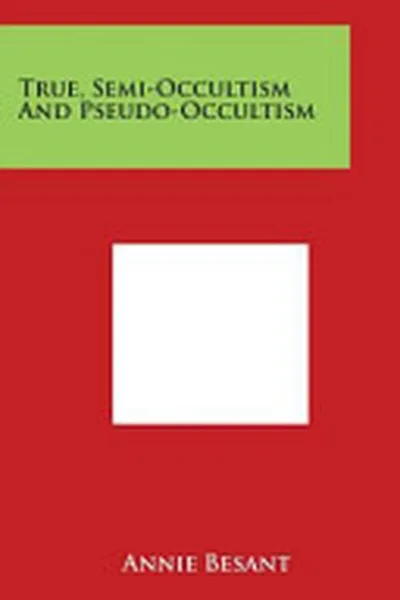
True, Semi-Occultism and Pseudo-Occultism
 71
71

True, Semi-Occultism and Pseudo-Occultism
Annie Besant’s "True, Semi-Occultism and Pseudo-Occultism" offers a sharp, if dated, critique of spiritual charlatanism from an era rife with it. Besant, a formidable intellect and leader within Theosophy, attempts to draw clear lines between authentic spiritual progress and mere theatricality. Her most compelling arguments lie in her dissection of motives – the genuine occultist, in her view, seeks self-purification and universal betterment, not fame or personal power. A notable limitation is the inherent bias of her Theosophical framework, which can feel exclusionary to practices or beliefs outside its specific doctrines. The discussion on "Semi-Occultism," attempting to categorize practices that are neither wholly true nor false, is particularly insightful, highlighting the nuances of spiritual engagement. While the prose can be dense, it is underpinned by a firm conviction and a clear desire to guide earnest seekers through a confusing spiritual marketplace of 1912. It serves as a fascinating historical document on discerning spiritual authenticity.
📝 Description
71
Annie Besant's 1912 work distinguishes genuine spiritual development from its imitations.
Annie Besant's "True, Semi-Occultism and Pseudo-Occultism" appeared in 1912, a time when various spiritual and occult movements vied for attention. This book is not a guide to magical practices but a sharp analysis of those claims. Besant, a major figure in Theosophy, sought to separate authentic inner growth from what she saw as superficial mimicry. She created a system for readers to judge the merits of different occult paths.
The book addresses students of esoteric history, especially those interested in the Theosophical movement and its intellectual circles. It helps readers understand the early 20th-century occult scene, identifying sincere seekers versus those who exploited others. Those studying spiritual philosophies comparatively will find Besant's analytical style useful for examining current spiritual trends.
Besant argued that "True Occultism" involved ethical growth, self-control, and service, while "Pseudo-Occultism" relied on sensationalism, personal profit, and deceiving people. She used the term "Semi-Occultism" for practices that had some genuine elements but were not fully realized.
Published in 1912, this book emerged during a period of significant spiritual ferment in the West. Theosophy, led by figures like Blavatsky and Besant, exerted a strong influence, inspiring numerous smaller groups and individuals. This era saw a rise in spiritualist societies, esoteric orders, and public psychics, many of whom Besant examines critically. The work reflects a broader Western interest in Eastern religions and esoteric traditions, a cultural current also seen in the writings of contemporaries such as Aleister Crowley, though their perspectives differed greatly.
💡 Why Read This Book?
• Understand the Theosophical criteria for genuine occultism, learning to differentiate between self-purification and superficial spiritual claims, as articulated by Besant in her critique of early 20th-century movements. • Gain insight into the historical context of spiritualism and occultism around 1912, recognizing how figures like Besant navigated and critiqued the burgeoning landscape of esoteric pursuits. • Develop a framework for evaluating spiritual practices by examining Besant's distinction between "True Occultism" and "Pseudo-Occultism," focusing on motive and ethical development.
⭐ Reader Reviews
Honest opinions from readers who have explored this book.
❓ Frequently Asked Questions
What is the primary difference between 'True Occultism' and 'Pseudo-Occultism' according to Annie Besant?
Besant defines 'True Occultism' as a path of ethical self-development, service, and spiritual evolution, requiring discipline and purity of motive. 'Pseudo-Occultism,' conversely, is characterized by sensationalism, ego-driven desires for power or recognition, and often preys on the credulous.
When was Annie Besant's 'True, Semi-Occultism and Pseudo-Occultism' originally published?
The original publication date for Annie Besant's "True, Semi-Occultism and Pseudo-Occultism" was 1912, reflecting the spiritual and intellectual currents of that specific era.
What is 'Semi-Occultism' as described in the book?
'Semi-Occultism' refers to practices or beliefs that contain elements of genuine occult truth but are either incomplete, misunderstood, or misapplied. Besant uses this category to address phenomena that are not entirely false but fall short of true, disciplined occult attainment.
How does Besant view the role of motive in occult practices?
Motive is paramount for Besant. She argues that the motive behind occult pursuits reveals their authenticity. True occultism stems from selfless desire for growth and service, whereas pseudo-occultism is driven by personal ambition, curiosity, or the desire to impress others.
Is this book a practical guide to performing occult rituals?
No, "True, Semi-Occultism and Pseudo-Occultism" is not a practical manual for rituals. Instead, it is a critical and philosophical examination of the nature of occultism and the discernment required to distinguish genuine spiritual paths from fraudulent ones.
What is the significance of the Theosophical perspective in this book?
The book is deeply rooted in Besant's Theosophical background. This perspective shapes her definitions of true occultism, her understanding of spiritual evolution, and her critique of other movements, providing a specific doctrinal lens for her analysis.
🔮 Key Themes & Symbolism
Discernment in Spiritual Seeking
Besant's work provides a critical lens for evaluating the myriad spiritual claims prevalent in the early 20th century. She emphasizes the necessity of discernment, urging readers to look beyond superficial phenomena and sensationalism. The core idea is that true spiritual progress is an internal, disciplined process, not an external display of powers or esoteric knowledge for personal gain. She contrasts this with "Pseudo-Occultism," which she argues often exploits the unwary through misrepresentation or vanity, highlighting the importance of motive and ethical conduct.
The Nature of True Occultism
According to Besant, "True Occultism" is intrinsically linked to moral and spiritual purification. It is a path of dedicated self-mastery, selfless service, and the cultivation of higher consciousness, aligned with the evolutionary purpose of humanity as understood within Theosophy. This involves rigorous training, ethical discipline, and a genuine aspiration to serve the greater good. It is not about acquiring psychic powers for personal advantage but about achieving a state of inner harmony and wisdom that naturally benefits all beings.
Critique of Pseudo-Occultism
Besant dedicates significant attention to dissecting what she terms "Pseudo-Occultism." This category encompasses fraudulent practices, self-deceived individuals, and sensationalist spiritual performances that lack genuine substance. She identifies common traits such as an emphasis on external phenomena, a desire for recognition, the exploitation of others' beliefs, and a disregard for ethical principles. By exposing these manifestations, Besant aims to protect earnest seekers from falling prey to charlatans and misguided spiritual endeavors.
The Theosophical Framework
The entire analysis is framed within Annie Besant's Theosophical worldview. Concepts like spiritual evolution, the role of Masters (or Adepts), and the interconnectedness of all life inform her definitions and critiques. "True Occultism" is understood as the disciplined path towards fulfilling one's divine potential within this grand cosmic scheme. This perspective inherently values inner transformation and universal brotherhood as the ultimate goals of esoteric study and practice.
💬 Memorable Quotes
Direct passages from the work, attributed to the author.
“The pseudo-occultist seeks power, the true occultist seeks wisdom.”
— Here, Besant draws a stark contrast between the motivations driving authentic versus fraudulent spiritual pursuits. Power is associated with ego and control, while wisdom signifies enlightenment and a higher understanding.
“Many dabble in psychic phenomena without understanding the moral responsibilities involved.”
— This highlights Besant's concern about the unguided exploration of psychic abilities. She implies that such dabbling, without a strong ethical foundation, can lead to harm or misguided development, characteristic of pseudo-occultism.
“Service is the highest law for the occult student.”
— This statement underscores the ethical imperative within Besant's concept of true occultism. It posits that the ultimate aim of esoteric development is not personal aggrandizement but contribution to the welfare of humanity.
“The desire for healing or for knowledge of the future can be a door to illusion if not rightly controlled.”
— Besant warns against common desires that can lead individuals astray. She suggests that even seemingly noble aims, if pursued without proper control and ethical grounding, can become avenues for pseudo-occult practices and self-deception.
💡 Key Ideas
Editorial paraphrase of the work's core concepts — not direct quotes.
The true occultist is one who has learned to control himself, his thoughts, his emotions, his desires.
This quote captures Besant's emphasis on inner discipline. It suggests that genuine occult attainment is not about external manipulation but about profound self-mastery, a central to ethical spiritual development.
🌙 Esoteric Significance
Tradition
This work is firmly situated within the Theosophical tradition, a movement founded by Helena Blavatsky in the late 19th century. Besant, a leading figure, interprets occultism through the lens of Theosophical doctrines concerning spiritual evolution, karma, and the existence of enlightened Masters. It attempts to define "true occultism" as a path aligned with these Theosophical tenets, differentiating it from other esoteric systems or popular spiritualist phenomena that did not conform to its specific cosmology and ethics.
Symbolism
While not heavily reliant on specific esoteric symbols in the way some texts are, Besant's work implicitly uses the concept of the "Master" as a symbol of perfected spiritual attainment and guidance within the Theosophical hierarchy. The "path" itself, requiring discipline and ethical conduct, functions as a symbolic representation of the evolutionary journey. "Light" and "darkness" are used metaphorically to represent spiritual knowledge and ignorance, or genuine practice versus deception.
Modern Relevance
Besant's early 20th-century critique of spiritual authenticity remains relevant in the contemporary field of New Age spirituality, online gurus, and alternative healing practices. Modern esoteric thinkers and practitioners interested in the history of Theosophy, or those seeking to develop critical discernment skills in their own spiritual journeys, find value in her analysis. Her framework for evaluating motives and ethical conduct continues to inform discussions about genuine spiritual versus commercialized or ego-driven spiritual pursuits.
👥 Who Should Read This Book
• Students of Theosophy and early 20th-century esoteric movements will find this a valuable primary source for understanding Besant's perspective and the intellectual debates of her time. • Individuals interested in comparative spirituality and the history of occultism can gain insight into how genuine spiritual paths were distinguished from fraudulent ones over a century ago. • Seekers of spiritual knowledge who wish to develop critical discernment will benefit from Besant's framework for evaluating the authenticity and ethical basis of esoteric practices.
📜 Historical Context
Published in 1912, "True, Semi-Occultism and Pseudo-Occultism" emerged during a period of intense spiritual ferment in Europe and America. Theosophy, led by Annie Besant after Helena Blavatsky's death, was a major intellectual and spiritual current, influencing countless individuals and smaller movements. This era witnessed a proliferation of spiritualist societies, esoteric orders, and individual psychics, many of whom Besant scrutinizes. The work engages with the broader Western esoteric revival, a trend also explored by contemporaries like Aleister Crowley, whose magical practices and philosophies offered a contrasting approach to occultism. Besant's book provided a Theosophical framework for discernment amidst this diverse spiritual landscape, seeking to guide earnest seekers away from what she perceived as delusion and charlatanry.
📔 Journal Prompts
The core motive behind your spiritual inquiries: Does it align with Besant's criteria for true occultism?
Reflect on the "Pseudo-Occultism" Besant describes. How might these tendencies manifest in contemporary spiritual circles?
Consider the concept of self-control as presented by Besant. What specific practices could cultivate this in your daily life?
Analyze the distinction between "Semi-Occultism" and "True Occultism." Where might you observe practices that fall into this intermediary category?
Besant links true occultism with service. How can the pursuit of esoteric knowledge be integrated with selfless action?
🗂️ Glossary
True Occultism
Besant's term for genuine spiritual development characterized by self-mastery, ethical conduct, inner purity, and the aspiration to serve humanity, aligned with Theosophical principles.
Pseudo-Occultism
Practices or beliefs that falsely claim occult authority, often driven by ego, sensationalism, personal gain, or a misunderstanding of spiritual principles, according to Besant.
Semi-Occultism
A category used by Besant for spiritual phenomena or practices that contain elements of truth but are incomplete, misguided, or lack the full ethical discipline of true occultism.
Psychic Phenomena
Manifestations of subtle energies or consciousness beyond the scope of ordinary physical perception, which Besant discusses in the context of their potential for both genuine experience and deception.
Motive
The underlying intention or reason for engaging in spiritual or occult pursuits. Besant considers motive a critical factor in distinguishing authentic from fraudulent practices.
Theosophy
A spiritual movement founded by Helena Blavatsky, emphasizing the study of ancient wisdom, universal brotherhood, and the spiritual evolution of humanity, which heavily influences Besant's views.
Masters
In Theosophy, enlightened beings or adepts who have undergone spiritual evolution and guide humanity. Besant refers to them as part of the framework for true occult training.













![Τ[alpha] Ελευσίν[alpha] μυστήρι[alpha]](/img/thumb/τalpha-ελευσίνalpha-μυστήριalpha-paul-françois-foucart-360580.webp)