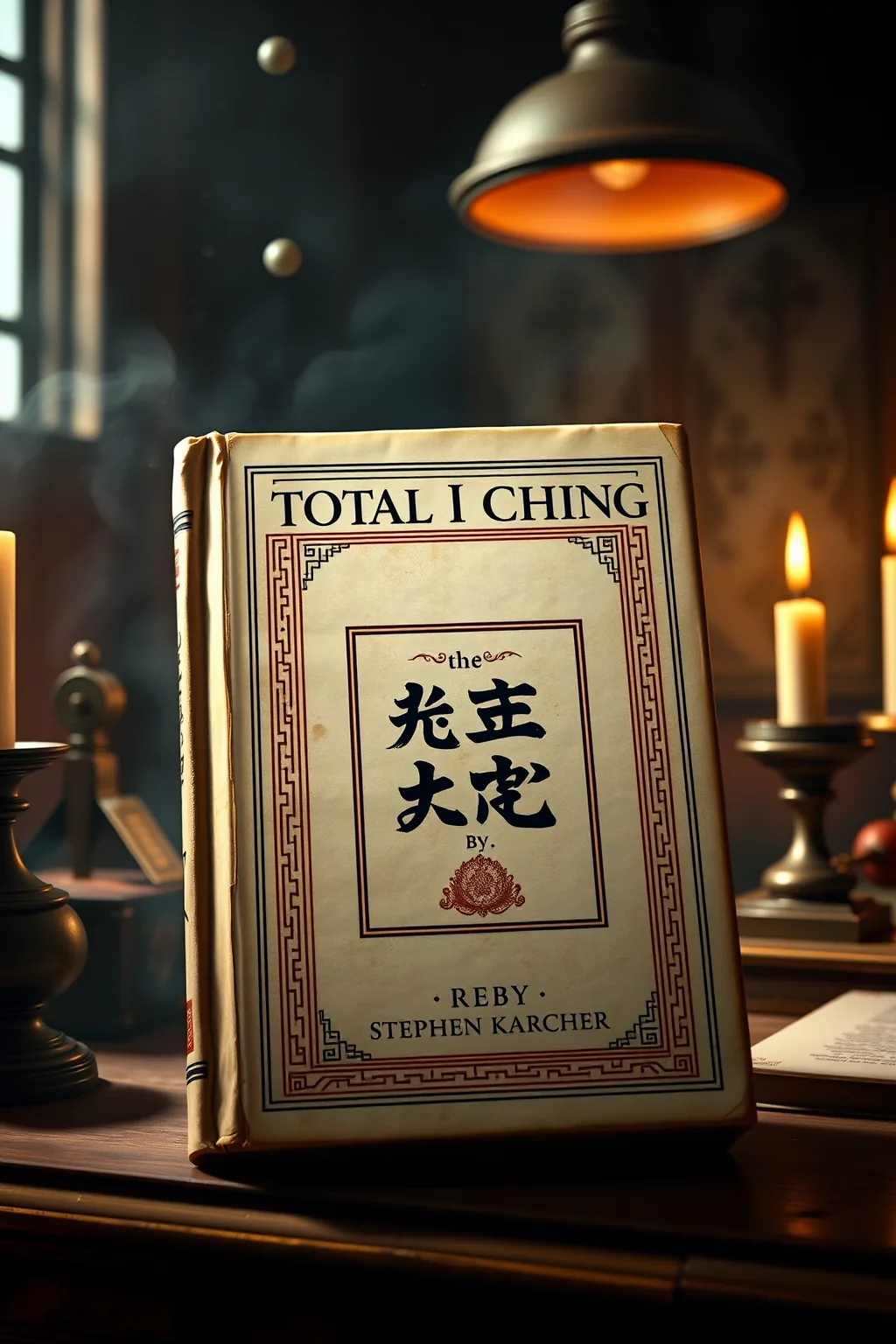
Total I Ching C Pbp
 61
61

Total I Ching C Pbp



Silas Hawthorne (Hermetic Studies Editor) — Stephen Karcher’s 'Total I Ching C Pbp' is a monumental achievement, offering a deeply resonant and spiritually charged interpretation of this ancient Chinese oracle. Karcher’s unique approach breathes new life into the hexagrams, revealing their profound esoteric underpinnings and practical application for modern seekers. He masterfully bridges the gap between ancient philosophy and contemporary consciousness, presenting the I Ching not just as a divinatory tool, but as a living map of the soul’s journey. This work is indispensable for anyone serious about exploring the depths of symbolic language, cosmic order, and the art of conscious living. A true treasure for the discerning student.
📝 Description
61
Stephen Karcher's 'Total I Ching C Pbp' (published 2000) decodes the I Ching as a living cosmology.
Stephen Karcher's 'Total I Ching C Pbp' examines the I Ching not just as a divination tool, but as a system that maps cosmic principles and human fate. Karcher breaks down the symbolism within the hexagrams, showing how subtle energies influence existence and can guide individuals toward inner peace and clarity. The book functions as a gateway to grasping the unity of all things, the nature of change, and the fundamental forces that shape human experience. It is intended for those seriously studying esoteric knowledge, seeking contemplation, or pursuing self-mastery. This work allows engagement with an old system of deep philosophical and spiritual thought.
This book connects with Taoist philosophy, Hermeticism, and broader concepts of consciousness. It presents the I Ching as a framework for understanding the relationships between Heaven, Earth, and humanity, aligning with traditions that seek to map the patterns of the universe and human life within it. Karcher's approach aims to reveal the underlying structure of reality as perceived through this ancient Chinese oracle.
💡 Why Read This Book?
Unveil the sacred blueprint of existence within the 'Total I Ching C Pbp.' This book is for the spiritual seeker yearning for profound self-understanding, the scholar fascinated by ancient wisdom traditions, and the practitioner seeking to align their life with universal currents. Discover practical guidance for navigating life’s challenges and unlock profound insights into the nature of change and destiny. If you are drawn to the mysteries of the cosmos and the power of symbolic language, this is your essential guide.
⭐ Reader Reviews
Honest opinions from readers who have explored this book.
❓ Frequently Asked Questions
What is the I Ching?
The I Ching, or 'Book of Changes,' is an ancient Chinese classic text used for divination and wisdom. It comprises 64 hexagrams, each representing a fundamental situation and its potential transformations, offering guidance on how to act in accordance with cosmic principles.
Who was Stephen Karcher?
Stephen Karcher was a renowned scholar, author, and translator who dedicated his life to exploring and interpreting ancient esoteric traditions, particularly the I Ching. His work is celebrated for its depth, spiritual insight, and accessibility.
What makes this version of the I Ching unique?
Karcher's interpretation goes beyond literal translation, delving into the symbolic, psychological, and spiritual dimensions of each hexagram. It offers a holistic understanding, integrating philosophical concepts and practical applications for modern life.
Is prior knowledge of Chinese philosophy required?
No, while beneficial, prior knowledge is not strictly required. Karcher's clear prose and comprehensive explanations make the 'Total I Ching C Pbp' accessible to both newcomers and seasoned practitioners of the I Ching.
How can the I Ching be used for personal growth?
The I Ching serves as a mirror to the soul, reflecting underlying patterns and offering counsel. By consulting its wisdom, individuals can gain clarity on their situations, understand their motivations, and make more conscious, aligned choices.
🔮 Key Themes & Symbolism
The Taoist Cosmology of Change
Look at the profound Taoist understanding of the universe as a dynamic, ever-changing flux. Karcher masterfully elucidates how the I Ching's hexagrams embody this principle, illustrating the constant interplay of Yin and Yang, creation and dissolution. This theme explores the cyclical nature of existence, the impermanence of all phenomena, and the wisdom found in aligning oneself with the natural flow of the Tao. It’s an invitation to perceive life not as a static state, but as a continuous dance of transformation, offering clear insights into navigating personal and collective shifts with grace and understanding.
Archetypal Symbolism and the Human Psyche
Explore the collection of archetypal symbols embedded within the I Ching’s hexagrams. Karcher reveals how these ancient patterns resonate deeply with the collective unconscious, offering a profound lens through which to examine the human psyche. Each hexagram becomes a doorway to understanding fundamental human experiences, motivations, and developmental stages. This theme illuminates the I Ching as a sophisticated psychological map, providing clarity on inner conflicts, personal growth potentials, and the universal dramas that shape our individual journeys toward wholeness and self-awareness.
Divination as a Spiritual Dialogue
Experience the I Ching not merely as a fortune-telling device, but as a sacred dialogue between the seeker and the universal intelligence. Karcher emphasizes the ethical and mindful approach to consulting the oracle, framing it as an opportunity for introspection and spiritual guidance. This theme explores how the I Ching, through its symbolic language and nuanced interpretations, encourages active participation in one's destiny, fostering wisdom, discernment, and the courage to act in accordance with higher principles. It is an exploration of synchronicity and the profound ways in which the universe communicates with us.
💬 Memorable Quotes
Direct passages from the work, attributed to the author.
“Change is the only constant; wisdom lies in understanding its flow.”
— This highlights the core philosophical tenet of the I Ching, emphasizing that true insight comes from embracing and adapting to the inevitable transformations of life, rather than resisting them.
“Each hexagram whispers a story of cosmic order and human potential.”
— This suggests that the I Ching’s sixty-four symbols are not arbitrary but are imbued with deep meaning, offering guidance on both universal principles and the inherent capabilities within each individual.
“To consult the oracle is to engage in a dialogue with the timeless.”
— This elevates the act of I Ching consultation from a simple query to a profound spiritual practice, a connection with ancient wisdom and the underlying consciousness of the universe.
“The path to enlightenment is paved with the understanding of paradox.”
— This points to the I Ching's ability to present seemingly contradictory forces (like Yin and Yang) as complementary and essential, mirroring the complex and often paradoxical nature of reality and spiritual growth.
💡 Key Ideas
Editorial paraphrase of the work's core concepts — not direct quotes.
The I Ching is a mirror of the soul, reflecting the hidden currents of destiny.
This quote captures the I Ching's function not just as a predictive tool, but as a profound instrument of self-reflection, revealing our inner landscape and the forces shaping our path.
🌙 Esoteric Significance
Tradition
The 'Total I Ching C Pbp' is deeply rooted in the Taoist tradition, specifically its exploration of the Tao, the fundamental principle of the universe. It also draws upon Hermetic philosophy's emphasis on correspondence between the macrocosm and microcosm, and the alchemical process of transformation. Furthermore, its symbolic language and cyclical understanding of change echo Gnostic and Neoplatonic ideas about divine order and human spiritual evolution, making it a rich text for those interested in comparative esotericism and universal wisdom.
Symbolism
The core symbolism of the I Ching revolves around the interplay of Yin (feminine, passive, dark) and Yang (masculine, active, light) lines, which combine to form the eight trigrams and subsequently the sixty-four hexagrams. These symbols represent fundamental forces, archetypal situations, and natural phenomena. Karcher illuminates how each hexagram's imagery, judgments, and line texts act as potent metaphors for understanding the dynamic processes of change, the balance of opposing forces, and the underlying patterns that govern all existence, offering keys to unlock hidden meanings.
Modern Relevance
In our rapidly evolving and often chaotic world, the I Ching offers a profound anchor of wisdom and clarity. Karcher's interpretation makes its ancient principles highly relevant for modern challenges, providing tools for conscious decision-making, navigating uncertainty, and fostering inner resilience. Its emphasis on balance, adaptability, and understanding the natural flow of events equips individuals with a timeless framework for personal growth, ethical living, and finding harmony amidst complexity. It serves as a powerful guide for cultivating mindfulness and aligning one's actions with a deeper sense of purpose.
👥 Who Should Read This Book
This comprehensive edition of the I Ching is important for a wide spectrum of readers. For the absolute beginner, Karcher's clear explanations provide an accessible entry point into this profound system. Scholars of comparative religion and philosophy will find a meticulously researched and insightful resource. Spiritual seekers and practitioners of divination will discover a deeply resonant and spiritually charged guide for personal insight and transformative practice. Those interested in Jungian psychology and archetypal studies will appreciate the book's profound exploration of the human psyche through symbolic language. Ultimately, anyone yearning for deeper wisdom, self-understanding, and a more harmonious connection with the universe will benefit immensely.
📜 Historical Context
The I Ching, or 'Book of Changes,' boasts a lineage stretching back over three millennia, originating in ancient China. Its earliest strata are believed to date from the Western Zhou dynasty (c. 1046–771 BCE), evolving through subsequent dynasties with significant contributions from Confucian scholars like King Wen and Duke of Zhou, who are traditionally credited with ordering the hexagrams and their judgments. The commentary known as the 'Ten Wings,' attributed to Confucius and his disciples, significantly shaped its philosophical and cosmological interpretations, transforming it from a divinatory manual into a profound text of wisdom. Throughout Chinese history, the I Ching has served as a core part of imperial governance, scholarly inquiry, and personal spiritual practice. Its influence permeated philosophy, art, literature, and even military strategy. During periods of intellectual ferment and religious syncretism, its esoteric dimensions were further explored, linking it to Taoist, Buddhist, and even proto-scientific ideas. Its enduring appeal lies in its adaptability, offering timeless wisdom that continues to resonate across cultures and epochs, a proof of its deep understanding of the human condition and the natural world.
📔 Journal Prompts
Reflect on a recent situation where you felt a significant shift or change. How did the principles of Yin and Yang manifest in that experience?
Choose a hexagram that speaks to your current life circumstances. What wisdom does its imagery and judgment offer for your path forward?
Consider a recurring pattern or challenge in your life. How might the I Ching's perspective on change and transformation offer a new approach?
How can you consciously cultivate balance between your active (Yang) and receptive (Yin) energies in your daily life?
If the I Ching were to offer you advice on your greatest potential, what do you believe it would be, and how would you strive to embody it?
🗂️ Glossary
Hexagram
A figure composed of six stacked horizontal lines, each line being either solid (Yang) or broken (Yin). There are 64 unique hexagrams in the I Ching, representing fundamental situations and their transformations.
Yin
The principle of femininity, passivity, darkness, receptivity, and the moon. Represented by a broken line (--) in the I Ching.
Yang
The principle of masculinity, activity, light, creativity, and the sun. Represented by a solid line (—) in the I Ching.
Tao (or Dao)
The fundamental, ineffable principle of the universe in Taoism. It represents the natural order, the source of all existence, and the way things are meant to be.
Trigram
A figure composed of three stacked horizontal lines (Yin or Yang). There are eight trigrams (Ba Gua), which are the building blocks for the 64 hexagrams.
This book appears in 2 collections
🔮 Readers Also Liked
Browse all →









More by Stephen Karcher
All books →





From the “I Ching” Collection
View all →









More Free Divination & Tarot Books
View all →