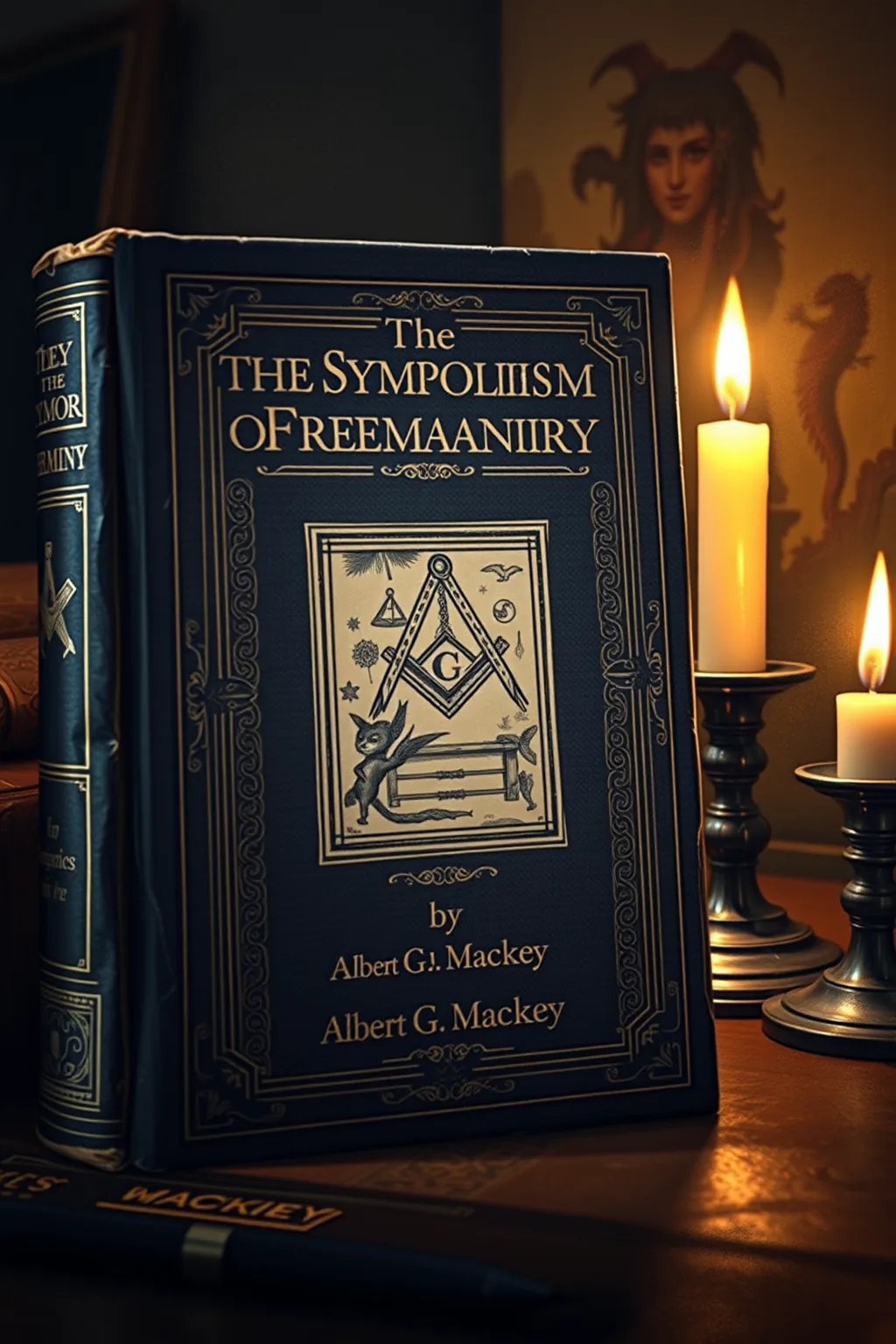
The Symbolism of Freemasonry
 80
80

The Symbolism of Freemasonry


Sophia Crane, Associate Editor: Albert G. Mackey's 'The Symbolism of Freemasonry' remains an unparalleled cornerstone for understanding the esoteric dimensions of the Craft. Mackey masterfully dissects the symbolic language, revealing its deep philosophical roots and mystical implications. His lucid explanations demystify complex allegories, making this text essential for anyone seeking authentic insight beyond ritualistic performance. The book's strength lies in its comprehensive approach, bridging historical context with enduring spiritual principles. This is not a superficial glance, but a profound dive into the very soul of Freemasonry, recommended for serious students of Western esotericism and Masonic philosophy.
📝 Description
80
Albert G. Mackey's 1869 book deciphers Masonic symbols, linking them to ancient mysteries.
Albert G. Mackey's 'The Symbolism of Freemasonry', first published in 1869, examines the symbolic language embedded within Masonic rituals and teachings. Mackey, a prominent Masonic scholar, dissects various symbols, such as the Square and Compasses, tracing their origins and interpreting their allegorical meanings. He argues that these symbols are not mere decorations but are vehicles for conveying deep philosophical and spiritual truths.
The book aims to illuminate the underlying science and philosophy of Freemasonry for those seeking a deeper understanding of its practices. Mackey's approach connects Masonic symbolism to broader concepts of man's place in the universe and his pursuit of personal and spiritual growth. The writing style encourages thoughtful consideration of the rituals and their potential for self-discovery.
This work situates itself within the tradition of Western esotericism, specifically focusing on the symbolic interpretation of fraternal orders. Freemasonry, often viewed as an esoteric system, uses allegory and ritual to transmit moral and philosophical lessons. Mackey's analysis connects these symbols to broader currents of Hermeticism, Kabbalah, and ancient mystery traditions, suggesting a lineage of hidden knowledge passed down through symbolic systems. His effort is to reveal the 'science' and 'philosophy' behind the outward forms of Masonry, aligning with the esoteric goal of uncovering deeper realities through symbolic intermediaries.
💡 Why Read This Book?
Uncover the hidden meanings behind Masonic symbols and rituals. This book offers a profound journey into the philosophical and mystical foundations of Freemasonry, revealing its connection to ancient wisdom traditions. Ideal for spiritual seekers, esoteric scholars, and Freemasons looking to deepen their understanding of the Craft's profound symbolism and its path to self-knowledge.
⭐ Reader Reviews
Honest opinions from readers who have explored this book.
❓ Frequently Asked Questions
What is the primary focus of 'The Symbolism of Freemasonry'?
The book's primary focus is to unveil and explain the rich tapestry of symbols, allegories, myths, and philosophical concepts embedded within Freemasonry, illuminating its esoteric science and spiritual teachings.
Who is Albert G. Mackey?
Albert G. Mackey (1807-1881) was a prominent American physician, author, and one of the most respected Masonic scholars of his time, known for his extensive writings on Masonic ritual and symbolism.
Is this book suitable for non-Masons?
Yes, while written for Masons, the book's exploration of universal symbolism and philosophical concepts makes it highly valuable for anyone interested in esoteric traditions, comparative religion, and the history of secret societies.
What historical period does this book primarily address?
The book draws upon historical Masonic traditions and practices, with its original publication in 1869, reflecting the understanding and interpretation of symbolism prevalent in the 19th century.
Does the book explain specific Masonic rituals?
While it explains the symbolism inherent in rituals, the book focuses on the philosophical and allegorical meanings rather than providing a step-by-step guide to performing rituals.
🔮 Key Themes & Symbolism
The Language of Symbols
Mackey posits that Freemasonry is a system of morality veiled in allegory and illustrated by symbols. This theme studies how geometric shapes, tools, and architectural elements are imbued with profound philosophical meanings, serving as a unique language to convey complex spiritual and ethical truths that transcend ordinary discourse and speak directly to the soul.
Ancient Wisdom and Esoteric Traditions
This section explores the deep roots of Masonic symbolism, tracing its connections to ancient mystery schools, Pythagorean philosophy, Hermeticism, and Kabbalah. Mackey argues that Freemasonry acts as a conduit for preserving and transmitting timeless esoteric knowledge, offering insights into the universe and humanity's divine potential, passed down through millennia.
The Path of Self-Perfection
The symbolism of Freemasonry is presented as a roadmap for individual spiritual growth and moral development. Mackey illustrates how the allegorical journey within the Craft encourages introspection, the cultivation of virtue, and the pursuit of knowledge, guiding the aspirant towards a more enlightened state of being and a deeper understanding of their own inner temple.
💬 Memorable Quotes
Direct passages from the work, attributed to the author.
“Masonry is a progressive science.”
— This suggests that Masonic knowledge and understanding unfold gradually, revealing deeper layers of meaning and wisdom as the practitioner progresses through its teachings and experiences.
“The legends of Masonry are but the dress in which its symbols are clothed.”
— This highlights that the narratives and stories within Freemasonry serve as a framework or allegory designed to present and protect its core symbolic teachings and philosophical principles.
“Every Mason is a builder.”
— This speaks to the Masonic ideal of self-improvement and contribution, where each member is encouraged to construct their character and contribute to building a better society.
“The symbolism of Freemasonry is its soul.”
— This profound statement asserts that the symbolic language is not merely an aspect of Freemasonry but its very essence, providing the framework for its teachings and spiritual depth.
💡 Key Ideas
Editorial paraphrase of the work's core concepts — not direct quotes.
The symbols of Masonry are not mere ornaments; they are the exponents of ideas.
This quote emphasizes that Masonic symbols are not decorative but carry profound philosophical and spiritual concepts, serving as powerful tools for conveying wisdom.
🌙 Esoteric Significance
Tradition
Mackey's work is deeply embedded in the Western Esoteric Tradition, drawing connections to Hermeticism, Pythagoreanism, Kabbalah, and ancient mystery cults. It views Freemasonry as a modern repository of primeval wisdom, a symbolic system designed to guide the initiate through a process of spiritual alchemy and intellectual illumination.
Symbolism
The book meticulously dissects the symbolic lexicon of Freemasonry, interpreting everything from geometric figures like the square and compasses to architectural elements and legendary narratives. These symbols are presented not as arbitrary signs, but as universal archetypes that reveal fundamental truths about creation, morality, and the human condition, acting as keys to unlocking deeper consciousness.
Modern Relevance
In an age often characterized by materialism and spiritual searching, Mackey's exploration of symbolic meaning offers a timeless pathway to introspection and self-discovery. The principles of moral rectitude, intellectual pursuit, and universal brotherhood espoused through Masonic symbolism remain profoundly relevant for anyone seeking to navigate life with greater purpose and understanding.
👥 Who Should Read This Book
This key work is essential for Freemasons seeking a deeper comprehension of their Craft's symbolic language and philosophical underpinnings. It is equally useful for scholars of Western esotericism, comparative religion, and secret societies, offering a rigorous analysis of a significant historical order. Spiritual seekers and students of ancient wisdom traditions will find useful insights into universal truths and the perennial philosophy, making it a foundational text for anyone interested in the intersection of symbolism, philosophy, and spiritual development.
📜 Historical Context
Published in 1869, 'The Symbolism of Freemasonry' emerges from a period of intense interest in esoteric philosophy, spiritualism, and the revival of ancient orders in the West. The 19th century saw a burgeoning academic and popular fascination with hidden knowledge, occultism, and the reinterpretation of historical religious and philosophical traditions. Freemasonry, with its rich allegorical tradition and claims to ancient wisdom, was a significant focal point of this intellectual current. Mackey's work reflects the era's desire to systematize and philosophically elaborate upon Masonic teachings, presenting them not just as fraternal rituals but as a coherent system of moral and spiritual instruction deeply rooted in historical and symbolic antecedents.
📔 Journal Prompts
Reflect on a personal symbol that holds deep meaning for you. How does its meaning evolve?
Consider the tools of your own 'trade' or daily life. What symbolic meanings might they hold beyond their practical function?
How can the Masonic concept of 'building' be applied to personal growth and societal contribution?
Explore a Masonic legend or myth. What universal human experiences or truths does it seem to represent?
In what ways does allegory and symbolism enhance understanding compared to direct explanation?
🗂️ Glossary
Allegory
A story, poem, or picture that can be interpreted to reveal a hidden meaning, typically a moral or political one. In Freemasonry, it's a primary method for conveying complex truths.
Symbolism
The use of symbols to represent ideas and qualities by giving them symbolic meanings that are different from their literal sense. Freemasonry is rich in symbolic language.
Esoteric
Intended for or likely to be understood by only a small number of people with a specialized knowledge or interest. Refers to inner, hidden teachings.
Myth
A traditional story, especially one concerning the early history of a people or explaining some natural or social phenomenon, and typically involving supernatural beings or events. Masonic myths often carry symbolic weight.
Initiation
The process of being formally admitted to membership of a society or group, typically involving a ceremony. Masonic degrees are stages of initiation.
This book appears in 2 collections
🔮 Readers Also Liked
Browse all →








From the “Secret Societies” Collection
View all →




More Free Freemasonry & Secret Societies Books
View all →