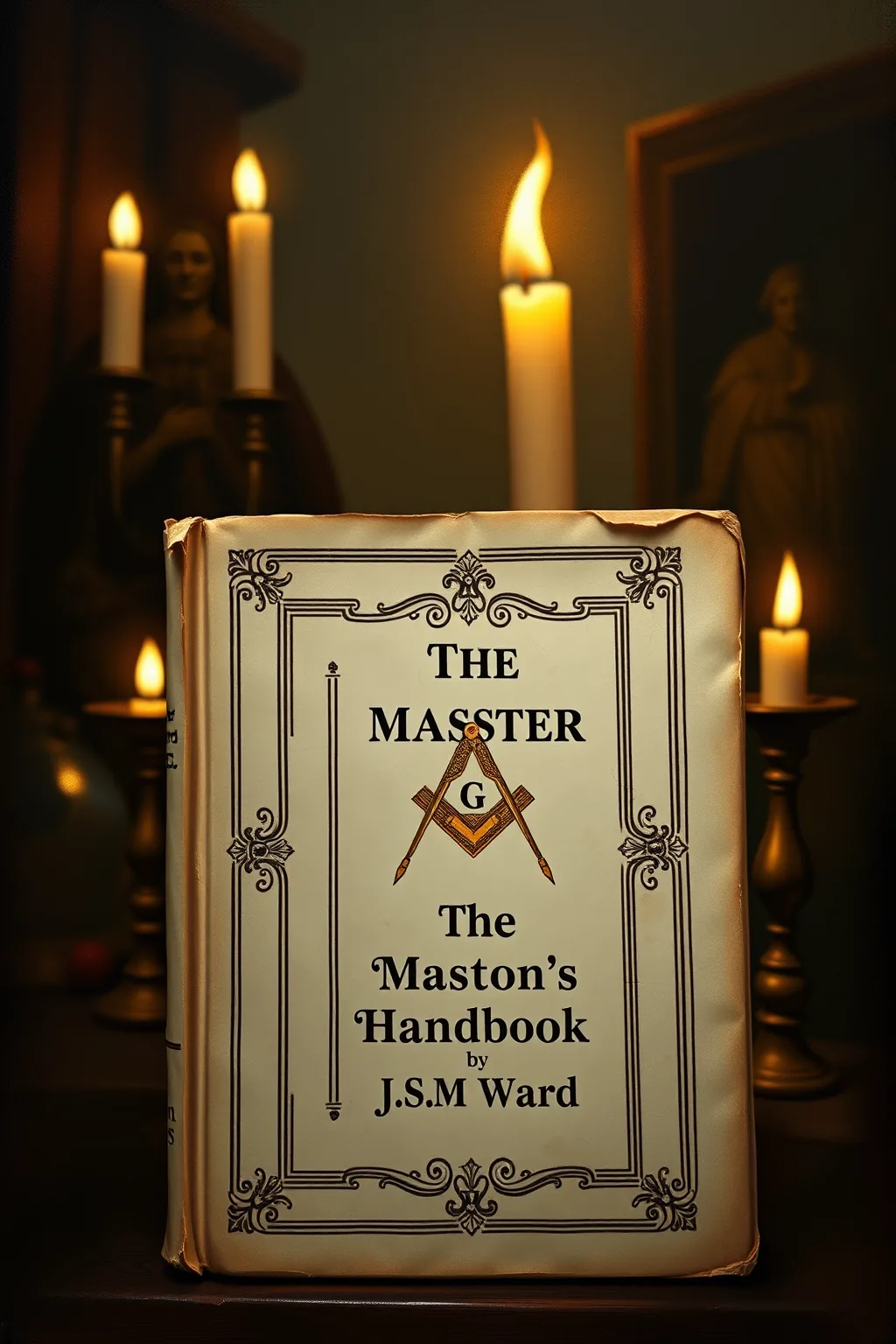
The Master Mason’s Handbook
 73
73

The Master Mason’s Handbook


Balthazar Finch (Senior Critic, Occult Philosophy) — J.S.M. Ward's 'The Master Mason's Handbook' is an indispensable key for unlocking the deeper mysteries of Masonic progression. Published in an era ripe with occult inquiry, this text brilliantly elucidates the Third Degree, moving beyond rote memorization to illuminate its profound symbolic and spiritual significance. Ward’s clarity is remarkable, offering the working Mason a pathway to genuine comprehension of the allegorical journey. It is a treasure for those who seek not just membership, but true illumination within the ancient brotherhood. A must-read for any serious student of Freemasonry's esoteric dimensions.
📝 Description
73
J.S.M. Ward published 'The Master Mason's Handbook' in 1923 to explain the Third Degree.
Published in 1923, J.S.M. Ward's 'The Master Mason's Handbook' goes beyond simple instructions for the Master Mason degree. Ward, known for his studies in esoteric subjects, unpacks the ceremonies, secret words, and symbolic actions central to this level of Masonic initiation. The book encourages serious students to understand the moral and spiritual lessons within each ritualistic act. It collects key information for Masons who wish to comprehend the philosophical ideas and hidden meanings within Masonic tradition. The text aims to show how ritual can lead to understanding and spiritual transformation.
This work fits within the broader tradition of Masonic literature that seeks to interpret the fraternity's rituals and symbols through an esoteric lens. It follows a lineage of writers who believed Freemasonry contained ancient wisdom, accessible through careful study of its allegorical elements. Ward's approach connects the specific practices of the Master Mason degree to wider philosophical and spiritual concepts, aiming to reveal a deeper meaning beyond the literal. It is part of a larger effort in the early 20th century to systematize and explain the symbolic language of Freemasonry.
✍️ Author
💡 Why Read This Book?
For seekers of hidden knowledge and practitioners of esoteric arts, 'The Master Mason's Handbook' offers an unparalleled deep dive into the Third Degree of Freemasonry. It serves as both a practical manual and a philosophical treatise, illuminating the symbolic journey and moral lessons. Ideal for Masons wishing to enrich their understanding and scholars of secret societies interested in the practical application of esoteric principles.
⭐ Reader Reviews
Honest opinions from readers who have explored this book.
❓ Frequently Asked Questions
What is the primary focus of 'The Master Mason's Handbook'?
The book primarily focuses on the Third Degree of Craft Freemasonry, detailing its ceremonies, symbols, and the moral and spiritual lessons intended for the candidate's enlightenment.
Who is the intended audience for this book?
The intended audience is primarily working Masons who wish to gain a deeper, more philosophical understanding of the Third Degree, as well as scholars and enthusiasts of Freemasonry and secret societies.
What makes this book 'esoteric'?
It delves into the symbolic meanings, allegorical journeys, and hidden wisdom embedded within Masonic rituals, presenting them not just as ceremonies but as pathways to spiritual and moral development, aligning with esoteric traditions.
When was 'The Master Mason's Handbook' first published?
The book was first published in 1923, placing it within a significant period of exploration and dissemination of esoteric knowledge.
Does this book explain how to perform Masonic rituals?
Yes, it sets out the ceremonies, passwords, and signs of the Third Degree, but crucially, it goes beyond mere description to interpret their symbolic and philosophical significance.
🔮 Key Themes & Symbolism
The Alchemical Transformation of the Soul
Ward elucidates how the Third Degree acts as an alchemical crucible, symbolically transforming the candidate from a base material into a purified essence. This process mirrors ancient alchemical practices of transmutation, where base metals are refined into gold, representing the elevation of the human spirit through trials, suffering, and the acquisition of divine knowledge. The rituals and symbols are presented not as mere theatrical performances, but as potent catalysts for inner change, guiding the aspirant towards a higher state of consciousness and moral integrity.
The Journey of the Pilgrim Soul
The book frames the candidate's progression through the Third Degree as a profound spiritual pilgrimage. Each step, symbol, and allegorical encounter represents a stage in the soul's quest for enlightenment and reunion with the divine. This journey is fraught with challenges designed to test virtue, courage, and wisdom, mirroring the paths undertaken by mystics and sages throughout history. Ward emphasizes the internal nature of this quest, asserting that true Masonic understanding is found not in external rites alone, but in the internal transformation they inspire.
The Language of Symbols and Allegory
Central to Ward's exposition is the interpretation of Masonic symbolism as a sophisticated, universal language designed to convey profound metaphysical truths. The handbook systematically deciphers the allegorical meanings behind the ceremonies, tools, and narrative elements of the Third Degree. This approach highlights Freemasonry's connection to ancient mystery schools that employed symbolic narratives to impart esoteric wisdom, making the text a vital resource for understanding the deeper, hidden layers of meaning within Masonic tradition.
💬 Memorable Quotes
Direct passages from the work, attributed to the author.
“Ritual is the vessel, but wisdom is the wine.”
— This emphasizes that the external forms of Masonic ritual are important as containers, but their true value lies in the profound spiritual and philosophical insights they hold and impart.
“The greatest light is found within.”
— A core esoteric principle, this suggests that true enlightenment and understanding originate from within the individual, guided by their inner wisdom and the lessons learned.
“Each symbol is a key to unlock a hidden chamber of truth.”
— This highlights the rich symbolic language of Freemasonry, positioning each symbol as a tool for accessing deeper levels of esoteric knowledge and spiritual understanding.
“The lessons of the Master Mason are written not in stone, but in the soul.”
— This profound statement conveys that the true impact and learning from the Master Mason's degree are deeply internalized and transformative, affecting the very essence of one's being.
💡 Key Ideas
Editorial paraphrase of the work's core concepts — not direct quotes.
The Third Degree is not an ending, but a new beginning.
This quote underscores the transformative nature of the Master Mason's degree, suggesting it opens a gateway to further knowledge and spiritual evolution, rather than marking the culmination of learning.
🌙 Esoteric Significance
Tradition
This work is deeply rooted in the Western Esoteric Tradition, drawing heavily from Hermetic philosophy, Kabbalistic symbolism, and the broader lineage of mystery schools. It interprets Masonic ritual through a lens that seeks to reveal universal spiritual laws and the transformative potential of the human psyche, aligning it with practices aimed at achieving gnosis or higher consciousness.
Symbolism
The handbook meticulously unpacks the rich symbolic set of the Master Mason's Degree. Key symbols such as the setting maul, the shattered column, and the celestial canopy are not merely descriptive elements but allegorical representations of mortality, the fall from grace, and the ultimate hope for resurrection and spiritual ascension. These symbols serve as a mnemonic and pedagogical tool for imprinting profound moral and philosophical lessons onto the candidate's consciousness.
Modern Relevance
In an age often characterized by superficiality and disconnection, 'The Master Mason's Handbook' offers a powerful reminder of the value of introspection, moral fortitude, and the pursuit of deeper meaning. Its exploration of symbolic journeys and internal transformation remains profoundly relevant for anyone seeking personal growth, ethical guidance, and a connection to timeless wisdom traditions, transcending its specific Masonic context.
👥 Who Should Read This Book
This handbook is essential for Master Masons seeking to deepen their appreciation of the Third Degree's esoteric dimensions, moving beyond ritual to grasp its philosophical weight. Scholars of Freemasonry and secret societies will find it an invaluable primary source for understanding early 20th-century interpretations of Masonic symbolism. Spiritual seekers and practitioners of occult arts interested in allegorical pathways to self-improvement and higher consciousness will also discover useful insights within its pages.
📜 Historical Context
Published in 1923, 'The Master Mason's Handbook' emerged during a vibrant period of esoteric revival and increased public interest in Freemasonry's mystical dimensions. The early 20th century saw scholars and practitioners actively exploring the historical roots and symbolic intricacies of various occult traditions, including Hermeticism, Kabbalah, and Rosicrucianism. J.S.M. Ward, a notable figure in Masonic literature, contributed significantly to this intellectual climate by making complex esoteric concepts accessible. His work reflects a desire to bridge the gap between the outward practice of Freemasonry and its inward, philosophical significance, offering a more profound understanding than mere ritualistic observance. The book stands as a proof of the enduring appeal of secret societies as repositories of ancient wisdom and as vehicles for personal spiritual development.
📔 Journal Prompts
Reflect on the 'shattered column' symbol: What aspects of your own life feel broken or incomplete, and what is the potential for their symbolic reconstruction?
Consider the Master Mason's journey as an allegory for your own spiritual path. What are the 'trials' you have faced, and what 'lights' have guided you?
How does the concept of 'immortality' or 'eternal life' resonate with you beyond a literal interpretation, as presented in the Third Degree?
Ward emphasizes that the true lessons are written 'in the soul.' What personal transformations has this book inspired or prompted you to consider?
Beyond the specific Masonic context, what universal truths or moral imperatives can be drawn from the symbolic narrative of the Third Degree?
🗂️ Glossary
Third Degree
The highest of the three Craft degrees in Freemasonry, often referred to as the Master Mason degree, which symbolizes the completion of a symbolic journey and the attainment of profound moral and philosophical understanding.
Allegory
A story, poem, or picture that can be interpreted to reveal a hidden meaning, typically a moral or political one. In this context, Masonic rituals and symbols are often presented allegorically.
Esoteric
Intended for or likely to be understood by only a small number of people with a specialized knowledge or interest; relating to or denoting the inner or secret meaning of something.
Gnosis
Spiritual knowledge, especially esoteric knowledge gained through direct experience or intuition, often associated with early Christian and Hellenistic mystical traditions.
Transmutation
In alchemy, the process of changing one element or substance into another. In a spiritual context, it refers to the transformation of the lower self into a higher, more refined state of being.
This book appears in 2 collections
🔮 Readers Also Liked
Browse all →





More by J S M Ward
All books →
From the “Secret Societies” Collection
View all →






More Free Freemasonry & Secret Societies Books
View all →