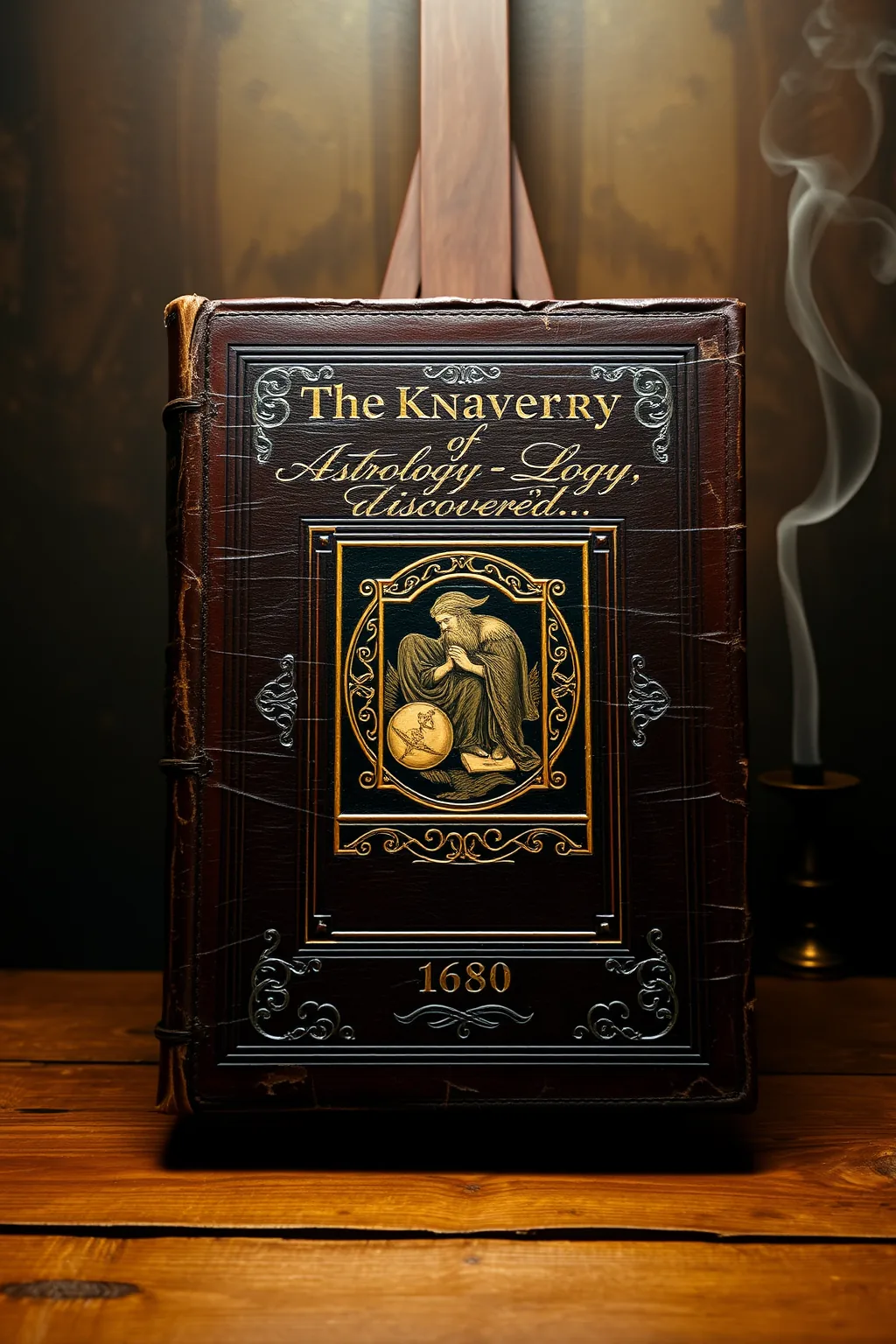
The knavery of astrology discover'd,... 1680
 77
77

The knavery of astrology discover'd,... 1680


Silas Hawthorne (Hermetic Studies Editor) — This seminal, albeit anonymous, 1680 text offers a bracingly rational critique of prevalent astrological systems. It meticulously unravels the fallacies and deceptions embedded within celestial divination, urging a return to more grounded, albeit still mystical, forms of wisdom. The author's sharp intellect and keen observational skills expose the 'knavery' not just of charlatans, but of the very framework that allowed such practices to flourish unchecked. It's a vital read for anyone seeking to understand the historical evolution of occult thought and to purify their own pursuit of hidden knowledge from superstition. Recommended for seasoned practitioners and critical scholars alike.
📝 Description
77
Published in 1680, 'The Knavery of Astrology Discover'd' critiques astrological claims with a skeptical eye.
This anonymous 1680 text critically examines the claims of astrology. The author dissects astrological practices, employing a lens that resembles alchemical analysis in its rigor. It addresses readers seeking truth beyond simple pronouncements, prompting contemplation on celestial influence versus human choice. The work embodies intellectual resistance, questioning the prevailing methods of celestial interpretation in the late 17th century.
It appeals to those who balance skepticism with spiritual curiosity. The book's importance comes from its early challenge to deterministic cosmic viewpoints. It argues for a clearer understanding of fate, free will, and the unseen forces guiding human lives. This is more than just criticism; it is an invitation to consider the deeper streams of occult knowledge. The author encourages readers to look inward rather than solely to the stars for understanding.
Appearing in 1680, this work emerges from a period of intense intellectual ferment regarding natural philosophy and occult sciences. While many contemporaries sought to integrate astrology into new scientific frameworks or defend traditional views, this anonymous author takes a distinctly critical stance. It stands apart from treatises that sought to legitimize or expand astrological systems, instead focusing on exposing perceived charlatanism and logical fallacies. Its skeptical approach places it within a tradition of critical engagement with esoteric claims, even as it implicitly acknowledges the existence of deeper, perhaps hidden, forces.
💡 Why Read This Book?
Embark on a journey to deconstruct astrological dogma and uncover the true nature of celestial influence. This rare 1680 text challenges conventional wisdom, encouraging critical thinking and a deeper understanding of esoteric truths. Ideal for seekers of authentic knowledge, scholars of occult history, and practitioners wishing to refine their discernment.
⭐ Reader Reviews
Honest opinions from readers who have explored this book.
❓ Frequently Asked Questions
What is the main argument of 'The Knavery of Astrology Discover'd'?
The book primarily argues that many astrological practices of its time were deceptive and lacked genuine foundational truth, exposing what the author perceived as 'knavery' or trickery in the field.
Who is the author of this work?
The author is unknown, adding to the mystique and anonymous nature of this critical exposé on astrology.
What historical period does this book represent?
The book was published in 1680, placing it firmly within the late 17th century, a period of significant intellectual and scientific ferment, alongside enduring interest in esoteric subjects.
Is this book a condemnation of all astrology?
While critical of prevailing practices, the book's focus is on the 'knavery' and deception, implying a distinction between flawed implementation and the potential for genuine, albeit perhaps differently understood, cosmic connections.
What kind of reader would appreciate this book?
This book is best suited for readers interested in the history of occultism, critical approaches to divination, and those seeking to understand the intellectual debates surrounding astrology in the early modern period.
🔮 Key Themes & Symbolism
The Art of Discerning Truth
This theme explores the author's dedication to unveiling deception within astrological practices, urging readers to cultivate critical faculties. It's about looking beyond surface pronouncements and questioning established doctrines to find genuine insight. The book champions intellectual rigor as a tool for spiritual growth, suggesting that true wisdom lies not in blind acceptance of celestial interpretations, but in the active pursuit of verifiable knowledge and the discernment of genuine occult principles from mere artifice. This encourages a more profound engagement with the mystical, where understanding is earned through careful examination.
Cosmic Influence vs. Human Agency
The treatise grapples with the age-old debate on the extent to which celestial bodies dictate human destiny. It questions the deterministic nature often ascribed to astrological readings, suggesting a more nuanced interplay between cosmic forces and individual free will. The author probes whether the 'stars incline' or 'constrain,' advocating for a perspective where human consciousness and choice play a significant role in navigating life's currents. This theme invites contemplation on the balance of fate and freedom, and how one might consciously interact with, rather than be passively governed by, perceived cosmic energies.
The Symbolism of Hidden Knowledge
This theme studies the author's implicit exploration of hidden knowledge and the esoteric systems that sought to interpret it. By exposing the 'knavery,' the text implicitly points towards the existence of more authentic, perhaps lost or suppressed, forms of occult understanding. The critique serves as a gateway, suggesting that true esoteric wisdom is often veiled and requires careful excavation. It highlights the symbolic language of the cosmos and the potential for misinterpretation, urging readers to seek deeper, more foundational truths that lie beneath the superficial layers of popular occultism.
💬 Memorable Quotes
Direct passages from the work, attributed to the author.
“The stars may incline, but they do not compel.”
— This powerful statement suggests that while celestial influences may exist, they do not predetermine human actions or ultimate fate, emphasizing the role of free will.
“Discernment is the key to unlocking celestial secrets.”
— This emphasizes the importance of critical thinking and careful judgment when approaching any form of divination or esoteric knowledge, especially astrology.
“The true cosmos resides within, not solely above.”
— This suggests a shift in focus from external celestial bodies to the internal spiritual landscape as the ultimate source of profound understanding and power.
“To know the stars is to know oneself, but not through mere calculation.”
— This implies that a genuine understanding of cosmic principles requires inner reflection and spiritual insight, rather than just empirical or mathematical methods.
💡 Key Ideas
Editorial paraphrase of the work's core concepts — not direct quotes.
Truth hides in plain sight, often obscured by charlatanry.
This quote highlights the author's belief that genuine wisdom is accessible but can be easily overlooked or distorted by those who seek to deceive for personal gain.
🌙 Esoteric Significance
Tradition
This work draws from a tradition of critical rationalism within esoteric thought, challenging the more dogmatic and superstitious elements that can infiltrate mystical practices. It aligns with currents of thought that emphasize inner illumination and the discernment of true spiritual principles from mere external phenomena. The author's approach can be seen as a form of intellectual alchemy, refining understanding by separating dross from gold, urging a return to foundational truths rather than adherence to popular, potentially corrupt, interpretations of cosmic order.
Symbolism
The 'knavery' itself becomes a symbol of deception and illusion, representing the distorted reflections of deeper cosmic truths. The stars, often revered as divine guides, are here portrayed as potentially misleading when interpreted through flawed systems. The act of 'discovering' this knavery symbolizes the seeker’s journey towards authentic knowledge, peeling back layers of artifice to reveal the underlying, more potent, spiritual realities. The book implicitly advocates for a symbolic understanding of the cosmos that transcends literal interpretation, emphasizing inner meaning over outward display.
Modern Relevance
In an age saturated with information and diverse belief systems, the call for discernment and critical thinking remains profoundly relevant. "The Knavery of Astrology Discover'd" encourages a sophisticated engagement with spiritual and occult subjects, urging readers to question, investigate, and seek authentic understanding rather than passively accepting pronouncements. It serves as a timeless reminder that genuine esoteric wisdom requires introspection and intellectual rigor, promoting a more conscious and empowered approach to exploring the mysteries of existence in the 21st century.
👥 Who Should Read This Book
This foundational text is essential for seekers of authentic esoteric knowledge, offering a historical perspective on the critical examination of occult practices. Scholars of early modern intellectual history and the evolution of astrology will find invaluable insights into the debates of the 17th century. Practitioners of astrology or related divination arts who wish to deepen their understanding and refine their methodology will benefit from its rigorous approach. Beginners curious about the historical context of occultism and the importance of discernment will find it an accessible yet profound introduction to intellectual skepticism within mystical traditions.
📜 Historical Context
Published in 1680, "The Knavery of Astrology Discover'd" emerged during a central era in intellectual history. The late 17th century witnessed the burgeoning of the Scientific Revolution, characterized by empirical observation, mathematical reasoning, and a growing skepticism towards traditional beliefs. Simultaneously, however, interest in alchemy, magic, and astrology remained potent, often existing in complex dialogue with nascent scientific thought. Authors like Isaac Newton, though a pioneer of physics, also delved deeply into alchemical studies. This period saw a tension between rationalism and mysticism, with many thinkers attempting to reconcile or critique these seemingly disparate realms. The anonymous nature of this work suggests a cautious approach to challenging established practices, perhaps to avoid the persecution or ridicule faced by those who questioned prevailing norms or ventured into controversial intellectual territories. It reflects a society grappling with new ways of understanding the universe, where the old celestial influences were being both defended and rigorously examined.
📔 Journal Prompts
What societal factors in the 1680s might have contributed to the 'knavery' described in this text?
How does the author's critique of astrology resonate with modern forms of divination or self-help trends?
If you were to re-examine astrological principles today, what methods would you employ to discern truth from deception?
Consider a time when you felt misled by external pronouncements; how did you eventually find clarity or truth?
Reflect on the balance between external cosmic influences and internal personal agency in your own life.
🗂️ Glossary
Knavery
Dishonest or unscrupulous behavior; trickery or deceit. In this context, it refers to the perceived dishonest practices within astrology.
Astrology
The study of the movements and relative positions of celestial bodies interpreted as having an influence on human affairs and the natural world.
Discernment
The ability to judge well; the quality of being able to assess situations or people accurately and make good judgments.
Celestial
Positioned in or relating to the sky, or outer space as observed in astronomy; of or from heaven.
Charlatanry
A person falsely claiming to have a special knowledge or skill, especially in medicine; a quack.
This book appears in 1 collection
🔮 Readers Also Liked
Browse all →








From the “Astrology” Collection
View all →







More Free Astrology & Cosmology Books
View all →