The House that Stood Still
 72
72

The House that Stood Still
A. E. van Vogt's "The House that Stood Still" presents a compelling, albeit occasionally dense, exploration of temporal stasis and its philosophical ramifications. The central conceit of individuals achieving a voluntary, conscious "Stillness" is conceptually rich, offering a unique angle on time travel and existential detachment. Van Vogt excels at building a world where this ability shapes society, leading to intriguing power dynamics and moral quandaries. However, the narrative pacing can become uneven, with certain plot developments feeling rushed while others are laboriously explained. The character motivations, while often driven by the logic of their unique state, sometimes lack a relatable human core. A particular strength lies in the depiction of the "Stillness" itself – the mental discipline and altered perception it requires. Despite its flaws in execution, the novella’s core idea about transcending temporal limitations remains a potent one for speculative fiction. It's a curious piece that rewards patient readers with its imaginative scope.
📝 Description
72
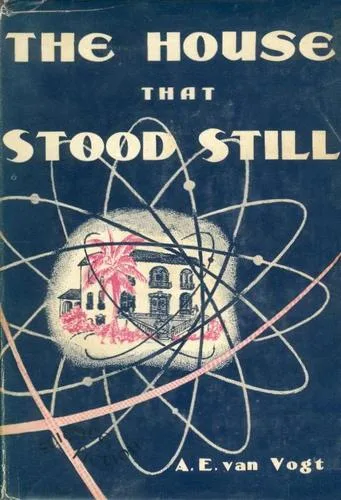
A. E. van Vogt published "The House that Stood Still" in 1952, a novella about consciousness and time.
This 1952 science fiction novella by A. E. van Vogt examines consciousness and perception. It presents a society where individuals can enter a state of suspended animation, not just for preservation, but to bypass linear time and physical limits. The story follows characters as they confront the consequences of these abilities and the societal structures that develop around them.
Van Vogt's work appeals to readers interested in early to mid-20th-century speculative fiction that goes beyond simple adventure. It is for those who enjoy narratives that question the nature of self, the manipulation of time, and the possibility of altered states of existence. Readers seeking science fiction that encourages thought about existential matters and the limits of human awareness will find it rewarding.
Published in 1952, "The House that Stood Still" appeared during science fiction's Golden Age. While contemporaries focused on grand narratives, van Vogt incorporated psychological depth and abstract ideas. The novella touches on themes prevalent in post-war existentialism, exploring how scientific advancement might impact the human condition. Its focus on altered states of being and the manipulation of consciousness positions it as an early exploration of concepts that would later appear in speculative fiction concerning reality and self.
💡 Why Read This Book?
• You will gain an understanding of "Stillness" as a unique form of consciousness, distinct from mere suspended animation, as depicted in the novella's exploration of temporal detachment. • You will encounter early 1950s science fiction's engagement with existential themes, specifically how "The House that Stood Still" questions the nature of existence outside linear time. • You will consider the societal structures and control mechanisms that might arise from individuals capable of manipulating their temporal state, as explored through the narrative's world-building.
⭐ Reader Reviews
Honest opinions from readers who have explored this book.
❓ Frequently Asked Questions
What is the primary concept explored in "The House that Stood Still"?
The novella's core concept is "Stillness," a voluntary state of conscious suspension outside the normal flow of time, allowing for detached observation and potential manipulation of temporal events.
When was "The House that Stood Still" first published?
"The House that Stood Still" was first published in 1952, placing it within the Golden Age of science fiction literature.
Does the book involve traditional time travel mechanics?
No, it focuses on a state of being outside of time rather than active travel through it, exploring consciousness's relationship with temporality differently.
What kind of societal implications does the book suggest?
It suggests implications for power structures, control, and the potential for an elite group to exist apart from the conventional temporal progression of society.
Is "The House that Stood Still" a standalone work?
Yes, it is a novella that functions as a standalone narrative, though it shares thematic elements with other works by A. E. van Vogt.
What is the main challenge faced by characters regarding "Stillness"?
Characters grapple with the philosophical, psychological, and societal consequences of achieving and maintaining "Stillness," including the risks of detachment and control.
🔮 Key Themes & Symbolism
Consciousness Beyond Time
The central theme revolves around the possibility of human consciousness existing independently of linear time, a state termed "Stillness." This isn't mere suspended animation but an active, aware detachment that allows for a different mode of perception and existence. The work probes whether true awareness can persist when freed from the constraints of chronological progression, suggesting that such a state offers a unique vantage point from which to observe reality, but also carries profound risks of alienation and existential disconnect.
Societal Control and Evolution
"The House that Stood Still" implicitly examines how the mastery of "Stillness" could lead to societal stratification and control. Those who achieve this state might form an elite, influencing or observing society from an external temporal perspective. The novella raises questions about whether this represents a form of evolution or a dangerous detachment that ultimately hinders genuine human connection and progress. It explores the tension between individual transcendence and the collective human experience, and the potential for power derived from temporal manipulation.
The Nature of Reality and Perception
By positing a state where time is not a linear progression, the book challenges conventional understandings of reality. Characters in "Stillness" perceive events differently, potentially able to witness cause and effect from a removed vantage point. This exploration touches upon how our perception of reality is intrinsically linked to our temporal experience. The narrative implicitly asks: if one can step outside of time, does the very fabric of reality alter, or is it merely one's interpretation of it that changes?
Existential Detachment
The novella explores the existential implications of achieving "Stillness." While offering a potential escape from mortal limitations and the anxieties of time, it also presents the danger of profound isolation. The characters must work through the psychological toll of existing apart from the flow of life, relationships, and societal change. This theme questions the value of existence when divorced from engagement and the inherent human need for connection, even as it explores the allure of a timeless, unburdened state.
💬 Memorable Quotes
Direct passages from the work, attributed to the author.
“He was in a state of suspended animation, but he was aware.”
— This highlights the core concept of 'Stillness' – it's not just a physical pause, but an active, conscious state of being that transcends normal temporal limitations.
“Time was no longer a river, but a lake from which one could observe.”
— This metaphor vividly illustrates the shift in perception for those in 'Stillness,' moving from experiencing time sequentially to viewing it as a static, observable entity.
“They existed in the pauses between heartbeats.”
— This evocative phrase captures the essence of the characters' state, suggesting they inhabit moments so fleeting and outside normal experience that they are almost imperceptible.
“Power lay in understanding the pattern, not in forcing the flow.”
— This interpretation points to a key theme: the value of passive observation and deep comprehension of temporal causality from a detached state, rather than direct intervention.
💡 Key Ideas
Editorial paraphrase of the work's core concepts — not direct quotes.
The true danger was not in stopping time, but in forgetting how to live within it.
This paraphrase suggests the novella explores the psychological and existential risks of prolonged detachment, warning that escaping temporal constraints can lead to a loss of connection to life itself.
🌙 Esoteric Significance
Tradition
The work can be loosely aligned with metaphysical and esoteric traditions that explore consciousness beyond the physical form and linear time, echoing themes found in some interpretations of Gnosticism or Theosophy regarding higher states of being. It departs from traditional occultism by grounding its concepts in a speculative, rather than overtly mystical, framework. The idea of achieving a voluntary, conscious state outside of normal temporal experience aligns with contemplative practices that seek altered states of awareness, though van Vogt frames it through a science-fictional lens.
Symbolism
The "house" itself can symbolize the physical body or the individual's confined existence within linear time. The "Stillness" represents a state of liberation or transcendence, a potential spiritual awakening achieved through mental discipline. The concept of "time" as a lake or a static entity symbolizes a shift from subjective, flowing experience to objective, observable reality, a hallmark of certain mystical insights into the nature of existence.
Modern Relevance
Contemporary discussions around consciousness studies, simulation theory, and philosophical explorations of time continue to resonate with the themes presented in "The House that Stood Still." Thinkers and writers examining the nature of subjective experience, the potential for non-linear perception, and the philosophical implications of advanced technology or altered states of consciousness can find conceptual precursors in van Vogt's work. It remains relevant for those interested in speculative fiction's capacity to explore the edges of human understanding.
👥 Who Should Read This Book
• Readers interested in the philosophical underpinnings of speculative fiction, particularly those who enjoy exploring concepts of consciousness and time beyond conventional narrative. • Students of early to mid-20th-century science fiction who wish to understand how authors like A. E. van Vogt expanded genre themes beyond pure technological advancement. • Individuals curious about speculative explorations of altered states of being and their potential impact on societal structures and personal identity.
📜 Historical Context
Published in 1952, "The House that Stood Still" arrived during a period of intense scientific optimism and existential inquiry in post-war America. The Golden Age of Science Fiction was in full swing, with authors like Robert A. Heinlein and Isaac Asimov dominating the scene with grand narratives. Van Vogt, however, consistently pushed the boundaries of genre conventions, introducing more complex psychological and philosophical elements. This era also saw the rise of existentialist thought, influencing literature to explore themes of individual freedom, responsibility, and the search for meaning in a seemingly absurd world. While the dominant scientific discourse focused on atomic power and space exploration, "The House that Stood Still" engaged with more esoteric notions of consciousness and temporal manipulation, diverging from the more materialist leanings of some contemporaries. Its reception was largely within the science fiction readership, appreciating its speculative depth.
📔 Journal Prompts
The experience of "Stillness" as a temporal detachment.
The societal implications of transcending linear time.
Perception of reality when divorced from chronological progression.
The balance between individual transcendence and collective existence.
The existential risks of achieving a timeless state.
🗂️ Glossary
Stillness
A voluntary state of conscious suspension where an individual exists outside the normal flow of linear time, capable of detached observation and potentially influencing events.
Temporal
Relating to time; in the context of the book, it refers to the experience and progression of time as a linear sequence.
Suspended Animation
A state of reduced metabolic activity, often used in science fiction for long-term space travel or preservation. Van Vogt distinguishes 'Stillness' as a conscious state, unlike typical suspended animation.
Consciousness
The state of being aware of and responsive to one's surroundings. The novella explores consciousness's potential to exist and function independently of temporal constraints.
Causality
The relationship between cause and effect. Characters in 'Stillness' may observe causality from a detached perspective, understanding the chain of events more clearly.
Perception
The ability to see, hear, or become aware of something through the senses. The book examines how perception shifts when one is outside the normal temporal flow.
Transcendence
Existence or experience beyond the normal or physical level. The novella explores the idea of transcending the limitations of time and physical existence.
🔮 Readers Also Liked
Browse all →








More by A. E. van Vogt
All books →
More Free Occult Philosophy Books
View all →