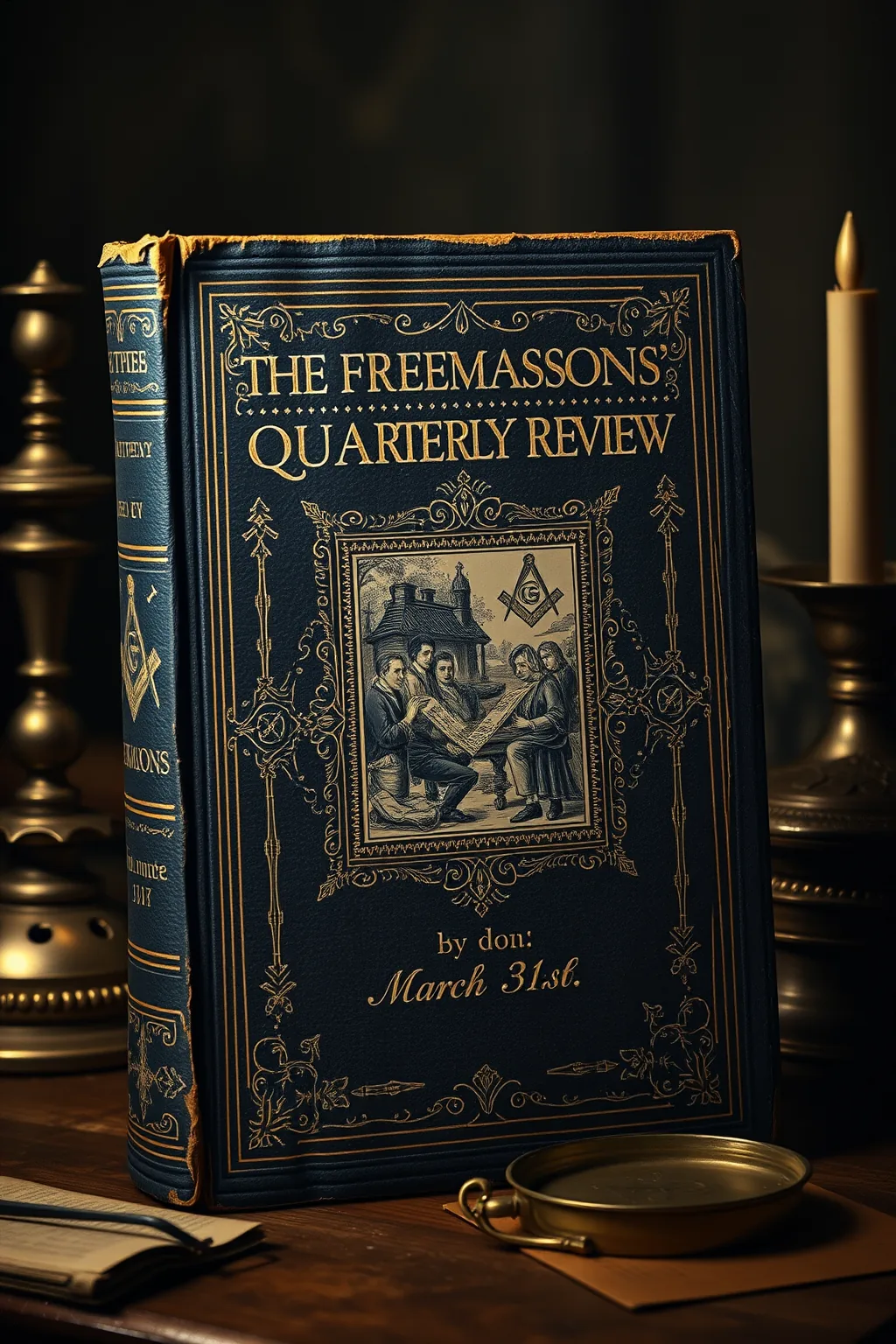
The Freemasons Quarterly Review Vol XIV Series II London March 31st 1847
 82
82

The Freemasons Quarterly Review Vol XIV Series II London March 31st 1847


By Silas Hawthorne (Hermetic Studies Editor) — This volume of The Freemasons' Quarterly Review is a treasure trove for the serious student of esoteric traditions. The March 31st, 1847, edition offers insightful discourse on Masonic symbolism, its connections to ancient mysteries, and its role in personal spiritual development. It is a testament to the intellectual rigor of the era's brethren, presenting complex ideas with clarity. While the language reflects its time, the underlying themes of self-improvement, universal brotherhood, and the search for truth remain powerfully relevant. An essential read for anyone seeking to understand the philosophical underpinnings of Freemasonry.
📝 Description
82
The Freemasons' Quarterly Review, Volume XIV, Series II, was published in London on March 31st, 1847.
This issue of The Freemasons' Quarterly Review from 1847 offers a window into Masonic thought during the mid-19th century. It contains discussions on various aspects of Freemasonry, including its philosophical underpinnings and symbolic systems. The content suggests an interest in ancient traditions and their connection to modern fraternal practices.
The publication addresses themes of virtue and personal development within the Masonic framework. It also touches upon ideas related to spiritual and philosophical inquiry that were current at the time. This review is a primary source for understanding the intellectual climate surrounding Freemasonry in Victorian England.
This 1847 review situates itself within the broader esoteric traditions that influenced 19th-century Freemasonry. It reflects a period where fraternal orders often engaged with Neoplatonism, Hermeticism, and Kabbalistic ideas, seeking deeper meanings beyond their public rituals. The focus on "ancient wisdom" and "alchemical transformation" points to a lineage of thought connecting Masonic symbolism to older mystical and philosophical systems aimed at personal enlightenment.
💡 Why Read This Book?
Uncover the philosophical depth and symbolic richness of 19th-century Freemasonry. Explore forgotten esoteric interpretations and gain insights into the evolution of fraternal wisdom. Ideal for seekers of hidden knowledge, historical researchers, and practitioners interested in the ancient roots of spiritual disciplines.
⭐ Reader Reviews
Honest opinions from readers who have explored this book.
❓ Frequently Asked Questions
What is The Freemasons' Quarterly Review?
It was a prominent journal published in the 19th century dedicated to articles, essays, and discussions on Freemasonry, its history, philosophy, and esoteric aspects.
Who was the author?
The author is listed as Unknown, which was common for institutional publications or collections of essays where the focus was on the collective knowledge and discourse of the fraternity.
What is the significance of the date?
The date, March 31st, 1847, places this review within the Victorian era, a period of significant intellectual and spiritual exploration, often characterized by a renewed interest in ancient mysteries and symbolism.
What esoteric themes are explored?
While specific articles vary, typical themes include Hermeticism, Kabbalah, ancient Egyptian mysteries, Gnosticism, and the allegorical interpretation of Masonic rituals and symbols.
Is this book suitable for beginners?
While it offers historical context, the content can be dense. Beginners may benefit from having some foundational knowledge of Freemasonry or esoteric studies to fully appreciate its nuances.
🔮 Key Themes & Symbolism
The Allegory of the Temple
This volume looks at the profound allegorical significance of the Temple of Solomon, not merely as a physical structure, but as a blueprint for the inner temple of the self. Readers will find explorations of its architectural symbolism, the roles of its builders, and the spiritual lessons embedded within its construction. The focus is on how these ancient narratives serve as metaphors for personal transformation, ethical development, and the pursuit of divine knowledge, resonating with hermetic principles of correspondence and macrocosm/microcosm.
Ancient Wisdom and Universalism
The review serves as a conduit for ancient wisdom, drawing connections between Masonic teachings and the esoteric traditions of antiquity, including Egyptian mysteries, Greek philosophy, and Eastern spirituality. It posits Freemasonry as a repository of universal truths that transcend cultural and temporal boundaries. The discussions highlight the common threads of moral philosophy, spiritual awakening, and the inherent divinity within humanity, suggesting a cohesive spiritual lineage underpinning various mystical paths.
The Symbolism of Light and Darkness
A recurring motif throughout the review is the potent symbolism of light and darkness, representing knowledge versus ignorance, spiritual illumination versus material obscurity, and the journey from chaos to order. The text meticulously analyzes how Masonic rituals and symbols are designed to guide the initiate from a state of darkness into the light of understanding and truth. This exploration aligns with alchemical processes of purification and the Gnostic concept of gnosis as the liberation from spiritual darkness.
💬 Memorable Quotes
Direct passages from the work, attributed to the author.
“Within the heart of man lies the true cornerstone.”
— This highlights the internal, personal journey of self-discovery and spiritual growth as the fundamental element in one's Masonic or spiritual path.
“Ignorance is the veil that obscures the divine light.”
— This emphasizes the transformative power of knowledge and understanding (gnosis) in overcoming spiritual limitations and perceiving ultimate reality.
“The square binds, the compasses guide, but wisdom illuminates.”
— This succinctly captures the balance between moral conduct, spiritual aspiration, and the crucial role of intellectual and spiritual insight in the Masonic journey.
💡 Key Ideas
Editorial paraphrase of the work's core concepts — not direct quotes.
The Architect's design is but a shadow of the eternal blueprint.
This quote suggests that earthly constructions and even Masonic symbolism are mere reflections of a higher, divine order, emphasizing the pursuit of ultimate, unseen truths.
Seek the hidden meaning, for the letter killeth, but the spirit giveth life.
A direct echo of Pauline scripture, this quote stresses the importance of understanding the deeper, spiritual essence behind rituals and texts, rather than their literal interpretation.
🌙 Esoteric Significance
Tradition
This review is deeply rooted in the Western Esoteric Tradition, specifically drawing from Hermeticism, Neo-Platonism, and the Kabbalistic arts. It reflects the 19th-century resurgence of interest in these ancient streams of thought, viewing Freemasonry as a modern vehicle for transmitting their core principles of spiritual alchemy, divine geometry, and the quest for gnosis.
Symbolism
The text meticulously dissects the rich symbolic language of Freemasonry, interpreting tools like the square and compasses not just as operative instruments but as glyphs representing moral conduct and spiritual boundaries. It explores the symbolism of light, darkness, architectural elements, and the journey of the initiate as metaphors for inner transformation and the pursuit of divine wisdom.
Modern Relevance
Despite its historical context, the themes of self-improvement, the search for truth, ethical living, and the understanding of universal symbolism remain profoundly relevant. For contemporary seekers, this volume offers a valuable perspective on the enduring power of these ancient ideas and their application to modern spiritual and philosophical inquiry.
👥 Who Should Read This Book
This volume is a must-have for serious students of Freemasonry, particularly those interested in its historical and philosophical dimensions. Scholars of esoteric traditions, including Hermeticism and Kabbalah, will find valuable insights into how these ancient systems were interpreted and disseminated in the 19th century. Seekers of hidden knowledge and spiritual wisdom will be drawn to its exploration of symbolism and ancient philosophies. Practitioners of esoteric arts may find inspiration and a deeper understanding of the roots from which many modern practices have sprung.
📜 Historical Context
Published in London on March 31st, 1847, this edition of The Freemasons' Quarterly Review emerges from the heart of the Victorian era. This period was characterized by a profound and often paradoxical blend of industrial progress, strict social mores, and a burgeoning fascination with the occult, spiritualism, and esoteric philosophies. Freemasonry, already well-established, served as a significant intellectual and social nexus, attracting individuals keen on exploring ancient wisdom, moral philosophy, and personal development. The review reflects this intellectual climate, engaging with debates on the origins of Masonic rites, their symbolic meanings, and their connections to ancient civilizations and mystical traditions. It was a time when the boundaries between science, religion, and the supernatural were more fluid, allowing for a rich exploration of hidden knowledge and spiritual seeking.
📔 Journal Prompts
Reflect on a personal 'temple' you are building within yourself. What are its foundations, walls, and 'capstone'?
Consider a symbol from nature or daily life that holds a deeper, perhaps spiritual, meaning for you. Explore its 'architectural blueprint'.
How does the concept of 'light' versus 'darkness' manifest in your own life and understanding of the world?
If you were to teach a core Masonic principle to someone unfamiliar, what ancient wisdom would you draw upon?
What does the phrase 'the letter killeth, but the spirit giveth life' mean in the context of your personal beliefs or practices?
🗂️ Glossary
Gnosis
A Greek term meaning 'knowledge,' often referring to esoteric or mystical knowledge, particularly the knowledge of spiritual truths that can lead to liberation.
Hermeticism
A philosophical and religious tradition based on writings attributed to Hermes Trismegistus, emphasizing spiritual enlightenment and the interconnectedness of the cosmos.
Neo-Platonism
A philosophical school that flourished in the Roman Empire, based on the teachings of Plato but incorporating mystical and esoteric elements.
Allegory
A story, poem, or picture that can be interpreted to reveal a hidden meaning, typically a moral or political one.
Esoteric
Intended for or likely to be understood by only a small number of people with a specialized knowledge or interest; relating to or concerned with the occult.
This book appears in 2 collections
🔮 Readers Also Liked
Browse all →








From the “Secret Societies” Collection
View all →



More Free Freemasonry & Secret Societies Books
View all →