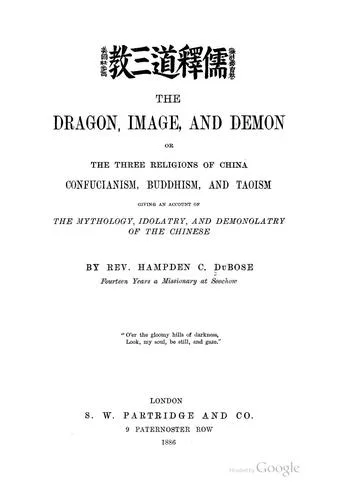
The dragon, image, and demon
 74
74

The dragon, image, and demon
Hampden C. Dubose's "The dragon, image, and demon" offers a dense, symbolic exegesis that avoids simplistic allegories. The author’s strength lies in meticulously unpacking the layered meanings of these archetypes, particularly the nuanced portrayal of the 'demon' not solely as an adversary but as a complex, often misunderstood, aspect of the psyche. A passage discussing the dragon's coiled energy as a metaphor for latent potential is particularly striking. However, the book's theoretical density can at times feel overwhelming, demanding significant prior knowledge of esoteric symbolism. The prose, while precise, occasionally lacks accessibility for those new to the subject matter. It is a valuable, if demanding, exploration for dedicated researchers.
📝 Description
74
Hampden C. Dubose's 2018 book examines the dragon, image, and demon as symbolic forces.
The dragon, image, and demon treats these potent symbols not as literal beings but as representations of internal states and external forces shaping human experience. Dubose analyzes the archetypal significance of the dragon, the abstract power of the 'image' as a psychic construct, and the complex nature of the 'demon.' He explores their roles in myth, ritual, and individual psychological development. The author posits that these are not merely relics of ancient belief but active forces within the modern psyche. This work is suited for serious students of comparative mythology, Jungian psychology, and Western esotericism. It will appeal to those who approach symbolic systems with a critical yet open mind, seeking to understand the deeper currents of meaning behind common, yet often misunderstood, imagery.
Published in 2018, The dragon, image, and demon emerges as esoteric traditions see renewed interest, met with both academic scrutiny and popular engagement. This period allows for broader interpretation and application of concepts previously confined to niche circles. Dubose's text contributes to this milieu by dissecting these specific archetypes, offering a focused look at their psychological and symbolic underpinnings.
This book engages with Western esoteric traditions, particularly those that interpret symbolic figures through a psychological lens. It draws on comparative mythology and Jungian psychology to understand how archetypes like the dragon and demon function within the human psyche. The text considers these figures not as external spiritual entities but as internal psychological forces that influence perception and behavior. Its publication in 2018 places it within a contemporary resurgence of interest in esoteric thought, where such symbolic systems are analyzed with both scholarly rigor and popular curiosity.
💡 Why Read This Book?
• Gain a deeper understanding of the dragon archetype, moving beyond simplistic depictions to grasp its representation of primal energy and transformative potential, as explored in the book's analysis of serpentine imagery. • Explore the concept of the 'image' as a psychological construct, learning how manufactured or perceived images can exert influence, a key theme highlighted by the book's examination of visual symbolism. • Re-evaluate the 'demon' archetype, discerning its multifaceted role in esoteric traditions as a force of chaos, temptation, or even a catalyst for spiritual growth, as detailed in the text's symbolic interpretations.
⭐ Reader Reviews
Honest opinions from readers who have explored this book.
❓ Frequently Asked Questions
What is the central theme of "The dragon, image, and demon"?
The book's central theme revolves around the symbolic interpretation of potent archetypes—the dragon, the image, and the demon—examining their psychological significance and manifestation within esoteric traditions.
Who is Hampden C. Dubose?
Hampden C. Dubose is the author of "The dragon, image, and demon," a work first published in 2018 that delves into esoteric symbolism and archetypal psychology.
What esoteric traditions does the book draw upon?
While not explicitly detailing every lineage, the book engages with concepts common in Western esotericism, including Jungian psychology and comparative mythology, to interpret its core symbols.
Is "The dragon, image, and demon" suitable for beginners in esotericism?
The text is dense and assumes some familiarity with symbolic language and psychological concepts, making it more suitable for intermediate or advanced students of esoteric subjects.
When was "The dragon, image, and demon" first published?
The work was first published in 2018, placing it within contemporary discussions on esoteric thought and symbolism.
What does the book suggest about the 'demon' archetype?
The book proposes that the 'demon' is not merely an external evil but a complex psychological force, often representing shadow aspects, internal conflicts, or transformative challenges within the psyche.
🔮 Key Themes & Symbolism
Archetypal Dragon Symbolism
The dragon is presented not merely as a mythical beast but as a profound symbol of primal energy, untamed forces, and potential for both destruction and transformation. The text explores its presence across various cultures, linking its coiled form and reptilian nature to concepts of hidden wisdom, earthly power, and the cyclical nature of existence. It suggests the dragon embodies the potent, often chaotic, forces that lie dormant within both the individual psyche and the material world, awaiting understanding or confrontation.
The Power of the Image
This theme scrutinizes the 'image' as a potent construct influencing perception and reality. It moves beyond simple visual representation to discuss how mental constructs, societal ideals, and archetypal impressions shape our understanding of ourselves and the world. The book examines how these images, whether internal or external, can become sources of power, illusion, or distortion, acting as intermediaries between the unseen and the manifest.
Many-sided Demonology
The 'demon' is deconstructed from simplistic notions of pure evil. The work probes its role as a shadow aspect, a force of disruption essential for growth, or a representation of suppressed desires and fears. It examines how these figures in esoteric lore often represent challenges that, when faced and understood, lead to spiritual or psychological advancement, rather than being purely malevolent entities.
Psychological and Esoteric Interplay
A core concept is the seamless integration of psychological interpretation with esoteric traditions. The book argues that ancient symbols and figures are not merely historical artifacts but continue to function as active elements within the human psyche. It bridges the gap between analytical psychology, particularly Jungian concepts, and the symbolic language of occultism, suggesting a shared understanding of deep human patterns.
💬 Memorable Quotes
Direct passages from the work, attributed to the author.
“The dragon's coiled form signifies latent power awaiting conscious direction.”
— This statement emphasizes the dragon not as a static monster but as a dynamic symbol of potential energy. It suggests that this archetypal force, when understood and integrated, can be channeled for creative or spiritual purposes rather than remaining a source of uncontrolled chaos.
“Images function as psychic conduits, shaping belief and action.”
— This highlights the active role of visual and mental imagery in human experience. It implies that the way we perceive and are perceived through images has a direct impact on our internal states and external behaviors, serving as a bridge between abstract thought and tangible reality.
“The demon often embodies that which must be integrated, not merely vanquished.”
— This interpretation reframes the demonic archetype. Instead of a force solely to be destroyed, it is presented as a necessary component of the psyche or spiritual journey, whose confrontation and assimilation are crucial for wholeness and development.
“Archetypal figures are persistent patterns within the collective unconscious.”
— This concept links the book's subjects to broader psychological theories. It posits that the dragon, image, and demon are not arbitrary creations but deeply ingrained structures of the human psyche that manifest across different times and cultures.
“Understanding the symbolic language unlocks deeper layers of meaning.”
— This emphasizes the book's methodological approach. It suggests that the esoteric symbols discussed are keys to accessing profound truths about the human condition and the nature of reality, requiring careful study and interpretation.
🌙 Esoteric Significance
Tradition
This work appears rooted in Western Esotericism, drawing heavily on archetypal psychology, particularly the ideas popularized by Carl Jung, and integrating them with symbolic interpretations found in comparative mythology and occult literature. It doesn't strictly adhere to a single lineage like Hermeticism or Kabbalah but rather synthesizes concepts from various traditions that explore the human psyche and its relationship with symbolic forces.
Symbolism
Key symbols include the 'dragon,' often representing primal energy, chaos, or the unconscious; the 'image,' symbolizing how perceived forms and mental constructs shape reality and perception; and the 'demon,' interpreted not solely as malevolent but as a complex psychological force, representing shadow aspects, internal conflicts, or catalysts for transformation within the esoteric framework.
Modern Relevance
Contemporary thinkers and practitioners in fields like Jungian analysis, transpersonal psychology, and modern occultism find value in Dubose's work. It provides a framework for understanding the persistent power of ancient archetypes in the modern, often desacralized, world, offering tools for psychological integration and spiritual exploration.
👥 Who Should Read This Book
• Students of Jungian psychology seeking to connect archetypal theory with concrete symbolic representations found in esoteric lore. • Researchers of comparative mythology interested in cross-cultural interpretations of powerful mythical figures like the dragon. • Individuals engaged in personal development and shadow work who wish to understand the psychological role of figures often perceived as negative, such as the demon.
📜 Historical Context
The dragon, image, and demon, published in 2018, arrived during a period of significant revival and re-evaluation of esoteric thought. This era saw a confluence of academic interest in occultism, fueled by scholars like Wouter J. Hanegraaff, and a burgeoning popular engagement with spiritual and psychological symbolism. Unlike earlier waves of esoteric interest, the 2010s were marked by increased digital accessibility of texts and a greater willingness to synthesize traditions. Dubose's work emerges in this climate, offering a contemporary lens on archetypal figures that were also being explored by figures like Carl Jung in the mid-20th century. While Jungian psychology provided a framework for understanding archetypes, Dubose's text likely engages more directly with the specific symbolic language found within Western occult traditions, potentially differentiating itself from purely psychological analyses.
📔 Journal Prompts
The dragon's symbolism as latent power: how does this manifest in your life?
Reflect on the influence of 'images' on your decision-making processes.
Consider the 'demon' archetype: what internal conflicts might it represent for you?
Analyze the interplay between archetypal figures and your personal experiences.
Explore the concept of symbolic conduits and their impact on your belief systems.
🗂️ Glossary
Archetype
A fundamental, universal pattern or image that recurs in the collective unconscious, influencing human thought, behavior, and perception. Examples include the hero, the mother, and the shadow.
Esotericism
A broad category of spiritual or philosophical traditions that are 'inner' or 'hidden,' often involving secret knowledge, mystical practices, and symbolic interpretation accessible to a select few.
Psychic Construct
A concept or idea formed within the mind, often influenced by personal experience, cultural conditioning, and archetypal patterns, which can shape one's reality and behavior.
Shadow
In Jungian psychology, the unconscious aspect of the personality that the conscious ego does not identify in itself. It often contains repressed desires, weaknesses, and primitive instincts.
Symbolism
The use of symbols to represent ideas and qualities by giving them meanings that are different from their literal sense. In esoteric contexts, symbols are seen as keys to deeper understanding.
Collective Unconscious
A term coined by Carl Jung, referring to a layer of the unconscious mind that is shared by all humans, containing inherited archetypes and instincts.
Primal Energy
The fundamental, raw, often untamed force or power that underlies existence and consciousness, frequently symbolized in myth and esotericism by figures like the dragon.
🔮 Readers Also Liked
Browse all →








More by Hampden C. Dubose
All books →

More Free Occult Philosophy Books
View all →