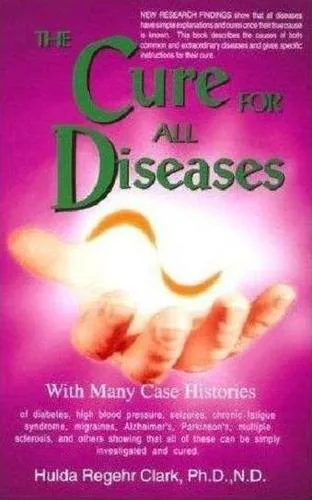
The cure for all diseases
 74
74

The cure for all diseases
Hulda Regehr Clark's The Cure for All Diseases, first published in 2002, offers a provocative and highly controversial framework for understanding and treating illness. Clark's central thesis—that a vast array of diseases stem from specific parasitic infections and environmental toxins, addressable through targeted herbal remedies and electronic frequencies—is presented with unwavering conviction. The book's strength lies in its direct, no-nonsense prose and its appeal to individuals frustrated by the limitations of conventional medicine. However, the work's significant limitation is its consistent disregard for peer-reviewed scientific consensus. Clark's assertion that a single "zapper" device can neutralize pathogens responsible for everything from HIV to cancer lacks empirical validation within established scientific communities. A notable passage details her use of black walnut hull and wormwood tincture, alongside specific frequencies, to target liver flukes, a concept presented as universally applicable. Ultimately, the book serves as a historical document of a fringe healing philosophy, offering a stark alternative perspective rather than a scientifically supported medical guide.
📝 Description
74
Hulda Regehr Clark's 2002 book, The Cure for All Diseases, proposes a unified theory of illness causation.
Hulda Regehr Clark's 2002 book, The Cure for All Diseases, presents a health philosophy that diverges from conventional medical understanding. Clark posits that specific pathogens and environmental toxins are the primary causes of a wide range of illnesses. Her approach involves identifying these perceived culprits and then removing them through targeted methods. The book outlines Clark's diagnostic tools and proposed treatments, encouraging a return to basic biological principles for sustained health.
This work is for readers interested in health perspectives beyond mainstream medicine, especially those who feel conventional treatments have not been effective. It will appeal to individuals who connect biology, environmental factors, and alternative healing practices. Those who focus on illness's root causes, rather than just managing symptoms, will find subjects for contemplation. The book may also interest researchers and practitioners examining non-traditional healing methods.
Published in 2002, The Cure for All Diseases aligns with vitalist traditions that view illness as a disruption of natural forces. Clark's work specifically connects to bio-energetic theories and fringe scientific ideas about frequency manipulation for health. Her focus on eliminating perceived external agents echoes earlier concepts of cleansing and restoring vital energy, often found outside academic study. This book emerged when public interest in alternative health grew alongside skepticism of industrial medicine.
💡 Why Read This Book?
• Learn about Hulda Clark's specific hypothesis regarding the role of parasites and toxins in a wide range of illnesses, as detailed in her 2002 publication, offering a perspective outside mainstream medical understanding. • Investigate Clark's proposed therapeutic methods, including the use of herbal remedies like black walnut hull and specific electronic frequencies for pathogen elimination. • Understand the historical context of alternative health movements in the early 2000s, examining how works like this challenged established medical paradigms.
⭐ Reader Reviews
Honest opinions from readers who have explored this book.
❓ Frequently Asked Questions
What is the primary claim of Hulda Clark's "The Cure for All Diseases"?
The book's central claim, first published in 2002, is that most diseases are caused by specific parasites and environmental toxins, which can be identified and eliminated through her proposed methods, including herbal remedies and electronic frequencies.
What are the main tools or methods Hulda Clark advocates for in her book?
Clark advocates for the use of herbal remedies, notably black walnut hull and wormwood, alongside a device she called the "zapper" or frequency generator, to neutralize pathogens and cleanse the body of toxins.
Does "The Cure for All Diseases" cite scientific studies to support its claims?
While the book presents Clark's findings and theories, it does not rely on or reference peer-reviewed scientific studies in the conventional sense to validate its core claims about pathogen eradication via frequencies.
When was "The Cure for All Diseases" first published?
The book "The Cure for All Diseases" by Hulda Regehr Clark was first published in the year 2002, entering the discourse on alternative health at the turn of the millennium.
What is the proposed role of parasites in Clark's theory?
Clark posits that specific types of parasites, often overlooked by conventional medicine, are directly responsible for initiating and sustaining a wide spectrum of illnesses, from common ailments to serious chronic conditions.
Is Hulda Clark's work accepted by the mainstream medical community?
No, Hulda Clark's theories and methods, including those presented in "The Cure for All Diseases" (2002), are largely considered outside the scope of established medical science and lack empirical validation by mainstream institutions.
🔮 Key Themes & Symbolism
Parasitic Causation of Disease
Clark's central thesis asserts that a vast majority of human ailments are directly attributable to specific parasitic organisms residing within the body. She identifies numerous parasites, such as the common liver fluke, as instigators of conditions ranging from digestive disorders to cancer. The work details how these organisms allegedly thrive on specific foods and toxins, creating an environment conducive to disease. Clark's approach involves systematically identifying and eradicating these parasites through a combination of herbal remedies and electronic frequency treatments, aiming to restore the body's natural state of health.
Environmental Toxins and Health
Beyond parasitic invaders, "The Cure for All Diseases" places significant emphasis on the detrimental impact of environmental toxins on human health. Hulda Clark identifies common household substances, heavy metals, and industrial pollutants as key contributors to disease. She argues that these toxins weaken the body's natural defenses, making it more susceptible to parasitic infestation and cellular damage. The book outlines detoxification protocols designed to purge the body of these harmful agents, advocating for the elimination of specific pollutants from one's living and eating environment to support recovery and prevent illness.
Frequency Therapy and Herbalism
Central to Clark's proposed cures are two primary modalities: herbal medicine and electronic frequency therapy. She champions specific herbs, most notably black walnut hull and wormwood, for their antiparasitic properties. Equally important is her invention, the "zapper," a device designed to emit specific electrical frequencies intended to kill pathogens. The book explains the rationale behind using these frequencies, suggesting that each pathogen has a unique resonant frequency that can be disrupted. This dual approach of natural remedies and technological intervention forms the bedrock of her therapeutic system.
Holistic Health and Self-Responsibility
Underlying Clark's specific protocols is a philosophy of holistic health and personal responsibility. She advocates for a proactive approach to well-being, encouraging readers to take an active role in understanding and managing their health rather than passively accepting medical diagnoses. The work implies that true health is achievable by addressing root causes—biological and environmental—and by adopting practices that support the body's innate healing capabilities. This perspective empowers individuals to explore alternative paths to wellness, moving beyond symptom management to a more fundamental state of vitality.
💬 Memorable Quotes
Direct passages from the work, attributed to the author.
“If you get rid of the parasites, you get rid of the disease.”
— This concise statement captures Hulda Clark's foundational belief that parasitic organisms are the primary instigators of illness. It suggests a direct causal link, implying that successful treatment hinges entirely on the eradication of these internal invaders.
“The liver fluke is responsible for causing cancer.”
— This assertion highlights Clark's specific and controversial identification of the liver fluke as a direct precursor to cancer. It represents her tendency to attribute complex diseases to singular, identifiable biological agents, a hallmark of her diagnostic approach.
“Black walnut hull and wormwood are powerful herbal cleansers.”
— This interpretation points to Clark's reliance on specific herbal remedies. She promotes these botanicals for their potent antiparasitic and cleansing properties, integrating them into her protocols for ridding the body of harmful organisms and toxins.
“Frequency is the key to killing pathogens.”
— This statement reflects the core of Clark's technological innovation, the 'zapper.' It posits that by applying specific electrical frequencies, one can effectively neutralize and destroy disease-causing microorganisms without harming healthy cells.
💡 Key Ideas
Editorial paraphrase of the work's core concepts — not direct quotes.
Your body can heal itself if you remove the obstacles.
This paraphrased concept reflects Clark's belief in the body's inherent capacity for self-healing. The 'obstacles' she refers to are the parasites and toxins she details in her work, suggesting that health is a matter of clearing these impediments.
🌙 Esoteric Significance
Tradition
Clark's work, while framed in biological and chemical terms, touches upon esoteric traditions through its emphasis on vital forces and the body's energetic field. Her concept of specific frequencies neutralizing pathogens echoes ideas found in bio-energetic healing and some forms of vibrational medicine, which have roots in concepts like 'prana' or 'chi.' While not explicitly Kabbalistic or Gnostic, her system implies a hidden order of causation and cure that requires specialized knowledge to uncover and apply, a common characteristic of esoteric literature.
Symbolism
The primary symbolic elements in Clark's work are the "parasite" and the "frequency." The parasite symbolizes external corruption or invasion that disrupts the body's purity and integrity, a recurring motif in many spiritual traditions warning against negative influences. The "frequency" can be seen as a purifying agent, a harmonic force capable of restoring order by annihilating discordance, akin to a divine word or a sacred vibration that re-establishes cosmic balance.
Modern Relevance
Clark's ideas continue to find traction among certain segments of the alternative health community, particularly those interested in bio-hacking, detoxification protocols, and frequency-based therapies. Modern practitioners of energetic medicine, bioresonance, and some forms of naturopathy draw inspiration from her foundational concepts, adapting and expanding upon her methods. Her emphasis on identifying specific pathogens and toxins speaks to ongoing research into the microbiome and environmental health, though her specific diagnostic and therapeutic conclusions remain highly debated.
👥 Who Should Read This Book
• Individuals exploring unconventional health theories who are open to investigating the role of parasites and environmental toxins in disease, as presented in Clark's 2002 publication. • Practitioners of alternative medicine and naturopathy seeking to understand the historical development of certain bio-energetic and herbal healing modalities championed by Hulda Clark. • Readers interested in the intersection of biology, environmental science, and self-directed healing who wish to engage with a controversial yet influential perspective on wellness.
📜 Historical Context
Hulda Regehr Clark's "The Cure for All Diseases," published in 2002, emerged within a landscape increasingly receptive to alternative health narratives. The preceding decades had seen a rise in various holistic and natural healing movements, often fueled by skepticism towards the pharmaceutical industry and a desire for more personalized health solutions. Clark's work drew upon earlier vitalist traditions and fringe scientific explorations, particularly those investigating bio-energetic fields and specific pathogen-disease links. Her approach, however, diverged significantly from established medical science, which was then, and remains, primarily focused on germ theory and pharmaceutical interventions. While figures like Royal Raymond Rife had explored frequency-based therapies decades earlier, Clark synthesized and popularized her own unique version, including the "zapper" device and specific herbal combinations. Her theories faced considerable opposition and were often dismissed by the medical establishment, leading to legal challenges and limited acceptance within academic circles, contrasting sharply with the growing popularity of natural health practitioners.
📔 Journal Prompts
The parasite-disease connection proposed by Clark.
Hulda Clark's use of black walnut hull and wormwood.
The concept of pathogen-specific frequencies.
Personal toxins and their impact on health.
Self-directed health protocols versus conventional approaches.
🗂️ Glossary
Zapper
A device invented by Hulda Clark that emits specific low-frequency electrical currents, intended to neutralize and eliminate pathogens within the body without harming healthy tissues.
Liver Fluke
A type of parasitic flatworm that infects the liver. Clark controversially claimed that the presence of this parasite is a direct cause of cancer in humans.
Black Walnut Hull
The outer casing of the black walnut fruit. Clark advocated for its use as a potent herbal remedy with antiparasitic properties, particularly effective against liver flukes.
Wormwood
A bitter herb, botanically known as Artemisia absinthium. Clark recommended it alongside black walnut hull for its strong antiparasitic effects, especially against intestinal parasites.
Frequency
In Clark's context, a specific measurable rate of vibration or oscillation. She believed each pathogen had a unique resonant frequency that could be disrupted by her zapper device.
Detoxification
The process of removing harmful substances, such as toxins and heavy metals, from the body. Clark outlined specific protocols for cleansing organs like the liver and kidneys.
Pathogen
A microorganism or agent that causes disease. Clark focused on bacteria, viruses, fungi, and particularly parasites as the primary pathogens responsible for human illness.
🔮 Readers Also Liked
Browse all →








More by Hulda Regehr Clark
All books →


More Free Occult Philosophy Books
View all →