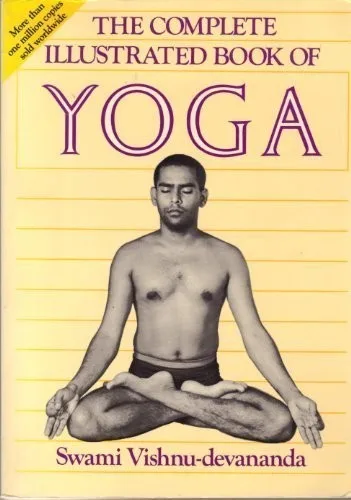
The complete illustrated book of yoga
 71
71

The complete illustrated book of yoga
Swami Vishnudevananda's 1960 manual remains a sturdy, if somewhat dated, primer on classical Hatha Yoga. Its strength lies in the sheer volume of detailed photographic illustrations accompanying each asana and pranayama technique; these visuals were remarkably comprehensive for a book of its time and still serve as a clear reference. The book doesn't shy away from the spiritual and philosophical dimensions, integrating the yamas and niyamas into its instruction, which elevates it beyond a mere exercise manual. However, the prose occasionally feels didactic, and some explanations of advanced concepts, particularly those related to subtle energies, might seem less nuanced when compared to contemporary scholarship or more specialized texts. The section on Raja Yoga, while present, is less developed than the Hatha Yoga components. Nevertheless, for its historical significance and the clarity of its foundational Hatha Yoga instruction, it holds its ground.
📝 Description
71
Swami Vishnudevananda's "The Complete Illustrated Book of Yoga" was first published in 1960.
Swami Vishnudevananda's "The Complete Illustrated Book of Yoga" serves as a comprehensive manual for understanding and practicing yoga. First published in 1960, this volume presents yoga as a holistic system for mind-body integration, not just physical exercise. It meticulously details asanas (postures), pranayama (breathing techniques), and meditation, all supported by clear photographic illustrations. The work also emphasizes the philosophical underpinnings of yoga, drawing from classical texts to explain its ethical and spiritual dimensions.
This book is suited for dedicated practitioners seeking a foundational text and for those interested in yoga's historical dissemination in the West. Its detailed instruction caters to individuals ready to commit to a rigorous personal practice. Students of comparative religion and spiritual traditions will find it valuable for understanding Swami Vishnudevananda's specific lineage and presentation style. Those curious about the impact of Indian spirituality on global culture in the mid-20th century will also find much to appreciate.
Released in 1960, "The Complete Illustrated Book of Yoga" emerged during a period of growing Western interest in Eastern philosophies. Yoga was being introduced through various channels, often filtered through Western interpretations. Swami Vishnudevananda, a disciple of Swami Sivananda, played a significant role in bringing a more direct, classical approach to North America. This book offered a systematic and accessible presentation for its era.
This book arrives from the Sivananda lineage of yoga, a tradition emphasizing the integration of yoga's spiritual and philosophical aspects alongside its physical practices. Swami Vishnudevananda, a direct disciple of Swami Sivananda, sought to present a complete system rooted in classical yogic texts. His approach aimed to convey yoga not as a mere physical discipline but as a path toward self-realization, drawing from Vedanta and other Indian philosophical schools. The book reflects a mid-20th century effort to transmit these teachings to a Western audience.
💡 Why Read This Book?
• Gain foundational Hatha Yoga techniques through clear, historically significant photographic illustrations, learning asanas and pranayama as presented by Swami Vishnudevananda in 1960. • Understand the ethical framework of yogic practice by studying the detailed explanations of the yamas and niyamas, which form the bedrock of yogic discipline. • Explore the philosophical integration of yoga by examining the four main paths—Karma, Bhakti, Raja, and Jnana Yoga—as outlined in the book's early chapters.
⭐ Reader Reviews
Honest opinions from readers who have explored this book.
❓ Frequently Asked Questions
When was The Complete Illustrated Book of Yoga first published?
The Complete Illustrated Book of Yoga by Swami Vishnudevananda was first published in 1960, marking a significant moment in the introduction of yoga to Western audiences.
What are the main topics covered in Swami Vishnudevananda's yoga book?
The book covers asanas (postures), pranayama (breathing exercises), meditation, and the philosophical underpinnings of yoga, including Karma, Bhakti, Raja, and Jnana Yoga paths.
Is this book suitable for absolute beginners in yoga?
Yes, its comprehensive illustrations and step-by-step instructions make it suitable for beginners, though its depth also serves intermediate practitioners.
What is the historical significance of this yoga book?
Published in 1960, it was instrumental in bringing a detailed and illustrated guide to classical yoga practices and philosophy to the West during a period of growing interest.
Does the book explain the ethical principles of yoga?
Indeed, it dedicates significant attention to the yamas (restraints) and niyamas (observances), presenting them as essential components of a holistic yogic lifestyle.
Are there advanced yoga techniques discussed?
While it provides a thorough grounding in foundational Hatha Yoga, it also touches upon aspects of Raja Yoga and pranayama, offering pathways for deeper exploration.
🔮 Key Themes & Symbolism
The Four Paths of Yoga
The work systematically introduces the four classical paths to spiritual realization: Karma Yoga (action), Bhakti Yoga (devotion), Raja Yoga (meditation), and Jnana Yoga (knowledge). It presents these not as separate disciplines but as complementary aspects of a unified yogic life, emphasizing that a balanced approach integrates all four. This framework provides practitioners with a structured understanding of yoga's multidimensional nature, moving beyond a singular focus on physical postures to encompass the mind, emotions, and intellect.
Asana and Pranayama Mastery
Central to the book are the detailed instructions and photographic illustrations of yoga asanas and pranayama techniques. The visual guide meticulously breaks down each posture, offering anatomical cues for alignment and safety, crucial for preventing injury. The pranayama section explains various breathing methods, highlighting their physiological and energetic effects. This emphasis on precise execution reflects a classical pedagogical approach, aiming to build a strong physical and energetic foundation for deeper yogic practices.
Yogic Ethics: Yamas and Niyamas
Vishnudevananda stresses that true yogic practice extends beyond the physical mat, deeply embedding the ethical precepts of the yamas (ethical restraints) and niyamas (observances) into the core of the teachings. These principles, such as ahimsa (non-violence), satya (truthfulness), and saucha (purity), are presented as indispensable for purifying the mind and fostering spiritual growth. Understanding and integrating these ethical guidelines is framed as essential for progress in all paths of yoga.
Subtle Anatomy and Energy
The book touches upon the yogic understanding of subtle anatomy, including the concepts of prana (life force), nadis (energy channels), and chakras (energy centers). It explains how pranayama and asana practice influence these subtle energetic systems, aiming to balance and awaken them. This esoteric dimension, while presented accessibly, hints at the deeper energetic transformations that yoga seeks to facilitate, connecting the physical practice to a more profound inner reality.
💬 Memorable Quotes
Direct passages from the work, attributed to the author.
“The goal of yoga is to bring about the union of the individual soul with the Universal Soul.”
— This statement expresses the ultimate aim of yoga as presented in classical traditions: not merely physical health or mental tranquility, but a profound spiritual realization of oneness with the divine or cosmic consciousness.
“The body is the temple of God.”
— This aphorism highlights the yogic perspective that the physical body is a sacred vessel, worthy of care and respect, and that its proper maintenance is conducive to spiritual development and self-realization.
“Control of the breath is control of the mind.”
— This concisely expresses the fundamental link between pranayama and mental discipline in Raja Yoga, suggesting that by regulating respiration, one can achieve greater focus, calm, and mastery over one's thoughts.
“Yoga is not a religion, but a way of life.”
— This clarifies that yoga, in its essence, is a practical system for living harmoniously and consciously, applicable to individuals regardless of their religious beliefs or background.
💡 Key Ideas
Editorial paraphrase of the work's core concepts — not direct quotes.
Practice and non-attachment lead to success in yoga.
Paraphrased concept from the Bhagavad Gita's teachings on yoga, emphasizing that consistent effort combined with detachment from the fruits of one's actions is key to achieving yogic goals.
🌙 Esoteric Significance
Tradition
This work fits within the lineage of classical Hatha and Raja Yoga, as transmitted through the Sivananda Vedanta tradition. While drawing heavily from Patanjali's Yoga Sutras and the Bhagavad Gita, its presentation is pragmatic and geared towards practical application, aligning with the modern Vedanta movement's aim to make yogic philosophy accessible globally. It departs from more strictly ascetic or purely philosophical interpretations by foregrounding detailed physical practice.
Symbolism
Key symbols include the lotus flower, representing spiritual enlightenment and purity, often seen in meditation postures. The 'Om' symbol (ॐ) signifies the primordial sound of the universe and the ultimate reality. Chakras, the energetic centers within the subtle body, are presented as vital points for energy cultivation and spiritual awakening, with each associated with specific qualities and transformation.
Modern Relevance
Contemporary yoga practitioners and teachers continue to reference Vishnudevananda's book for its foundational Hatha Yoga instruction and clear presentation of yogic philosophy. Its emphasis on the holistic nature of yoga—integrating physical, mental, and ethical dimensions—speaks to current trends in mindfulness and well-being. The Sivananda lineage itself remains active, influencing modern yoga studios and retreat centers worldwide.
👥 Who Should Read This Book
• Aspiring Hatha Yoga practitioners seeking a detailed, illustrated guide to postures and breathing techniques grounded in classical teachings. • Students of comparative religion and Eastern philosophies interested in understanding the historical introduction of yoga to the West in the mid-20th century. • Individuals exploring the ethical and philosophical dimensions of yoga, looking to integrate practices like the yamas and niyamas into daily life.
📜 Historical Context
The Complete Illustrated Book of Yoga emerged in 1960, an important year for the global dissemination of Indian spiritual traditions. Western engagement with yoga was escalating, moving beyond niche circles towards broader cultural adoption. Swami Vishnudevananda, a direct disciple of the influential Swami Sivananda, arrived in North America in 1957 and quickly established centers. His 1960 book offered a comprehensive, visually-driven approach that contrasted with more abstract or scholarly texts. At the time, figures like Paramahansa Yogananda were already well-known for popularizing Kriya Yoga, and Indra Devi was teaching Hollywood celebrities. Vishnudevananda's work distinguished itself by providing a systematic Hatha Yoga manual with extensive photographic guidance, making classical postures and breathing techniques more accessible than ever before to a Western audience grappling with post-war existentialism and seeking meaning.
📔 Journal Prompts
The integration of the yamas and niyamas within the practice of asanas.
The role of pranayama in achieving mental control, as described in the Raja Yoga sections.
Reflecting on the concept of 'union' as the ultimate goal of yoga.
How the visual instruction for specific asanas might be applied to personal practice.
The practical application of Karma Yoga principles in daily activities.
🗂️ Glossary
Asana
A physical posture or pose practiced in yoga, designed to promote strength, flexibility, and balance in the body.
Pranayama
The practice of breath control and regulation, considered a vital aspect of yoga for managing life force (prana) and influencing the mind.
Yamas
Ethical restraints or moral disciplines in yoga, forming the first limb of Ashtanga Yoga, including non-violence, truthfulness, and non-stealing.
Niyamas
Observances or positive duties in yoga, the second limb of Ashtanga Yoga, encompassing practices like purity, contentment, and self-study.
Chakras
Energy centers within the subtle body, typically described as located along the spine, believed to influence physical, emotional, and spiritual well-being.
Karma Yoga
The yoga of action, emphasizing selfless service and performing one's duties without attachment to the results, as a path to spiritual growth.
Raja Yoga
The 'royal path' of yoga, often associated with Patanjali's Yoga Sutras, focusing on meditation, concentration, and the control of the mind.
🔮 Readers Also Liked
Browse all →








More by Vishnudevananda Swami.
All books →

More Free Occult Philosophy Books
View all →