The Book of the Law
 77
77

The Book of the Law


Sophia Crane (Associate Editor) — 'The Book of the Law' is an undeniable cornerstone of modern Western esotericism, a text that demands engagement and contemplation. Liber AL vel Legis, attributed to the visionary Aleister Crowley, transcends mere religious doctrine, offering a potent philosophical framework for personal liberation and cosmic understanding. Its cryptic pronouncements, particularly the central tenet 'Do what thou wilt shall be the whole of the Law,' serve as a powerful catalyst for self-discovery and the exploration of one's deepest desires and capacities. This work is essential for anyone serious about the study of Thelema, ceremonial magic, or the evolution of consciousness. It is a challenging yet deeply rewarding read for the dedicated seeker.
📝 Description
77
Aleister Crowley published 'The Book of the Law' in 1909, claiming it was dictated by a supernatural intelligence.
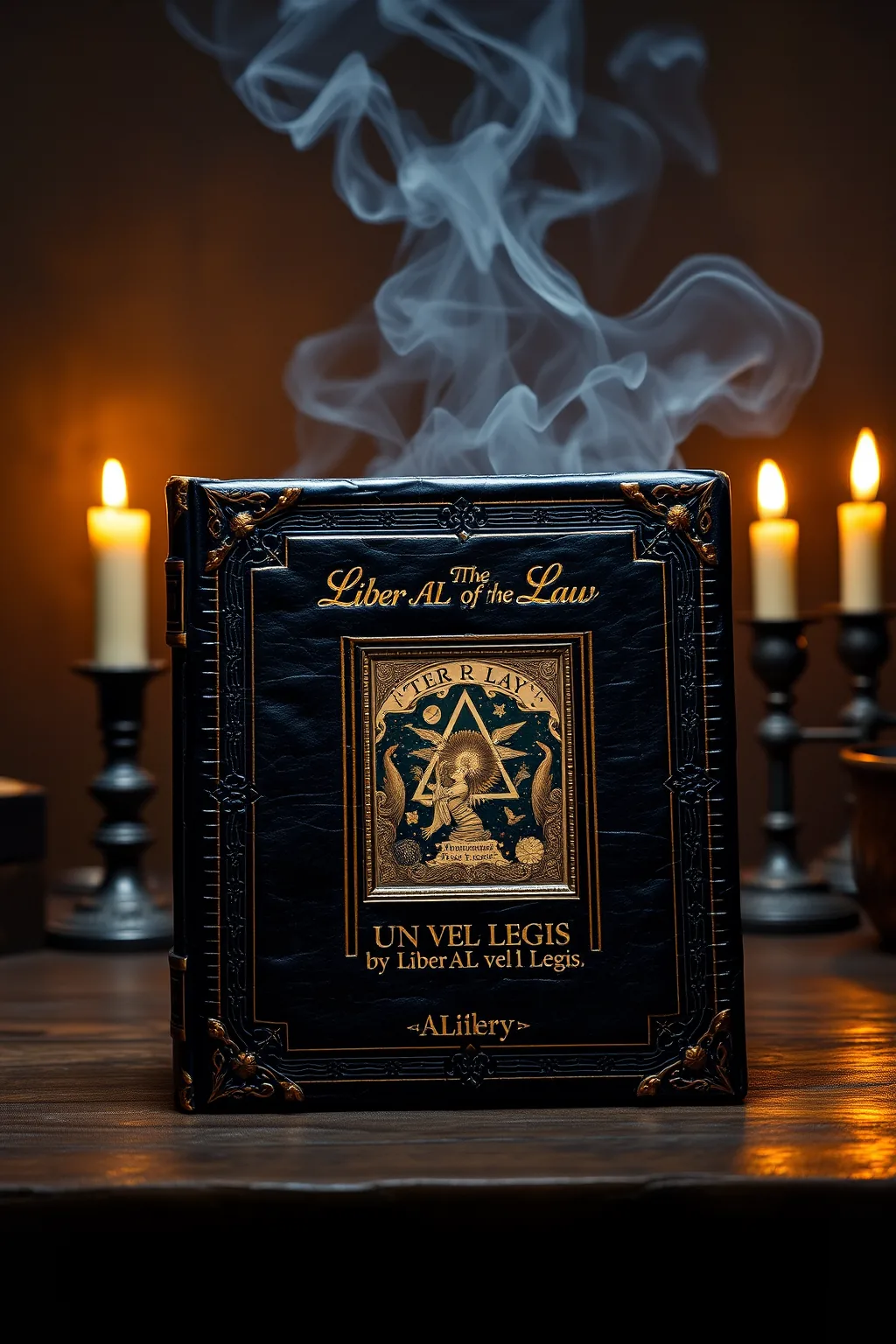
Liber AL vel Legis, commonly known as 'The Book of the Law,' presents itself as a divinely inspired text received by Aleister Crowley in Cairo in 1904. The book details pronouncements concerning the nature of existence, the importance of individual will, and the ushering in of a new spiritual era, the Aeon of Horus. It challenges established moral frameworks and advocates for the recognition of an inner divinity within each person.
This work is structured into three chapters, each attributed to a different spiritual messenger. The text's core message revolves around the concept of the 'True Will,' urging individuals to discover and enact their unique purpose. It speaks of a coming transformation, a shift in human consciousness and societal organization. The book's language is often symbolic and demands careful interpretation, making it a subject of ongoing study and debate within occult circles.
The Book of the Law emerged from the milieu of early 20th-century Western esotericism, drawing upon influences from Theosophy, Hermeticism, and ceremonial magic. It is central to the Ordo Templi Orientis (O.T.O.) and Crowley's personal magical system, Thelema. The text posits a new religious and philosophical framework intended to guide humanity through a period of significant change, distinct from earlier religious dispensations. Its reception and interpretation have shaped modern occult thought and practice.
💡 Why Read This Book?
Unravel the foundational text of Thelema and explore radical new perspectives on freedom, destiny, and the divine. 'The Book of the Law' is essential for practitioners of ceremonial magic, students of esoteric philosophy, and anyone seeking to understand the roots of 20th-century occultism and its enduring influence. It challenges readers to embrace their authentic selves and forge their own spiritual path.
⭐ Reader Reviews
Honest opinions from readers who have explored this book.
❓ Frequently Asked Questions
What is the primary message of 'The Book of the Law'?
The primary message is 'Do what thou wilt shall be the whole of the Law,' advocating for the pursuit of one's True Will as the ultimate spiritual and ethical directive, signifying a new era of individual liberty and cosmic alignment.
Who is Aiwass?
Aiwass is presented as the author's Holy Guardian Angel and the divine messenger who dictated 'The Book of the Law' to Aleister Crowley in 1904, representing a higher consciousness or divine intelligence.
Is 'The Book of the Law' a religious text?
While it contains spiritual and philosophical pronouncements, it is often considered a sacred text within the religion of Thelema. Its interpretation is highly personal and often debated within esoteric circles.
What is the Aeon of Horus?
The Aeon of Horus, as described in the book, is a new cosmic era characterized by child-like wonder, active assertion, and the realization of individual divinity, succeeding the Aeon of Osiris.
How should one approach reading 'The Book of the Law'?
Approach 'The Book of the Law' with an open mind, a willingness to question, and a commitment to introspection. It is best studied alongside scholarly interpretations and within a context of personal spiritual practice.
🔮 Key Themes & Symbolism
The True Will
The central tenet of 'The Book of the Law' revolves around the concept of 'True Will' – an individual's unique, inherent purpose and destiny. This is not mere desire or whim, but a profound alignment with one's deepest nature and cosmic function. The text urges readers to discover and execute this True Will, viewing it as the highest form of liberation and spiritual fulfillment. It implies a universe where individual sovereignty is paramount, and one's path is divinely ordained if truly understood and embraced. This theme challenges conventional notions of morality and external authority, placing the locus of truth within the individual.
The New Aeon
The book heralds the dawn of a new cosmic era, the Aeon of Horus, succeeding the Age of Osiris. This transition signifies a fundamental shift in human consciousness and spiritual understanding. The Aeon of Horus is characterized by the divine child, embodying active assertion, instinctual wisdom, and the recognition of the divine spark within every individual. It represents a move from passive subservience and patriarchal structures to empowered self-realization and the embrace of life's primal forces. This theme suggests a cosmic evolution, a recalibration of the universal energies that influence humanity.
Divine Incarnation and Sovereignty
A recurring theme is the inherent divinity within each person. 'The Book of the Law' asserts that every individual is a manifestation of the divine, a unique expression of the universe's creative power. This leads to a profound emphasis on personal sovereignty and the rejection of external dogma that seeks to suppress this inner divinity. The text encourages individuals to embrace their godhood, to recognize their own authority, and to act in accordance with their highest nature. This redefinition of the divine, placing it within humanity rather than solely in an external entity, is a radical departure from many traditional spiritual systems.
💬 Memorable Quotes
Direct passages from the work, attributed to the author.
“Nuit, she is the infinite space, and the infinite stars therein.”
— Nuit represents the boundless expanse of the cosmos, the divine feminine principle of potentiality and the receptive canvas upon which all existence unfolds.
“Every man and every woman is a star.”
— This powerful statement underscores the divine nature and unique individuality of every human being, asserting their inherent worth and cosmic significance.
“Do what thou wilt shall be the whole of the Law.”
— The central and most famous axiom, advocating for the pursuit of one's True Will as the ultimate guiding principle for life and spiritual development.
“Love is the law, love under will.”
— This expands on the primary law, emphasizing that true love is not merely an emotion but an active force, guided and informed by one's authentic purpose and True Will.
💡 Key Ideas
Editorial paraphrase of the work's core concepts — not direct quotes.
Hadit says: I am the flame that burns in every heart of man, and in the marrow of every star.
This quote illustrates Hadit's omnipresence and the divine spark residing within all beings and cosmic structures, connecting the microcosm and macrocosm.
🌙 Esoteric Significance
Tradition
The Book of the Law is the foundational text of Thelema, a philosophical and religious system founded by Aleister Crowley. It draws heavily on Gnosticism, Hermeticism, Kabbalah, and ancient Egyptian religious concepts, synthesizing them into a unique framework that emphasizes individual sovereignty, the pursuit of True Will, and the dawning of a new cosmic era. It is a key document in the lineage of Western esoteric traditions, offering a potent alternative to established religious and spiritual doctrines.
Symbolism
The book is rich with potent symbolism, primarily personified by the triad of Nuit, Hadit, and Ra-Hoor-Khuit. Nuit represents the infinite starry heavens, the divine feminine, and boundless space. Hadit embodies the point of consciousness, the divine spark, and the active, masculine principle. Ra-Hoor-Khuit, the winged child, symbolizes the new Aeon, active assertion, and the union of these divine forces. The text also employs Egyptian deities and numerological significance, combining a complex set of occult meaning accessible to the dedicated student.
Modern Relevance
In an age often characterized by external validation and societal pressures, 'The Book of the Law' offers a powerful call to introspection and self-determination. Its emphasis on discovering and enacting one's True Will speaks to contemporary desires for authenticity and purpose. Thelemic principles continue to inspire individuals seeking a spiritual path that champions personal liberty, intellectual rigor, and a holistic integration of life's experiences. Its exploration of consciousness, sexuality, and the divine within humanity remains profoundly relevant for modern spiritual seekers and philosophers.
👥 Who Should Read This Book
This key work is essential for serious students of Western esotericism, occultism, and the history of religions. Beginners in the occult may find it challenging but rewarding when approached with guidance and a spirit of inquiry. Scholars of comparative religion and philosophy will find its unique worldview a subject of intense study. Seekers of alternative spiritual paths will discover a potent philosophy of radical self-empowerment. Practitioners of ceremonial magic and those interested in Thelemic practices will find it an indispensable source text for understanding their core tenets and rituals.
📜 Historical Context
Penned in Cairo, Egypt, in April 1904, 'The Book of the Law' emerged during a vibrant period of occult revival and burgeoning interest in ancient Egyptian mysticism. Aleister Crowley, a figure who would become synonymous with Western esotericism, received the text through what he described as automatic dictation from a preternatural intelligence named Aiwass. This period saw a confluence of spiritual seeking, archaeological discoveries that fueled fascination with ancient civilizations, and the development of new philosophical and psychological theories. The book's radical pronouncements on individual will, sexuality, and a departure from traditional morality directly challenged the Victorian and Edwardian sensibilities of the time, positioning Crowley and his emergent philosophy of Thelema as a potent counter-cultural force. Its influence would extend through the 20th century and beyond, shaping various occult orders and spiritual movements.
📔 Journal Prompts
Meditate on the concept of 'True Will.' How does it differ from personal desires or societal expectations? What steps can you take to uncover your True Will?
Reflect on the symbolism of Nuit and Hadit. How do these archetypes manifest in your own life and in the world around you?
The book states, 'Every man and every woman is a star.' What does this statement mean to you personally? How can you embody your unique stellar nature?
Consider the phrase 'Love is the law, love under will.' How can you integrate this principle into your relationships and actions?
How does the idea of a 'new Aeon' challenge your current understanding of time, progress, and spiritual evolution?
🗂️ Glossary
Thelema
A philosophical and religious system founded by Aleister Crowley, centered on the principle 'Do what thou wilt shall be the whole of the Law,' emphasizing individual sovereignty and the pursuit of one's True Will.
True Will
An individual's unique, inherent purpose, destiny, and deepest nature, which must be discovered and enacted for spiritual fulfillment and liberation.
Aeon of Horus
A new cosmic era characterized by active assertion, individual divinity, and the realization of one's innate power, succeeding the Age of Osiris.
Nuit
The infinite starry heavens, the divine feminine principle of boundless space, potentiality, and the receptive aspect of the divine.
Hadit
The point of consciousness, the divine spark, the active, masculine principle that resides within every being and cosmic entity.
This book appears in 2 collections
🔮 Readers Also Liked
Browse all →









From the “Secret Societies” Collection
View all →




More Free Freemasonry & Secret Societies Books
View all →