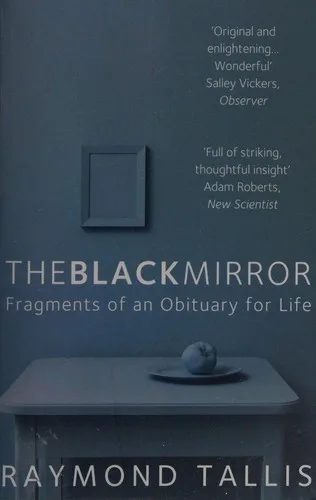
The black mirror
 63
63

The black mirror



Aurelia Blackwood, Occult Philosophy Critic: Raymond Tallis's 'The Black Mirror' is a masterclass in existential inquiry, drawing potent parallels to ancient wisdom traditions that confront mortality to illuminate life. Tallis masterfully employs the 'death perspective' not as a morbid fixation, but as an alchemical tool, transmuting everyday experience into profound esoteric insight. His examination of senses, space, and selfhood echoes Gnostic pursuits of true knowledge and Stoic meditations on impermanence. This work is essential for seekers who wish to transcend superficial existence and engage with the deeper currents of consciousness. Its strength lies in its intellectual rigor married with poetic grace, making it a cornerstone for understanding the human psyche through the veil of the inevitable.
📝 Description
63
Raymond Tallis's 2017 book, 'The Black Mirror,' confronts mortality by viewing the self as future corpse.
In 'The Black Mirror,' Raymond Tallis considers E.M. Forster's idea that death, while destructive, can be salvific. Tallis asks readers to adopt an external viewpoint, seeing themselves as a future corpse. This perspective, he argues, provides a stark but clear way to understand human existence. He examines how our senses connect us to the world and the fundamental forces they reveal. The book also discusses the complex ways distance, division, and closeness shape our relationships and our sense of space.
This work is more than a personal reflection; it is a philosophical inquiry into consciousness. Tallis urges readers to distinguish between what is truly important and what is temporary. 'The Black Mirror' addresses individuals seeking deeper understanding, students of human nature, and those interested in mindful awareness. It aims to shift one's outlook by contemplating the ultimate unknown, showing how the prospect of oblivion can reveal important truths about ourselves.
While not strictly esoteric in the occult sense, 'The Black Mirror' engages with traditions that contemplate existence and the self from non-ordinary perspectives. It draws parallels to contemplative practices that use visualizations of death to foster detachment from worldly concerns and to enhance appreciation for life. Similar to Stoic meditations on mortality or Buddhist reflections on impermanence, Tallis employs a stark intellectual exercise to reframe the reader's relationship with existence and the present moment. The book approaches these themes through philosophical reasoning rather than mystical revelation.
💡 Why Read This Book?
Uncover the hidden architecture of your life by confronting your own mortality. 'The Black Mirror' offers a unique perspective for seekers and scholars of consciousness, revealing the profound wisdom found in contemplating death. It’s ideal for those who yearn for deeper meaning, spiritual clarity, and a philosophical framework to understand their place in the cosmos. Practitioners of mindfulness and existential philosophy will find a powerful ally in Tallis's incisive prose.
⭐ Reader Reviews
Honest opinions from readers who have explored this book.
❓ Frequently Asked Questions
What is the central metaphor of 'The Black Mirror'?
The central metaphor is the 'black mirror' itself, representing the perspective of one's own future corpse. This external viewpoint allows for a clearer, more profound understanding of life's significance and ephemeral nature.
How does the book relate to E.M. Forster's ideas?
The book is directly inspired by E.M. Forster's quote, 'Death destroys a man but the idea of it saves him.' Tallis explores how contemplating death can lead to a more authentic and meaningful existence.
What kind of reader would most benefit from this book?
Readers interested in philosophy, existentialism, consciousness studies, and those seeking a deeper understanding of life and mortality will find immense value. It appeals to thinkers and those on a personal quest for meaning.
Does the book offer practical exercises for self-reflection?
While not a self-help guide with explicit exercises, the book inherently encourages deep introspection through its philosophical arguments and evocative descriptions, prompting readers to reflect on their own lives.
What is the tone of 'The Black Mirror'?
The tone is reflective, philosophical, and profoundly humanistic, yet imbued with a sense of wonder and stark honesty. It is both intellectual and deeply personal, offering a unique blend of gravitas and insight.
🔮 Key Themes & Symbolism
Mortality as Illumination
The core theme revolves around the transformative power of contemplating death. By adopting the perspective of one's future self, the author argues, the transient nature of existence becomes a beacon, highlighting what truly matters. This perspective strips away the mundane, revealing the essential beauty and urgency of lived experience. It’s an alchemical process where the shadow of oblivion casts a profound light on the present moment, urging a more authentic and engaged engagement with life’s fleeting wonders.
The Phenomenology of the Self
Tallis examines the intricate workings of the human senses and their role in constructing our reality. He examines how sensory input shapes our perception of space, distance, and intimacy, revealing the subjective field of consciousness. This exploration goes beyond mere biological function, looking at the philosophical implications of embodiment and the complex ways in which we experience and define ourselves within the world, particularly as we age and our sensory world shifts.
Existential Significance of Everyday Life
The book elevates ordinary activities, possessions, and utterances to profound existential significance when viewed through the 'black mirror' of death. What appears mundane in the rush of daily life gains a profound weight and meaning when considered from the ultimate perspective. Tallis encourages a radical re-evaluation of our priorities, possessions, and relationships, urging us to recognize the inherent value and meaning embedded within the fabric of our everyday human experience.
💬 Memorable Quotes
Direct passages from the work, attributed to the author.
“Death destroys a man but the idea of it saves him.”
— This foundational quote suggests that while physical death is final, the *contemplation* of it can be a powerful force for living a more meaningful and authentic life.
“I look back on my world from the standpoint of my future corpse.”
— This vividly illustrates the central premise: adopting an external, ultimate perspective to gain clarity and re-evaluate the significance of one's life experiences and surroundings.
“The senses that opened up my late world.”
— This poignant phrase highlights how aging can lead to a renewed or altered appreciation of sensory input, revealing less-obvious layers and nuances previously overlooked.
“The elements they reveal, the distances, divisions and intimacies of space.”
— This speaks to the profound way our perception of the physical and social world is shaped by our sensory experience and our understanding of connection and separation.
“The multifarious activities that occupied my days.”
— This reflects on the breadth of human endeavor, implying that even the most diverse daily pursuits gain a singular focus when viewed through the lens of finite existence.
🌙 Esoteric Significance
Tradition
While not overtly tied to a single esoteric tradition, 'The Black Mirror' aligns with contemplative practices found in Stoicism, Buddhism, and certain branches of Gnosticism. The act of meditating on impermanence and adopting an objective, detached viewpoint mirrors Buddhist 'vipassanā' meditation and Stoic 'praemeditatio malorum' (premeditation of evils). The exploration of subjective reality and the search for deeper truth also echoes Gnostic quests for hidden knowledge.
Symbolism
The 'black mirror' itself is a potent symbol, representing not just death, but also the void, the unknown, and the ultimate truth that lies beyond subjective perception. It symbolizes a tool for self-reflection, akin to a scrying mirror, used to reveal hidden aspects of the self and the nature of existence. The emphasis on senses and space can be seen as symbolic of the 'vehicles' through which the soul experiences its earthly incarnation.
Modern Relevance
In an age often characterized by distraction and superficiality, 'The Black Mirror' offers a vital counterpoint. Its relevance lies in its ability to guide readers toward genuine existential awareness, encouraging a more authentic and meaningful engagement with life. It provides a philosophical framework for reading through the anxieties of modern existence and finding solace and purpose by confronting our shared human condition of mortality.
👥 Who Should Read This Book
This profound work is a treasure for the introspective seeker, the dedicated scholar of philosophy and consciousness, and the practitioner yearning for deeper existential alignment. Beginners to philosophical inquiry will find Tallis's prose accessible yet deeply engaging, offering a gentle yet powerful introduction to existential themes. Scholars will appreciate the intellectual rigor and nuanced arguments. Practitioners of mindfulness, meditation, and existential therapy will discover a rich resource for deepening their understanding and practice. Ultimately, anyone who has ever pondered the meaning of life and the inevitability of death will find 'The Black Mirror' to be an informative and transformative read.
📜 Historical Context
Published in the early 21st century, 'The Black Mirror' emerges from a cultural landscape grappling with increasing secularization, advanced medical technologies that prolong life, and a persistent societal discomfort with mortality. Raymond Tallis, a philosopher and physician, brings a unique dual perspective to this conversation. His work speaks to a tradition of existentialist thought that gained prominence in the mid-20th century, particularly the writings of Jean-Paul Sartre and Albert Camus, which emphasized individual freedom, responsibility, and the confrontation with absurdity. However, Tallis injects a distinctly humanist and reflective tone, seeking not despair but useful insights and meaning derived from our finitude. The book also taps into a perennial philosophical and spiritual inquiry into the nature of consciousness and the self, a theme explored across centuries by mystics, philosophers, and theologians worldwide.
📔 Journal Prompts
Reflect on a moment when your perspective on life shifted dramatically. How did this shift alter your perception of time and value?
Imagine yourself as your 'future corpse.' What specific sensory experiences from your current life would you recall with the most vivid clarity and significance?
Consider an object or possession you hold dear. From the perspective of your future self, what true value does it hold, or what does it symbolize?
How do the 'distances, divisions, and intimacies of space' in your life reflect your internal state and your relationships with others?
If you could distill the essence of your life's activities into a single, profound utterance from your future perspective, what would it be?
🗂️ Glossary
Existentialism
A philosophical movement emphasizing individual existence, freedom, and choice. It posits that humans define their own meaning in life through their actions and decisions, often in the face of a seemingly meaningless universe.
Phenomenology
The philosophical study of the structures of experience and consciousness as experienced from the first-person point of view. It seeks to understand the essence of phenomena.
Mortality
The state of being subject to death; the condition of being mortal. In philosophy and theology, it refers to the human condition of having a finite lifespan.
Vantage Point
A position or place offering a good view; a mental or conceptual position from which something is considered or assessed.
Alchemical Process
In a metaphorical sense, a process of transformation and purification, often involving the conversion of something common or base into something precious or refined, akin to transmuting lead into gold.
This book appears in 4 collections
🔮 Readers Also Liked
Browse all →









From the “Augury” Collection
View all →









More Free Divination & Tarot Books
View all →