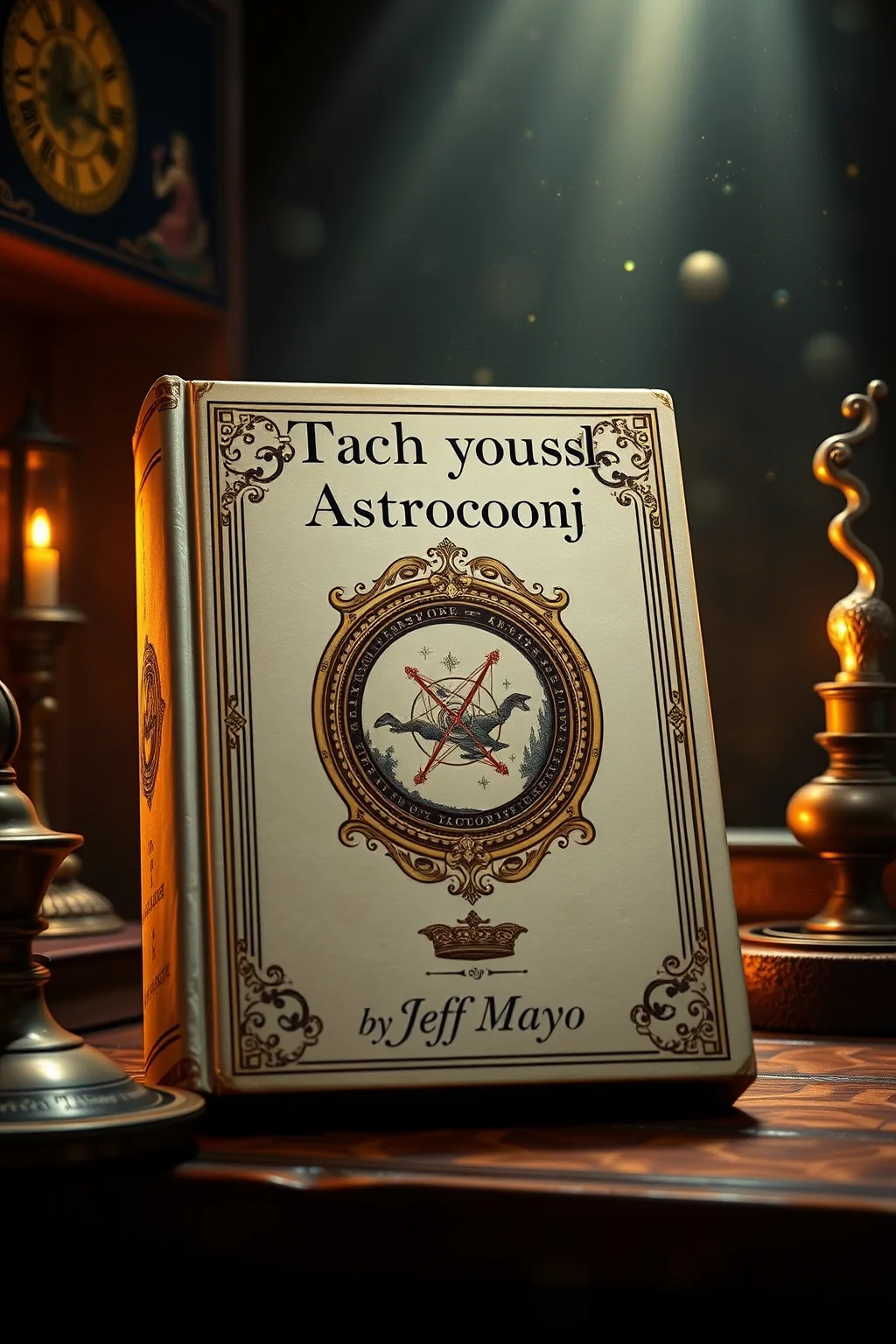
Teach Yourself Astrology
 76
76

Teach Yourself Astrology
Mayo and Ramsdale’s Teach Yourself Astrology presents a refreshingly straightforward entry into a field often shrouded in mystique. Its strength lies in its methodical progression, taking the reader from the basic building blocks of planets and signs to the more complex architecture of a natal chart. The authors’ commitment to clarity is evident, particularly in their early chapters explaining the twelve houses, which are often a stumbling block for newcomers. However, the book’s 1996 publication date means some of its illustrative examples and cultural references feel slightly dated. While it covers the core mechanics competently, it offers less on the nuanced psychological depth that contemporary astrology frequently explores. The section on interpreting composite charts, while present, could benefit from more detailed case studies. Despite this, the book provides a solid, dependable foundation for anyone beginning their astrological studies.
📝 Description
76
Jeff Mayo and Christine Ramsdale's Teach Yourself Astrology was first published in 1996.
Teach Yourself Astrology, by Jeff Mayo and Christine Ramsdale, offers a clear introduction to Western astrological principles. The book explains core components like zodiac signs, planets, houses, and aspects. It guides readers in interpreting birth charts with a focus on practical application. The authors present astrological ideas in an accessible way, avoiding complex jargon. This makes it a good starting point for anyone new to the subject.
This book is useful for those curious about astrology's predictive or psychological dimensions. It suits beginners with no prior knowledge but a strong interest in learning. Readers wanting to understand their own natal charts or those of others will appreciate the interpretive steps. It also serves students of esotericism looking for a structured entry into this divinatory art. The text aims to demystify astrology while retaining its fundamental concepts.
Published in the mid-1990s, Teach Yourself Astrology appeared during a time of growing interest in esoteric subjects. It continues a long tradition of astrological teaching that stretches back to antiquity. Figures like Ptolemy established early frameworks, and later thinkers such as Dane Rudhyar explored psychological dimensions. Mayo and Ramsdale sought to make astrology understandable for a wider audience. Their method aimed to simplify the subject without losing its essential meaning, setting it apart from more specialized astrological works.
💡 Why Read This Book?
• Gain a clear, step-by-step understanding of natal chart interpretation, moving from the individual components like zodiac signs and planets to their combined meaning, as detailed in the early chapters on astrological elements. • Learn the fundamental meanings of the twelve houses, which represent distinct areas of life, enabling you to analyze where planetary energies are most likely to manifest in a birth chart. • Understand the significance of planetary aspects, the angular relationships between celestial bodies, and how these create dynamic interactions within an astrological chart, as explained in dedicated sections.
⭐ Reader Reviews
Honest opinions from readers who have explored this book.
❓ Frequently Asked Questions
When was Teach Yourself Astrology first published?
Teach Yourself Astrology was first published in 1996, authored by Jeff Mayo and Christine Ramsdale, offering a comprehensive introduction to astrological principles.
What are the basic components of a birth chart explained in this book?
The book explains the twelve zodiac signs, the ten planets, the twelve houses, and the aspects, which are the geometric relationships between planets.
Is this book suitable for someone with no prior astrological knowledge?
Yes, Teach Yourself Astrology is specifically designed as an introduction for beginners, presenting astrological concepts in an accessible and structured manner.
Does the book offer practical guidance on chart interpretation?
Absolutely. It provides advice and methodologies for interpreting birth charts, guiding readers on how to synthesize the various astrological components into a coherent analysis.
What historical astrological figures or concepts are referenced or built upon?
While not explicitly detailing ancient figures, the book builds upon foundational Western astrological concepts that have roots tracing back to Hellenistic astrology and later developments.
What is the author's approach to astrological theory?
Jeff Mayo and Christine Ramsdale present astrological theory in a clear, methodical way, focusing on the fundamental significations of celestial bodies and their placement in the chart.
🔮 Key Themes & Symbolism
Natal Chart Synthesis
The core of this work lies in teaching readers how to synthesize the diverse elements of a natal chart. It moves beyond simply defining the zodiac signs, planets, and houses individually, to demonstrating how these factors interact. The book emphasizes that a birth chart is a dynamic map, not a static collection of symbols. Readers learn to see the interplay between a planet in a specific sign and house, and how aspects between planets modify these significations, providing a holistic view of an individual's potential and character.
Astrological Archetypes
Teach Yourself Astrology meticulously details the archetypal energies associated with the twelve zodiac signs and the planets. It presents these not merely as abstract concepts but as fundamental forces that shape personality and experience. Understanding these archetypes—such as the courageous archetype of Aries, the nurturing archetype of Cancer, or the communicative archetype of Mercury—is presented as crucial for interpreting their manifestation in a birth chart and in daily life.
The Houses as Life Arenas
A significant portion of the book is dedicated to explaining the twelve astrological houses. These divisions of the birth chart represent different domains of life, from personal identity (1st House) and finances (2nd House) to communication (3rd House) and home (4th House). The authors guide readers on how to identify which houses are emphasized by planetary placements and how this indicates areas where an individual's astrological energies are most likely to be expressed or encountered.
Planetary Aspects and Dynamics
The book explains the concept of planetary aspects, which are the angular relationships between planets in a birth chart. It covers major aspects like conjunctions, oppositions, squares, trines, and sextiles, detailing how each aspect signifies a particular type of dynamic or tension between the planets involved. This understanding is vital for grasping the inner workings and potential challenges or harmonies within an individual's psyche and life experiences.
💬 Memorable Quotes
Direct passages from the work, attributed to the author.
“The zodiac is a belt of 360 degrees, divided into twelve equal parts, each containing 30 degrees.”
— This defines the fundamental structure of the zodiac, establishing the 360-degree circle and its division into twelve signs, which is the primary framework for astrological interpretation.
“Each planet has a specific meaning and influence.”
— This highlights the core astrological principle that celestial bodies are not just astronomical objects but carry distinct symbolic significations that impact human affairs and personality.
“The houses represent different areas of life.”
— This concisely explains the function of the houses in astrology, framing them as distinct spheres of experience or activity within an individual's life chart.
“Aspects are the angles planets make to each other.”
— This provides a clear, technical definition of aspects, emphasizing their role in creating relationships and dynamics between different planetary energies within a birth chart.
“Interpreting a birth chart involves considering all its components together.”
— This underscores the holistic nature of astrological analysis, stressing that a comprehensive interpretation requires synthesizing the influences of signs, planets, houses, and aspects rather than analyzing them in isolation.
🌙 Esoteric Significance
Tradition
This work aligns with the Western Esoteric tradition, specifically within the branch of Hellenistic and Renaissance astrology that forms the basis of modern psychological and predictive astrology. It draws upon the established system of planets, signs, and houses that have been central to astrological practice for millennia. While it simplifies complex concepts for accessibility, it faithfully represents the core tenets of this lineage, serving as a gateway for individuals interested in exploring further into Hermetic or Kabbalistic influences on astrology.
Symbolism
The book prominently features the symbolism of the twelve zodiac signs as archetypal energies and the planets as personified forces. For instance, Mars is presented not just as a celestial body but as a symbol of action, assertion, and conflict. The houses are symbolic divisions representing the various arenas of life experience, from the self (1st House) to the collective (10th House). The geometric patterns formed by planetary aspects are also symbolic, representing the dynamic interplay and potential harmonies or dissonances within a life's unfolding.
Modern Relevance
Contemporary astrologers, particularly those focusing on practical chart interpretation and vocational astrology, continue to reference Teach Yourself Astrology as a foundational text. Its clear explanations are valuable for current students, especially in online courses and beginner groups. While modern psychological astrology has evolved, the core principles of sign, planet, and house interpretation, as laid out by Mayo and Ramsdale, remain relevant. The book's accessible approach makes it a common recommendation for those seeking to understand basic natal chart analysis without being overwhelmed by advanced theory.
👥 Who Should Read This Book
• Aspiring astrologers seeking a structured, foundational understanding of birth chart components. • Individuals curious about self-discovery and personal growth through astrological symbolism and archetypes. • Students of esoteric studies looking for a clear introduction to a key divinatory art within the Western tradition.
📜 Historical Context
Teach Yourself Astrology, released in 1996, emerged during a period when astrology was experiencing a significant resurgence in public interest, often associated with the broader New Age movement. This era saw a proliferation of self-help and esoteric texts, making astrology accessible to a wider audience beyond dedicated practitioners. The book follows in the lineage of pedagogical astrological works that sought to systematize and teach the art, a tradition stretching back to antiquity with figures like Ptolemy and continuing through authors like Alan Leo in the early 20th century. Unlike more academically-inclined or psychologically-focused approaches that gained traction with figures like Dane Rudhyar, Mayo and Ramsdale’s work aimed for a broad, practical introduction. It contributed to the ongoing debate about astrology’s validity, standing as a clear, instructional manual in contrast to more philosophical or esoteric explorations. Its publication predates the widespread digital tools that now assist chart calculation, emphasizing manual understanding.
📔 Journal Prompts
The Sun sign as the core identity: how does your Sun sign's archetype manifest in your daily actions?
Reflect on the ruling planet of your Ascendant: what does its sign and house placement reveal about your approach to new beginnings?
Analyze the distribution of planets across the four quadrants of your chart: what does this suggest about your life focus?
Consider the Moon's placement: how do the needs and emotional patterns associated with your Moon sign and house play out?
The meaning of Mercury in your chart: how does your communication style, as indicated by Mercury's sign and house, influence your relationships?
🗂️ Glossary
Zodiac Signs
The twelve divisions of the ecliptic, each 30 degrees in arc, named Aries, Taurus, Gemini, Cancer, Leo, Virgo, Libra, Scorpio, Sagittarius, Capricorn, Aquarius, and Pisces. Each sign is associated with specific archetypal energies and characteristics.
Planets
In astrology, the Sun, Moon, Mercury, Venus, Mars, Jupiter, Saturn, Uranus, Neptune, and Pluto are considered planets. Each represents a distinct psychological function or life force within the birth chart.
Houses
The twelve divisions of the celestial sphere, based on the local horizon and meridian at the time of birth. Each house corresponds to a different area of life experience.
Aspects
The angular relationships between planets in a birth chart, such as conjunctions, oppositions, squares, trines, and sextiles. Aspects indicate how different planetary energies interact.
Natal Chart
A snapshot of the celestial bodies' positions at the precise moment and location of a person's birth. It is used as a map to understand an individual's personality, potential, and life path.
Ascendant (Rising Sign)
The zodiac sign that was rising on the eastern horizon at the moment of birth. It is often considered a key indicator of personality, outward appearance, and approach to life.
Midheaven (MC)
The highest point in the birth chart, representing career, public image, and life direction. It is the cusp of the 10th house.