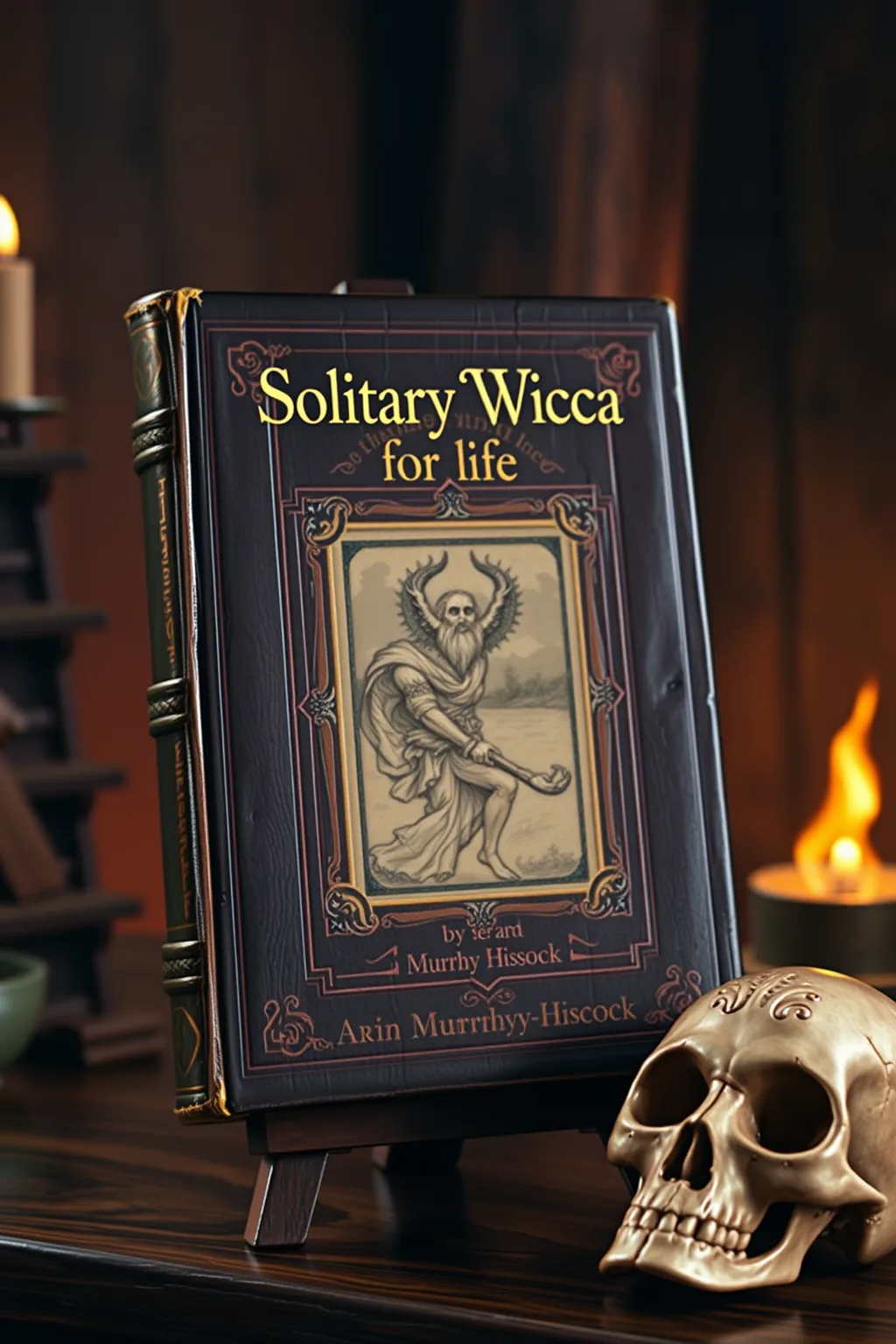
Solitary Wicca for life
 80
80

Solitary Wicca for life
Arin Murphy-Hiscock’s Solitary Wicca for Life, first appearing in 2005, provides a much-needed framework for the independent Wiccan practitioner. Unlike many texts that assume coven membership, this work acknowledges and supports the path of the solitary witch. Its strength lies in its practical, step-by-step approach to ritual creation and personal spiritual development. For instance, the detailed guidance on observing the Sabbats, such as the autumn equinox Mabon, offers concrete steps adaptable to a solo observance. However, the book occasionally leans towards a generalized approach; some readers might desire deeper dives into specific magical theory or historical Wiccan lineages beyond the solitary focus. Despite this, the work remains an essential resource for anyone seeking to build a robust, personal Wiccan practice. It’s a valuable manual for the self-guided spiritual seeker.
📝 Description
80
Arin Murphy-Hiscock's 2005 book provides a guide for practicing Wicca independently.
Solitary Wicca for Life addresses individuals who wish to follow Wiccan practices without belonging to a coven. The book details how a solo practitioner can build and sustain a meaningful spiritual life. It covers basic Wiccan tenets, how to create personal rituals, and how to weave Wiccan beliefs into everyday living. This guide is for those drawn to Wicca but who prefer or require a self-directed path. Readers will find practical advice for developing their own ceremonies, understanding seasonal cycles from an individual viewpoint, and achieving spiritual satisfaction apart from group settings. The author emphasizes personal commitment and the creation of an internal sacred space for connection.
Published in 2005, this work speaks to a growing interest in individualized spirituality within Paganism. While earlier Wiccan traditions, like those influenced by Gerald Gardner, often centered on coven structures, this book acknowledges practitioners who prioritize a direct connection to the divine and nature over group affiliation. It reflects a broader trend of personal spiritual seeking outside established religious frameworks.
💡 Why Read This Book?
• Learn to construct personal Wiccan rituals that align with your individual spiritual needs, drawing on guidance for observing the eight Sabbats of the Wheel of the Year. • Discover methods for self-dedication, a key concept for solitary practitioners, allowing for a formal commitment to your path without requiring a coven. • Gain practical advice on creating sacred space within your own environment, empowering you to connect with the divine and the natural world on your own terms.
⭐ Reader Reviews
Honest opinions from readers who have explored this book.
❓ Frequently Asked Questions
What is the primary focus of Solitary Wicca for Life?
The primary focus is on providing guidance and practical tools for individuals who wish to practice Wicca on their own, without belonging to a coven. It emphasizes self-dedication and personal spiritual development.
When was Solitary Wicca for Life first published?
The book was first published in 2005 by Arin Murphy-Hiscock, addressing the growing need for resources supporting solitary practitioners within the Wiccan tradition.
Does the book discuss specific Wiccan deities?
Yes, the book discusses the concept of deities within Wicca, often referencing the Horned God and the Triple Goddess, and explains how solitary practitioners can form their own relationships with divine figures.
What does 'Wheel of the Year' mean in this context?
The Wheel of the Year refers to the annual cycle of eight Wiccan festivals (Sabbats) that celebrate the changing seasons. The book explains how solitary practitioners can observe these important dates.
Is this book suitable for complete beginners to Wicca?
Absolutely. Solitary Wicca for Life is designed to be accessible to beginners, offering foundational knowledge and practical steps to start a solitary Wiccan path.
Are there any exercises or prompts in the book?
Yes, the book includes various exercises and journal prompts designed to help readers explore their personal beliefs, develop their intuition, and deepen their connection to their practice.
🔮 Key Themes & Symbolism
Personal Spiritual Authority
A central theme is the empowerment of the individual to be their own spiritual authority. Murphy-Hiscock guides readers in developing personal dogma and practice, moving away from reliance on group consensus or established coven structures. This concept is vital for the solitary practitioner who must forge their own connection to the divine and the natural world, finding validation within their own journey rather than external validation.
Ritual Crafting for One
The book provides extensive instruction on how to design and perform Wiccan rituals suitable for a single person. It breaks down the components of ritual—intent, space, tools, invocation, and closing—explaining how each can be adapted for solitary observance. This empowers practitioners to create meaningful ceremonies that align with their personal beliefs and life circumstances, rather than following pre-written group scripts.
The Inner Temple
Murphy-Hiscock emphasizes the creation of an 'inner temple'—a sacred space cultivated within the mind and spirit. This concept highlights that true sacredness resides within the practitioner, accessible through meditation, visualization, and focused intent. It serves as a portable sanctuary, allowing for spiritual connection and practice regardless of external location or circumstances.
Observing the Wheel of the Year Solo
This theme addresses the practicalities of observing the eight major Wiccan festivals (Sabbats) and their associated themes from a solitary perspective. The book offers suggestions for personal reflection, simple rituals, and symbolic actions that honor the seasonal shifts and the cycles of nature, ensuring that solo practitioners can fully engage with the Wiccan year.
💬 Memorable Quotes
Direct passages from the work, attributed to the author.
“There is no right or wrong way to practice Wicca as a solitary.”
— This statement underscores the book's core philosophy of personal autonomy in spiritual practice. It reassures readers that their individual path is valid and encourages them to trust their intuition and adapt traditions to their unique needs.
“Your altar is a reflection of your inner world.”
— This concept highlights the symbolic importance of the altar in solitary practice. It suggests that the arrangement of items on one's altar is not merely decorative but a tangible expression of the practitioner's spiritual focus, beliefs, and personal journey.
“The Goddess and God can be found within and without.”
— This interpretation points to the immanent and transcendent nature of the divine as understood in Wicca. It suggests that practitioners can connect with the divine through inner spiritual experience as well as through external observation of nature and the cosmos.
💡 Key Ideas
Editorial paraphrase of the work's core concepts — not direct quotes.
Self-dedication is a powerful personal commitment.
This paraphrased concept emphasizes the significance of the act of dedicating oneself to Wicca. It frames this personal vow as a profound and empowering step, validating the solitary practitioner's choice to commit to their spiritual path.
Each Sabbat offers a unique opportunity for personal reflection.
This paraphrased concept highlights the cyclical nature of the Wiccan year and the individual potential within each festival. It encourages practitioners to engage with the specific energies and themes of each Sabbat for personal growth and spiritual connection.
🌙 Esoteric Significance
Tradition
This work operates within the broad Neo-Pagan and specifically Wiccan tradition, a modern religious movement drawing heavily on pre-Christian European paganism and occult philosophies. While Wicca often has roots in ceremonial magic and Hermeticism, Murphy-Hiscock's approach is distinctly focused on personal, nature-based spirituality. It adapts core Wiccan tenets—such as reverence for nature, the divine couple (Goddess and God), and cyclical time—for a self-directed practice, departing from the more ritualistically structured and initiatory models found in some older Wiccan lineages.
Symbolism
Key symbols in Solitary Wicca for Life include the **Wheel of the Year**, representing the eight seasonal festivals and the cyclical nature of life, death, and rebirth. The **pentacle**, a five-pointed star, often symbolizes the elements and the human form, representing protection and balance for the solitary practitioner. The **athame** (ritual knife) is presented not just as a tool for directing energy but as a symbol of personal will and intent in ritual, even when used alone.
Modern Relevance
The principles articulated in Solitary Wicca for Life remain highly relevant today. Contemporary Neo-Paganism and the broader witchcraft revival continue to see a significant number of solitary practitioners. Thinkers and communities focused on decentralized spirituality, personal empowerment, and accessible nature-based practices draw on the foundation this book helped solidify. Its emphasis on self-dedication and crafting personal rituals appeals to modern spiritual seeking, where individuals often curate their own belief systems and practices outside traditional religious frameworks.
👥 Who Should Read This Book
• Individuals exploring Wicca for the first time who feel intimidated by or uninterested in group practices. They will gain a clear, accessible entry point to Wiccan beliefs and methods. • Existing solitary practitioners seeking to deepen their understanding and refine their personal rituals. They will find practical advice on observing the Wheel of the Year and developing spiritual authority. • Students of comparative religion or modern spirituality interested in the diversity of religious expression. They will learn about a significant branch of Neo-Paganism that prioritizes individual experience.
📜 Historical Context
Arin Murphy-Hiscock's Solitary Wicca for Life, published in 2005, emerged in an era where Wicca had moved beyond its mid-20th century origins, largely shaped by figures like Gerald Gardner and Doreen Valiente. By 2005, Wicca was more widely recognized, yet much public discourse and many instructional texts still centered on coven structures. This book directly addressed a growing demographic of individuals drawn to Wicca who did not affiliate with or seek out covens. It provided a practical counterpoint to the heavily coven-centric models that dominated early Wiccan literature. While not directly engaging with contemporary authors in its text, its publication implicitly responded to the need for resources that validated independent practice, a trend also seen in broader New Age and spiritual movements seeking personalized paths. The work implicitly acknowledges that by 2005, many spiritual seekers were prioritizing individual experience over institutional or group affiliation.
📔 Journal Prompts
Reflect on the concept of the 'inner temple' and how you might cultivate it daily.
Consider the symbolism of the pentacle and its personal meaning for your path.
Map out your intentions for observing the next Sabbat on the Wheel of the Year.
Identify one personal belief about the divine that you wish to formalize through self-dedication.
Explore how the energy of the Goddess and God can be perceived in your immediate environment.
🗂️ Glossary
Sabbat
One of the eight major festivals in the Wiccan Wheel of the Year, marking significant points in the solar and agricultural cycles, such as Samhain, Yule, Imbolc, Ostara, Beltane, Litha, Lughnasadh, and Mabon.
Self-Dedication
A personal commitment ceremony where an individual formally dedicates themselves to the Wiccan path, often involving vows and self-initiation without the presence or formal acceptance of a coven.
Wheel of the Year
The annual cycle of eight seasonal festivals celebrated in Wicca and other Neo-Pagan traditions, representing the continuous rhythm of nature and life.
Goddess and God
The principal divine figures in many Wiccan traditions, often viewed as complementary polarities representing the feminine and masculine principles, nature, and creation.
Pentacle
A five-pointed star, typically enclosed in a circle, used as a symbol in Wicca and other traditions to represent the five elements (Earth, Air, Fire, Water, Spirit) or protection.
Athame
A ritual knife, usually double-edged and unsharpened, used for directing energy, casting circles, and invoking or banishing spirits, but not for cutting physical objects.
Inner Temple
A concept referring to the sacred space created within one's own mind and spirit, accessible through meditation and visualization, serving as a personal sanctuary for spiritual connection.
🔮 Readers Also Liked
Browse all →







More by Arin Murphy-Hiscock
All books →


More Free Magic & Ritual Books
View all →