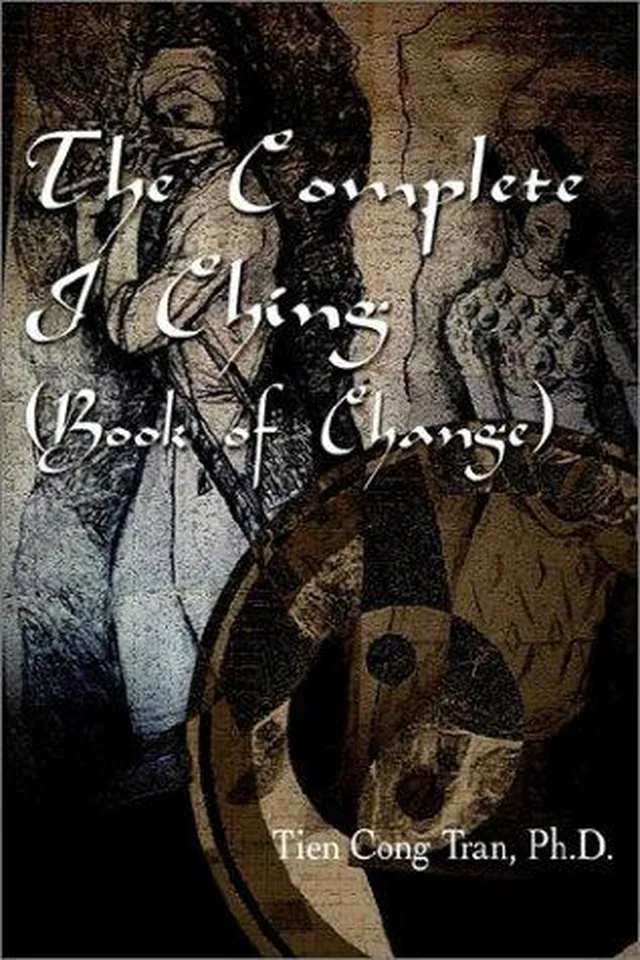
The Complete I Ching (Book of Change)
 62
62

The Complete I Ching (Book of Change)



Lorelei Sage, Contemplative Literature Editor: Tien Cong, Ph.D. Tran's 'The Complete I Ching' is a monumental achievement, a luminous beacon in esoteric literature. This edition meticulously unpacks the profound symbolism and philosophical depth of the ancient Chinese oracle, revealing its timeless relevance for modern spiritual seekers. Tran's scholarly yet accessible approach makes the complex concepts of hexagrams, trigrams, and the interplay of cosmic forces comprehensible without sacrificing their inherent mystery. It is an authoritative resource for anyone aspiring to deep self-understanding, profound wisdom, and a more harmonious connection with the universe's subtle currents. A must-read for practitioners and scholars alike.
📝 Description
62
Tien Cong, Ph.D. Tran's 2005 'The Complete I Ching' translates the ancient oracle.
This edition presents the sixty-four hexagrams of the I Ching, the world's oldest oracle. The text explains the symbolism within each hexagram and their relationship to the forces of Yin and Yang. It details how these symbols map onto the cycles of change and the subtle energies influencing events. The book aims to provide more than just methods for divination. It offers a philosophical perspective on change, transformation, and the interconnectedness of existence. Tran's scholarly work clarifies the spiritual and psychological insights of the I Ching. It encourages readers to understand natural patterns and approach life's changes with greater awareness.
The translation and commentary illuminate the I Ching's role as a guide for understanding universal patterns. It is presented as a resource for personal growth and spiritual development. The book's approach focuses on aligning with the natural order of things. It uses the hexagrams to offer insight into decision-making and life's unfolding events.
The I Ching belongs to the Taoist tradition of Chinese philosophy. Its origins are ancient, predating written records. The text is considered a guide to understanding the Tao, the fundamental principle of the universe. It uses a system of sixty-four hexagrams, each representing a specific situation or stage of transformation. These hexagrams are derived from combinations of broken (Yin) and unbroken (Yang) lines. The practice involves casting lots (traditionally yarrow stalks or coins) to determine which hexagram applies to a given question, followed by interpretation of the associated text.
💡 Why Read This Book?
Unlock ancient wisdom and navigate life's complexities with unparalleled clarity. 'The Complete I Ching' offers profound insights into change, destiny, and the universal forces at play. Ideal for seekers of spiritual growth, scholars of ancient philosophy, and practitioners of divination looking for a comprehensive and deeply resonant guide to self-discovery and cosmic alignment.
⭐ Reader Reviews
Honest opinions from readers who have explored this book.
❓ Frequently Asked Questions
What is the I Ching?
The I Ching, or 'Book of Change,' is an ancient Chinese divination text and philosophical classic. It uses a system of hexagrams, formed by six stacked horizontal lines of either solid (Yang) or broken (Yin), to offer insights into situations and potential outcomes.
How is the I Ching used for divination?
Traditionally, divination involves casting yarrow stalks or coins to generate a hexagram. The resulting hexagram, along with its changing lines, is then interpreted using the text to provide guidance on current circumstances and future possibilities.
What philosophical concepts are central to the I Ching?
Key concepts include the dynamic interplay of Yin and Yang, the constant process of change and transformation, the importance of balance, and the interconnectedness of all things within the cosmic order.
Who was Tien Cong, Ph.D. Tran?
Tien Cong, Ph.D. Tran was a respected scholar and translator dedicated to making ancient Eastern philosophical and mystical texts accessible to a Western audience, known for his rigorous scholarship and deep understanding of esoteric traditions.
Is this book suitable for beginners?
Yes, 'The Complete I Ching' is designed to be comprehensive. While its depth can satisfy advanced practitioners, Tran's clear explanations and structured approach make it an excellent starting point for those new to the study of the I Ching.
🔮 Key Themes & Symbolism
The Dynamics of Change and Transformation
Fundamentally, the I Ching is a profound exploration of impermanence and the cyclical nature of existence. It teaches that change is the only constant, and understanding its patterns allows one to navigate life's vicissitudes with wisdom and resilience. The sixty-four hexagrams represent archetypal situations and their inherent transformations, offering a framework for comprehending the ebb and flow of personal and cosmic events. This theme encourages adaptability, foresight, and acceptance of life's natural unfolding, fostering a deep connection to the Tao and the universe's inherent order.
The Interplay of Yin and Yang
The fundamental principle animating the I Ching is the cosmic dance between Yin (passive, feminine, dark, receptive) and Yang (active, masculine, light, creative). These complementary forces are not opposing but interdependent, constantly interacting and transforming into one another. Understanding this duality is crucial to interpreting the hexagrams and the subtle energies influencing situations. The text guides readers to recognize these forces within themselves and their environment, promoting balance, harmony, and a deeper appreciation for the inherent unity underlying apparent dualities.
Wisdom for Decision-Making and Self-Cultivation
Beyond mere fortune-telling, the I Ching serves as a profound guide for ethical conduct and personal development. Its wisdom lies in its ability to illuminate the underlying causes of situations and suggest the most auspicious course of action. By studying the hexagrams and their associated commentaries, individuals can cultivate self-awareness, develop discernment, and align their intentions with the natural order of the universe. This fosters a path of conscious living, enabling individuals to make wiser choices and foster inner peace amidst external challenges.
💬 Memorable Quotes
Direct passages from the work, attributed to the author.
“When the passions are disturbed, the mind is the slave of the passions.”
— A powerful reminder of the need for emotional regulation and mental discipline. It highlights how unchecked emotions can lead to a loss of agency and rational thought.
“The superior man understands the changes that he observes and adjusts his course accordingly.”
— This captures the core message of the I Ching: the necessity of adaptability and responsiveness to the ever-shifting currents of life. It promotes proactive engagement with circumstances.
“Where there is no foresight, there will be trouble.”
— A timeless adage stressing the value of planning and considering potential consequences. It encourages a proactive approach to challenges and opportunities.
💡 Key Ideas
Editorial paraphrase of the work's core concepts — not direct quotes.
The superior man, when he is in a place of obscurity, is like the sun hidden by clouds.
This quote emphasizes the importance of inner virtue and potential, even when external circumstances do not allow for outward recognition. It speaks to self-cultivation and the quiet strength that persists regardless of recognition.
The Book of Change is like a mirror; it shows you yourself.
This quote underscores the introspective nature of the I Ching. It is not just a predictive tool but a profound instrument for self-reflection and understanding one's inner landscape.
🌙 Esoteric Significance
Tradition
The I Ching is a foundational text within the Taoist and Confucian traditions, deeply embedded in Chinese esoteric cosmology. It is considered a primary oracle and philosophical guide, embodying the principles of the Tao, the Great Ultimate (Taijitu), and the natural order. Its esoteric significance lies in its capacity to reveal the hidden patterns of the universe, the interplay of spiritual forces, and the path to harmonizing oneself with the cosmic flow, offering a sophisticated system for spiritual cultivation and understanding.
Symbolism
The hexagrams, composed of Yin and Yang lines, are rich with symbolism representing archetypal forces, natural phenomena, and human situations. The eight trigrams (Pa Kua) are foundational, symbolizing Heaven, Earth, Thunder, Wind, Water, Fire, Mountain, and Lake. Their combinations into sixty-four hexagrams create a symbolic language that speaks to all aspects of existence, from the primal beginnings to the complexities of social interaction and personal transformation, offering a visual and conceptual map of reality.
Modern Relevance
In the modern era, the I Ching continues to serve as a profound tool for introspection, ethical guidance, and working through the complexities of contemporary life. Its emphasis on change, adaptability, and interconnectedness resonates deeply in a rapidly evolving world. Esoteric practitioners, psychologists, and philosophers alike find its wisdom useful for understanding personal challenges, fostering emotional intelligence, and seeking a deeper connection to universal principles, proving its timeless relevance beyond its ancient origins.
👥 Who Should Read This Book
This comprehensive edition is useful for a diverse audience. **Beginners** will find Tien Cong's clear explanations an accessible entry point into the profound world of the I Ching. **Scholars of Eastern philosophy and comparative religion** will appreciate the meticulous scholarship and deep contextualization. **Seekers of spiritual wisdom and self-discovery** will find a powerful guide for introspection and navigating life's challenges. **Practitioners of divination and esoteric arts** will benefit from its authoritative and comprehensive nature, enriching their understanding and practice.
📜 Historical Context
The I Ching, or 'Book of Change,' emerged from the mystical and philosophical milieu of ancient China, with its roots tracing back to the Shang Dynasty (c. 1600–1046 BCE) and further developed during the Zhou Dynasty (c. 1046–256 BCE). It evolved from early divinatory practices, incorporating the philosophical insights of Confucianism and Taoism, particularly during the Spring and Autumn period (771–476 BCE) and the Warring States period (475–221 BCE). Its profound influence extended through imperial China, shaping governance, personal ethics, and artistic expression for millennia. The I Ching's integration of cosmology, psychology, and practical wisdom made it a central to Chinese thought, influencing East Asian cultures and eventually captivating scholars and mystics worldwide with its enduring relevance.
📔 Journal Prompts
Reflect on a recent situation where you experienced significant change. How did the principles of Yin and Yang manifest?
Consider a current dilemma. If you were to consult the I Ching, what question would you ask and why?
How can you better cultivate balance between the active (Yang) and receptive (Yin) aspects within your own life?
Identify a 'changing line' in your life's current narrative. What transformation is being suggested?
Meditate on the concept of 'impermanence.' How does acknowledging this truth influence your perspective on your goals and desires?
🗂️ Glossary
Hexagram
A figure composed of six stacked horizontal lines, each either solid (Yang) or broken (Yin). There are 64 unique hexagrams in the I Ching, representing archetypal situations and their potential transformations.
Trigram
A figure composed of three stacked lines (Yin or Yang). There are eight trigrams, each symbolizing fundamental elements and forces of nature, and they form the basis for the 64 hexagrams.
Yin
The passive, dark, feminine, receptive, and yielding principle in Chinese philosophy. It is represented by broken lines in the I Ching.
Yang
The active, light, masculine, creative, and assertive principle in Chinese philosophy. It is represented by solid lines in the I Ching.
Tao
The fundamental principle of the universe in Taoism; the Way. It represents the natural order, the underlying reality, and the path of least resistance.
This book appears in 2 collections
🔮 Readers Also Liked
Browse all →









From the “I Ching” Collection
View all →









More Free Divination & Tarot Books
View all →