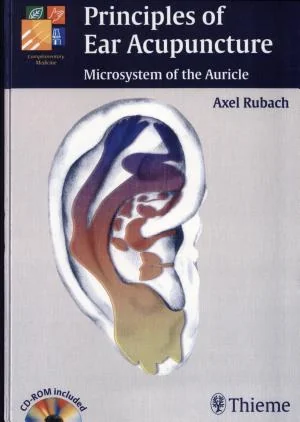
Principles of Ear Acupuncture
 78
78

Principles of Ear Acupuncture
Axel Rubach's Principles of Ear Acupuncture offers a commendably structured approach to a complex subject. The clarity with which the Second Edition (2016) delineates the French and Chinese schools of auricular therapy is its strongest asset. Rubach, drawing on his extensive experience, avoids overly academic jargon, making the detailed anatomical descriptions and point localizations accessible. A particular strength lies in the systematic presentation of point indications, allowing for rapid reference during practice. However, the book occasionally feels more like a comprehensive manual than an exploration of the deeper energetic principles that underpin these techniques. While the French school's VAS is mentioned, its theoretical underpinnings could be further elaborated for those seeking a more holistic understanding. Nevertheless, for practitioners focused on precise diagnosis and application via the ear, this work serves as an invaluable, practical resource.
📝 Description
78
Axel Rubach's Principles of Ear Acupuncture, first published in 2016, synthesizes French and Chinese auricular therapy methods.
This text provides a thorough examination of auricular therapy, serving as both a reference and a teaching tool. The second edition details the anatomical structures of the ear, locating acupoints and their therapeutic uses. Information comes from extensive clinical and teaching experience, structured for clarity.
It is designed for acupuncture practitioners, from experienced professionals to students. Researchers of complementary medicine and those interested in esoteric diagnostic systems that connect physical and energetic paradigms will also find value. The book details the ear's cartography as a microsystem, explaining how specific ear points relate to organs, structures, and bodily functions.
Ear acupuncture operates within traditions that view the body as a holistic system, where peripheral points reflect systemic conditions. This book bridges the French school, initiated by Paul Nogier's mapping of the ear's somatotopic representation based on the Vascular Autonomic Signal, with the Chinese approach that links ear points to the body's meridian network. It acknowledges a shared goal of influencing health through stimulation of specific ear zones, aligning with esoteric ideas of microcosm-macrocosm correspondence and energetic pathways.
💡 Why Read This Book?
• Gain a clear comparative understanding of the French (Nogier) and Chinese auricular acupuncture schools, essential for practitioners seeking a comprehensive diagnostic framework based on distinct historical mapping techniques. • Master the precise anatomical localization of over 100 ear acupoints, enabling more accurate and effective treatment strategies derived from Dr. Rubach's years of clinical teaching. • Learn to identify specific therapeutic points for common conditions, directly applying the practical, easy-to-read format of the Second Edition to enhance patient care.
⭐ Reader Reviews
Honest opinions from readers who have explored this book.
❓ Frequently Asked Questions
What is the primary difference between the French and Chinese schools of ear acupuncture as presented in Rubach's book?
The French school, following Nogier, maps points onto the ear based on somatotopic correspondences, often detected via the Vascular Autonomic Signal (VAS). The Chinese school integrates ear points within the broader meridian system, linking them to the body's energetic pathways and organ functions.
When was the Second Edition of Principles of Ear Acupuncture published?
The updated Second Edition of Principles of Ear Acupuncture was first published on December 14, 2016, reflecting contemporary understanding and practices.
Does the book explain the anatomy of the ear in detail?
Yes, the book provides a detailed description of the anatomy and morphology of the ear, which is crucial for accurately identifying and locating the specific acupoints used in auricular therapy.
Is this book suitable for beginners in acupuncture?
Absolutely. While comprehensive, the book is designed to be helpful and easy-to-read, making it suitable for students and practitioners new to the specialized field of ear acupuncture.
What is the significance of Paul Nogier in the context of this book?
Paul Nogier is a pivotal figure in the French school of ear acupuncture. His research and mapping of the ear's somatotopic representation are central to one of the two main methodologies discussed and detailed by Axel Rubach.
Can I learn specific points for treating conditions from this book?
Yes, the book offers specific points for ear acupuncture related to various conditions, presented in a helpful and accessible format based on Dr. Rubach's extensive experience.
🔮 Key Themes & Symbolism
Auricular Microsystem Mapping
The central theme is the ear's function as a microsystem, reflecting the entire human body. Rubach details how both French and Chinese traditions map specific points on the auricle to corresponding organs, limbs, and physiological systems. This includes understanding the somatotopic projection of the body onto the ear, a concept significantly developed by Paul Nogier, and its integration with traditional Chinese meridian theory. The precise localization of these points is paramount, enabling practitioners to stimulate these correspondences for therapeutic effect.
French vs. Chinese Auricular Schools
This work systematically contrasts and compares the distinct methodologies of the French (Nogier) and Chinese schools of ear acupuncture. It highlights their differing diagnostic indicators, point selection criteria, and theoretical frameworks. While the French school often relies on objective signals like the Vascular Autonomic Signal (VAS) for point detection, the Chinese approach typically aligns auricular points with the body's established meridian network. Rubach's text aims to synthesize these traditions, offering a richer understanding of auricular therapy's diverse applications.
Anatomy and Therapeutics
A significant focus is placed on the detailed anatomy and morphology of the ear itself, providing the necessary foundation for accurate point identification. The book links specific anatomical landmarks on the auricle to their corresponding acupoints and therapeutic indications. This approach underscores the principle that effective auricular therapy relies on a precise understanding of both the ear's structure and the energetic or neurological relationships it represents.
Practical Application and Pedagogy
Principles of Ear Acupuncture is structured as a practical textbook, emphasizing ease of use and direct applicability for practitioners. Rubach leverages his extensive experience as a teacher to present complex information in an accessible format. The book guides readers through diagnostic techniques and treatment protocols, making it a valuable resource for both learning and clinical reference, bridging theoretical knowledge with hands-on therapeutic skills.
💬 Memorable Quotes
Direct passages from the work, attributed to the author.
“The updated Second Edition... provides a comprehensive review of both the French (after Nogier) and Chinese schools of acupuncture.”
— This statement from the blurb highlights the book's core value: a comparative study. It signals that the work doesn't just present one system but integrates two major, historically distinct approaches to ear acupuncture, offering readers a broader perspective.
“The book offers a detailed description of the anatomy and morphology of the ear, acupoints on the ear and their localizations.”
— This emphasizes the anatomical precision required for effective auricular therapy. It suggests the text provides the foundational knowledge necessary for practitioners to accurately identify and stimulate specific points on the ear's complex surface.
“Dr. Rubach... provides valuable information in an easy-to-read, helpful format.”
— This points to the pedagogical success of the book. It implies that complex concepts and detailed anatomical information are presented in a way that is accessible and practical for learning and clinical application.
“principles of ear acupuncture”
— This phrase from the title itself expresses the book's purpose: to lay out the fundamental rules, theories, and systematic approaches that govern the practice of treating the body through points located on the ear.
“French (after Nogier) and Chinese schools”
— This indicates the book's comparative nature, focusing on two major, influential traditions in ear acupuncture. It suggests a detailed exploration of the distinct theories and techniques developed by Paul Nogier and those rooted in traditional Chinese medicine.
🌙 Esoteric Significance
Tradition
While not explicitly aligned with a single esoteric lineage like Hermeticism or Theosophy, ear acupuncture, particularly in its mapping of the body onto a small surface, shares principles with micro-systems and correspondences found in various esoteric traditions. It embodies a principle of 'as above, so below' or 'the part contains the whole,' where the ear acts as a microcosm reflecting the macrocosm of the body. This aligns with symbolic representation and energetic mapping concepts prevalent in Hermetic and Alchemical thought, focusing on finding universal patterns within specific forms.
Symbolism
The ear itself, with its intricate folds and curves, can be viewed as a symbolic landscape. The helix, for instance, often symbolizes the spine or the body's axis, while the lobule represents the head. These correspondences are not merely anatomical but symbolic, suggesting that the ear's form mirrors the body's energetic and structural organization. The points themselves can be seen as symbolic gateways or nodes through which the body's vital energy (qi) can be modulated, reflecting ancient concepts of energetic pathways and nodal points within a larger energetic matrix.
Modern Relevance
Contemporary practitioners of integrative medicine, acupuncture, and even some osteopathic and chiropractic fields draw upon the principles outlined by Rubach. Thinkers and practitioners exploring mind-body connections, somatic therapies, and energy medicine often reference auricular techniques. The work's synthesis of French and Chinese methods makes it relevant to modern approaches that seek to validate and integrate traditional healing practices with scientific understanding, particularly in pain management, stress reduction, and functional medicine.
👥 Who Should Read This Book
['• Acupuncturists and TCM practitioners seeking to deepen their expertise in auricular diagnosis and treatment, benefiting from the detailed comparison of French and Chinese methodologies.', '• Students of acupuncture and complementary medicine looking for a foundational text that clearly explains ear anatomy and point localization in an accessible format.', '• Health professionals interested in non-invasive therapeutic modalities that offer precise point selection based on specific anatomical and energetic correspondences.']
📜 Historical Context
The field of ear acupuncture, particularly the French school, saw significant development in the mid-20th century with the work of Dr. Paul Nogier. His systematic mapping of the ear's somatotopic representation, often linked to his discovery of the Vascular Autonomic Signal (VAS) around 1950, provided a distinct diagnostic and therapeutic framework separate from traditional Chinese medicine. This period was characterized by increasing interest in psychosomatic medicine and alternative therapeutic modalities in Europe. While Chinese acupuncture had a long history, its application to the ear was more systematically integrated into meridian theory later. Rubach's work, particularly the Second Edition published in 2016, reflects the ongoing dialogue and integration between these two influential schools. By presenting both Nogier's system and the Chinese auricular approach, the book situates itself within a modern context that acknowledges and syntheses diverse, yet often complementary, therapeutic traditions.
📔 Journal Prompts
The ear's anatomical landmarks as a map of the body: which specific feature on the auricle most intrigues you as a symbolic representation?
Comparison of the French (Nogier) VAS detection versus Chinese meridian palpation: what are the potential clinical implications of each method?
The concept of the ear as a microsystem: how does this principle challenge or reinforce your understanding of the body's interconnectedness?
Mapping specific acupoints like the 'Shen Men' point: reflect on its traditional Chinese meaning and its proposed function in the French school.
Axel Rubach's synthesis of French and Chinese schools: how might integrating these distinct approaches enhance therapeutic outcomes?
🗂️ Glossary
Auricular Acupuncture
A therapeutic modality using specific points on the external ear to diagnose and treat conditions affecting other parts of the body, based on the principle of the ear acting as a microsystem.
Paul Nogier
A French physician credited with systematically developing the French school of auriculotherapy (ear acupuncture) in the mid-20th century, notably through his mapping of somatotopic correspondences on the ear.
Vascular Autonomic Signal (VAS)
A diagnostic phenomenon described by Paul Nogier, characterized by a change in pulse tension when a specific point on the ear is stimulated, indicating therapeutic relevance.
Microsystem
A smaller area of the body (like the ear, hand, or foot) that reflects the entire body, allowing for diagnosis and treatment of distant parts through stimulation of the microsystem.
Meridian System
The network of pathways in traditional Chinese medicine through which vital energy (qi) flows, connecting different parts of the body, including specific acupoints on the ear.
Somatotopic Representation
The principle that specific points on the ear correspond to specific parts of the body (e.g., an organ, limb, or region), forming a map or projection.
Qi (or Chi)
The fundamental concept in traditional Chinese medicine referring to vital energy or life force that flows through the body's meridians, influencing health and well-being.