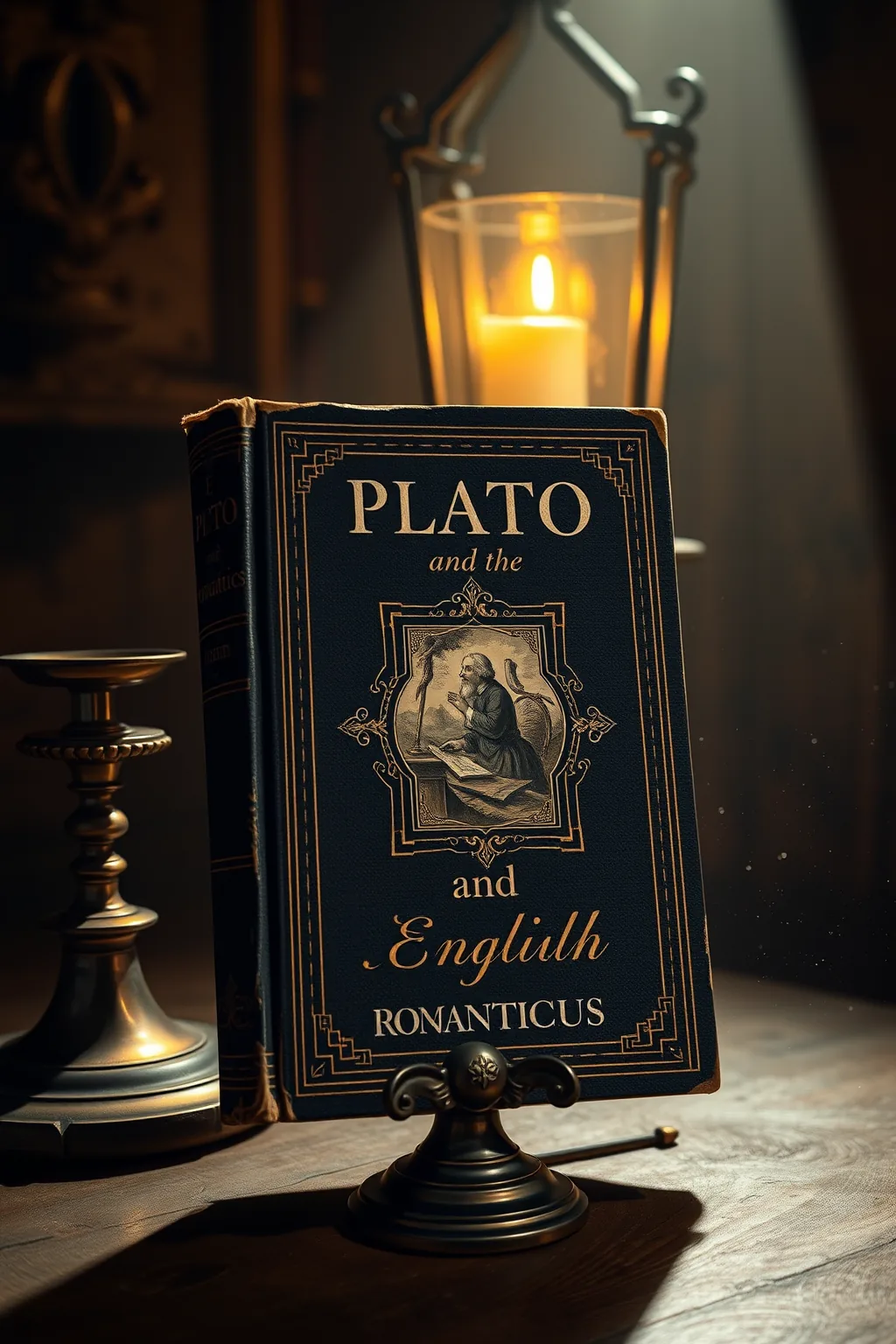
Plato and the English romantics
 62
62

Plato and the English romantics



Silas Hawthorne (Hermetic Studies Editor) — A luminous beacon for students of esoteric thought and literary history. Kabitoglou's meticulous scholarship brilliantly elucidates the profound, often-overlooked Platonic substratum beneath the efflorescence of English Romanticism. The book unearths the shared pursuit of transcendent knowledge and the symbolic language employed by both ancient philosophers and Romantic poets. It is an indispensable guide for understanding how Neoplatonic ideals fueled the Romantic quest for the infinite, the beautiful, and the divine. Highly recommended for scholars, practitioners, and any seeker yearning for deeper connection to the perennial philosophy.
📝 Description
62
E. Douka Kabitoglou's 1999 book connects Plato's philosophy to English Romantic poets.
This study examines the influence of Plato's philosophy on English Romantic writers. Kabitoglou argues that key Platonic concepts, such as the theory of Forms and the soul's recollection of innate knowledge, found a receptive audience among poets like William Blake, Samuel Taylor Coleridge, and Percy Bysshe Shelley. The book traces how these ideas, transmitted through various channels, informed the Romantics' search for transcendent experiences and their critique of materialism. It highlights the shared emphasis on a reality beyond the senses and the power of divine inspiration in both Platonic thought and Romantic literature. By demonstrating this intellectual lineage, the work illuminates the metaphysical foundations of the Romantic movement.
Kabitoglou details how Plato's ideas about the divine soul and perfect archetypes resonated with the Romantic pursuit of the sublime. The book shows how these ancient philosophical concepts provided a framework for the Romantics' revolutionary artistic and spiritual outlooks. It offers a detailed look at how specific Platonic doctrines shaped the imagination of a generation of poets.
This book situates Platonic philosophy within an esoteric tradition that emphasizes hidden knowledge and spiritual ascent. It connects Plato's dialogues, particularly concerning the Forms and the soul's journey, to the Romantic era's interest in mysticism and the occult. The work suggests that certain Romantic writers actively engaged with Neoplatonic interpretations of Plato, seeking a reality that transcended empirical observation. This aligns with a broader esoteric hermeneutic that sees ancient philosophies as keys to unlocking deeper spiritual truths, distinct from purely academic or historical readings.
💡 Why Read This Book?
Uncover the mystical bridge between ancient Greek philosophy and the heart of English Romanticism. If you seek to understand the hidden currents of esoteric thought that shaped poetry, explore the enduring influence of Plato's ideas on the search for ultimate truth and beauty, and appreciate the profound connection between philosophy and artistic expression, this book is your essential guide.
⭐ Reader Reviews
Honest opinions from readers who have explored this book.
❓ Frequently Asked Questions
What is the central thesis of the book?
The book argues that Platonic philosophy, particularly its Neoplatonic interpretations, provided a crucial intellectual and spiritual framework for the English Romantic movement, influencing their concepts of beauty, truth, and the divine.
Which English Romantic poets are discussed?
Key figures like William Blake, Samuel Taylor Coleridge, Percy Bysshe Shelley, and others are examined for their engagement with Platonic ideas and their subsequent impact on their poetic works.
What specific Platonic concepts are explored?
The book delves into Plato's theories of the Forms, the immortality of the soul, recollection (anamnesis), the concept of the Good, and the influence of Neoplatonists like Plotinus.
Is this book suitable for beginners in philosophy?
While scholarly, the book offers clear explanations of complex philosophical concepts, making it accessible to dedicated beginners interested in the esoteric roots of Romanticism.
How does this book connect to esoteric traditions?
It highlights the inherent esoteric nature of Plato's philosophy and its transmission through Neoplatonism, revealing a continuous thread of mystical and hidden knowledge influencing Western thought and art.
🔮 Key Themes & Symbolism
The Platonic Ascent: From Forms to Imagination
This theme explores Plato's theory of Forms as a blueprint for transcendent reality and how English Romantics adapted this concept. It examines their yearning for an ideal, perfect world beyond sensory experience, mirroring Plato's ascent from the visible to the intelligible realm. The discussion illuminates how the Romantics’ pursuit of the sublime, the beautiful, and the eternal was deeply rooted in this Platonic idealism, seeing imagination as a faculty capable of apprehending these higher truths.
The Soul's Journey: Recollection and Romantic Vision
Here, the focus shifts to Plato's doctrine of anamnesis – the soul's recollection of innate knowledge from a prior existence. Kabitoglou demonstrates how Romantic poets perceived inspiration and genius as forms of this recollection. The text reveals how this idea fostered a belief in the inherent divinity of the individual soul and its capacity to access universal truths, fueling their revolutionary ideas about selfhood, prophecy, and the creative process. It uncovers the mystical underpinnings of Romantic creativity.
Neoplatonic Currents: The Hermetic Inheritance
This theme traces the vital role of Neoplatonism, particularly the philosophies of Plotinus, in mediating Platonic thought to the Romantics. It emphasizes the Hermetic aspects of this transmission, where concepts like the One, the Demiurge, and the emanation of spiritual hierarchies were internalized by Romantic thinkers. The section highlights how these ideas contributed to the Romantic fascination with the occult, the mystical, and the interconnectedness of all things, framing their worldview as an inherently esoteric one.
💬 Memorable Quotes
Direct passages from the work, attributed to the author.
“The world of Forms is not a distant, abstract realm, but the very source of beauty and truth.”
— This suggests that Plato's Forms are not merely philosophical constructs but the active, vital essence that imbues our world with its most profound qualities, a concept central to Romantic appreciation of nature's sublimity.
“Inspiration is the soul remembering its divine origins.”
— This expresses the Romantic idea of genius as an innate faculty, linking poetic creativity to Plato's theory of recollection and the soul's connection to a higher, spiritual reality.
“The Romantic imagination sought to bridge the sensible and the intelligible.”
— This highlights the Romantic aspiration to perceive the spiritual or ideal within the material world, echoing Plato's philosophy of the Forms as immanent principles.
“Through symbols, the soul glimpses the eternal.”
— This emphasizes the importance of symbolism in Romantic poetry as a means of accessing hidden truths, a practice deeply rooted in Platonic and Hermetic traditions.
“The pursuit of beauty is a journey towards the Good.”
— This connects the Romantic aesthetic ideal directly to Plato's concept of the Form of the Good as the ultimate source of all value and reality.
🌙 Esoteric Significance
Tradition
This work is deeply rooted in the Platonic and Neoplatonic traditions, which are foundational to much of Western esoteric thought. It explores how these philosophies, with their emphasis on transcendent realms, the immortality of the soul, and the hidden order of the cosmos, were interpreted and utilized by Romantic writers as a framework for their own mystical and spiritual quests.
Symbolism
The book uncovers the wide range of symbolism employed by both Plato and the Romantics. It examines how concepts like light, ascent, the cave, and the divine Forms were used as symbolic keys to unlock deeper meanings and to represent the journey of the soul towards enlightenment. The Romantics, in particular, leveraged these symbols to express their vision of a spiritual reality underlying the material world.
Modern Relevance
In an age often characterized by materialism and fragmentation, the Platonic quest for unity, truth, and beauty offers a powerful counterpoint. The insights into the Romantic imagination's engagement with these perennial themes remain relevant for anyone seeking to cultivate a richer inner life, understand the enduring power of art and poetry, and explore the profound connections between philosophy, spirituality, and creative expression.
👥 Who Should Read This Book
This book is a treasure for scholars of literature and philosophy, particularly those specializing in Romanticism and the history of ideas. It is essential for students and practitioners of esoteric traditions seeking to understand the philosophical lineage of mystical thought. Seekers of wisdom, artists, poets, and anyone fascinated by the interplay of philosophy and imagination will find profound inspiration. For those new to Platonic thought, the book offers an accessible entry point into its esoteric dimensions, while seasoned researchers will appreciate its nuanced exploration of a vital intellectual connection.
📜 Historical Context
The English Romantic period, roughly spanning from the late 18th to the mid-19th century, was a time of profound social, political, and intellectual upheaval. The French Revolution and the Enlightenment's emphasis on reason had been followed by a reaction that valued emotion, imagination, and individualism. This era witnessed a burgeoning interest in the medieval past, the exotic, and the supernatural, a stark contrast to the preceding Age of Reason. Simultaneously, there was a rediscovery and reinterpretation of ancient philosophies, including Plato and the Neoplatonists, often through the lens of Hermeticism and mystical traditions. This intellectual climate fostered a yearning for a deeper, more spiritual understanding of the world, making Platonic ideals of transcendent reality, the divine soul, and the pursuit of beauty and truth highly resonant with the Romantic sensibility.
📔 Journal Prompts
Reflect on a time you felt a profound connection to something beyond the material world. How might Platonic ideals of Forms or the soul's recollection explain this experience?
Consider a favorite Romantic poem. What symbols or themes within it suggest a Platonic or Neoplatonic influence on the poet's worldview?
How does the concept of 'recollection' (anamnesis) resonate with your own understanding of learning, intuition, or creative breakthroughs?
In what ways do you see the Romantic yearning for the sublime or the ideal reflected in contemporary art, culture, or personal aspirations?
Explore the idea of the 'world of Forms' as a source of beauty and truth. How does this concept challenge or enrich your perception of reality?
🗂️ Glossary
Forms (Platonic)
In Plato's philosophy, these are perfect, eternal, and unchanging archetypes or essences that exist in an intelligible realm, serving as the true reality of which the physical world is merely a shadow or imperfect copy.
Neoplatonism
A philosophical system that developed from Platonic thought, particularly influenced by Plotinus. It emphasizes emanation from a single divine source (The One) and the soul's journey back to it, often incorporating mystical and religious elements.
Anamnesis (Recollection)
Plato's theory that learning is a process of remembering knowledge that the soul possessed before its incarnation in a physical body, implying innate knowledge and the immortality of the soul.
The Sublime
A concept central to Romanticism, referring to an awe-inspiring experience of beauty or power that transcends the ordinary, often evoking feelings of wonder, terror, and a sense of the infinite.
Hermeticism
A philosophical and religious tradition based on writings attributed to Hermes Trismegistus. It often deals with alchemy, astrology, magic, and the hidden knowledge of the cosmos, emphasizing correspondence between the macrocosm and microcosm.
This book appears in 3 collections
🔮 Readers Also Liked
Browse all →







From the “Neoplatonism” Collection
View all →






More Free Alchemy & Hermeticism Books
View all →