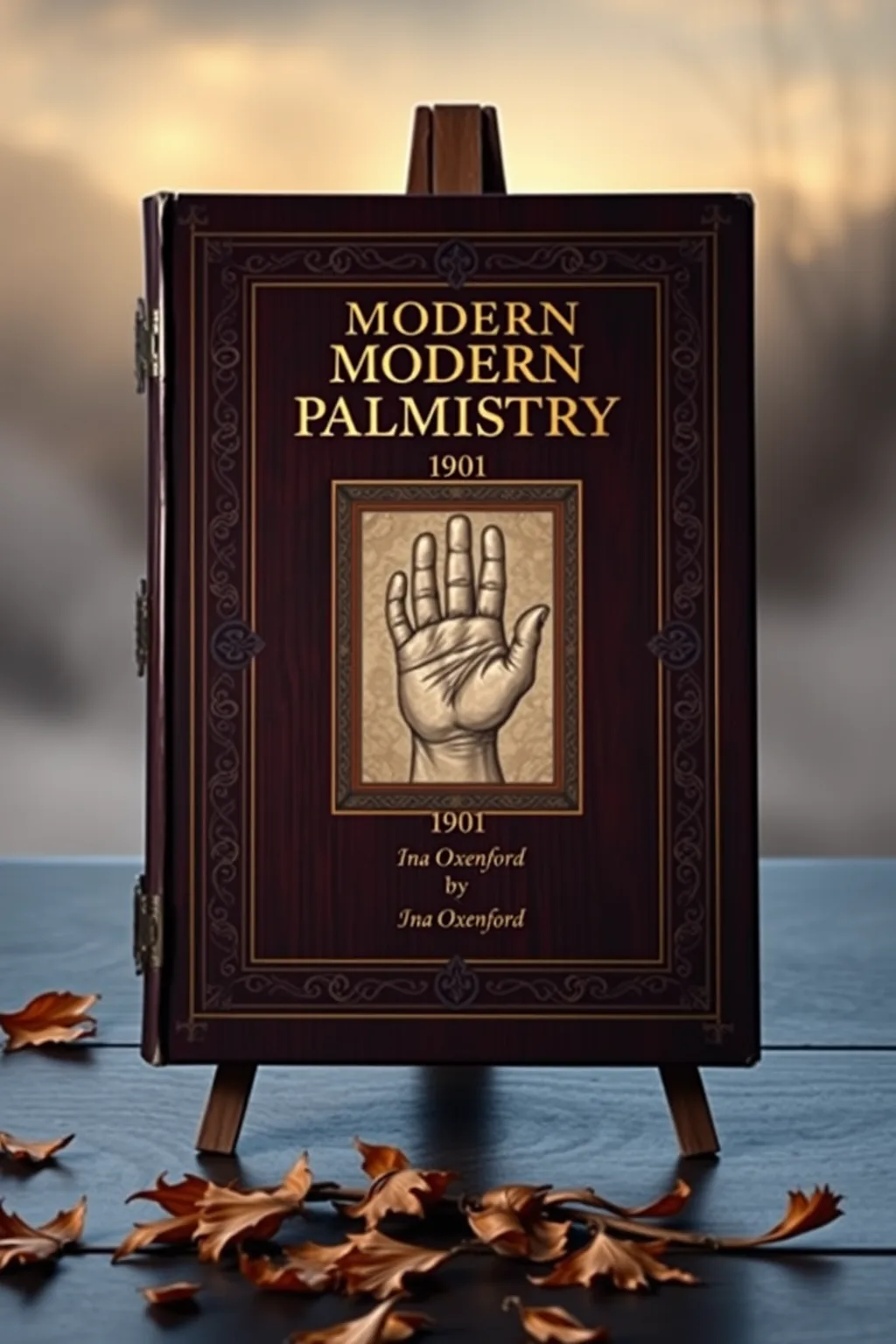
Modern Palmistry 1901
 61
61

Modern Palmistry 1901



Sophia Crane (Associate Editor) — Ina Oxenford's 'Modern Palmistry' is a cornerstone of chiromantic literature, offering a lucid and insightful exploration of hand interpretation from the dawn of the 20th century. Oxenford's approach is both scholarly and imbued with a palpable sense of esoteric reverence, presenting the hand as a microcosm of the universe. Her classifications of hand types, particularly her emphasis on fingertip shapes, reveal a keen observational eye and a deep understanding of sympathetic correspondences. This work is indispensable for anyone serious about delving into the foundational principles of palmistry, bridging the gap between ancient lore and a more accessible, modern (for its time) presentation. It’s a treasure for practitioners and seekers alike.
📝 Description
61
Ina Oxenford published 'Modern Palmistry' in 1901, presenting the hand as a map of the soul.
Ina Oxenford's 1901 book, 'Modern Palmistry,' examines the lines, mounts, and finger shapes of the hand. Oxenford treats palmistry not just as prediction, but as a method for self-understanding and spiritual awareness. She details how these physical features act as indicators of a person's inner life and destiny.
The book discusses the subtle energies associated with the hands and their connection to broader cosmic forces. It aims to show how the physical structure of the hand reflects deeper spiritual truths. Readers are invited to use the hand as a tool to comprehend destiny and the link between the body and spirit.
Published in 1901, 'Modern Palmistry' emerged during a period of significant interest in occultism and spiritualism in the West. It aligns with traditions that view the human body, particularly the hand, as a microcosm reflecting macrocosmic principles. This book fits within a larger movement that sought to find spiritual meaning and hidden knowledge in physical signs, connecting individual fate with universal energies.
💡 Why Read This Book?
Uncover the hidden language of your destiny etched in your palms. 'Modern Palmistry' by Ina Oxenford offers a profound, esoteric journey into chiromancy, revealing the symbolic connections between your hands and your spiritual essence. Ideal for seekers of ancient wisdom, practitioners of divination, and those yearning for deeper self-understanding through the lens of metaphysical science.
⭐ Reader Reviews
Honest opinions from readers who have explored this book.
❓ Frequently Asked Questions
What are the primary distinctions between hand types in this book?
Ina Oxenford categorizes hands based on the distinctive shapes of their fingertips when viewed from the back. These classifications are crucial for understanding the fundamental energetic and personality types associated with each hand, serving as the initial key to unlocking palmistic interpretation.
Is 'Modern Palmistry' suitable for beginners?
Absolutely. While rich in esoteric depth, Oxenford's writing is accessible, making it an excellent starting point for those new to palmistry seeking a solid, traditional foundation.
What is the philosophical basis of palmistry presented here?
The book posits that the hand is a direct reflection of the individual's spiritual nature, karma, and life path. It operates on the principle of correspondence, where the physical form mirrors the inner and cosmic realities.
How does this book differ from contemporary palmistry guides?
'Modern Palmistry' offers a glimpse into the early 20th-century esoteric approach, emphasizing a more mystical and less purely predictive framework. It retains a strong connection to older traditions and philosophical underpinnings.
Can palmistry truly predict the future?
This text views palmistry not as rigid prophecy, but as a map of tendencies, potentials, and karmic influences. It empowers the reader to understand their inner landscape and make conscious choices, rather than passively accepting a fixed fate.
🔮 Key Themes & Symbolism
The Hand as a Cosmic Mirror
This theme explores the profound belief that the lines, mounts, and shapes of the human hand are not random markings but deliberate inscriptions reflecting the individual's soul journey, karmic blueprint, and connection to universal energies. Oxenford presents the hand as a microcosm of the macrocosm, a divine map etched into our very being. It emphasizes how understanding these markings allows for a deeper comprehension of one's inherent nature, potential challenges, and spiritual destiny, transforming the hand into a sacred text for self-illumination and cosmic alignment.
Chiromancy as Esoteric Science
Ina Oxenford positions palmistry as a legitimate and sophisticated esoteric science, transcending mere superstition. This theme looks at the systematic study of the hand's anatomy and its corresponding symbolic meanings, rooted in ancient traditions. It highlights the intricate interplay between the physical form and the subtle energetic bodies, suggesting that the hand acts as a conduit and indicator of these invisible forces. The book aims to explain chiromancy, presenting it as a rigorous discipline for those seeking profound knowledge of human nature and the hidden laws of the universe.
Fingertip Typology and Personality
A core tenet of Oxenford's work lies in the detailed analysis of fingertip shapes as primary indicators of personality archetypes. This theme explores how the distinct forms of fingertips, when observed from the back of the hand, reveal fundamental character traits, temperaments, and inherent potentials. It moves beyond superficial interpretations to connect these physical attributes to deeper psychological and spiritual inclinations, providing a foundational layer for understanding the individual's unique energetic signature and their approach to life's experiences.
💬 Memorable Quotes
Direct passages from the work, attributed to the author.
“There are three types or classes of hands, distinguished by the shape of the finger tips.”
— This foundational observation highlights the core principle of Oxenford's systematic approach, emphasizing that subtle physical distinctions in the hand directly correlate to fundamental differences in character and destiny.
“The hand is a microcosm of the universe.”
— This profound statement captures the esoteric philosophy underpinning palmistry, suggesting that the human hand contains within it all the patterns and energies of the greater cosmos.
“Lines are the language of the soul.”
— This evocative phrase suggests that the palm lines are not mere physical marks but rather a symbolic script conveying the deepest truths and intentions of the individual's inner being.
“Each mount holds a planetary influence.”
— This points to the astrological correspondences within palmistry, illustrating how specific areas of the palm are believed to resonate with the energies of celestial bodies, influencing our lives.
“The shape of the hand speaks volumes of character.”
— This emphasizes the holistic nature of palmistry, indicating that the overall form and structure of the hand, beyond just the lines, provides crucial insights into one's innate personality.
🌙 Esoteric Significance
Tradition
This work is deeply rooted in the Western esoteric tradition, drawing heavily from classical chiromancy, which itself has connections to ancient Greek, Roman, and Indian (Ayurvedic) practices. It aligns with Hermetic principles of correspondence, where the microcosm (the hand) reflects the macrocosm (the universe), and the concept of divine inscription or fate. It also appeals to Neoplatonic ideas of the soul's journey and the physical body as a manifestation of spiritual realities.
Symbolism
The symbolism in 'Modern Palmistry' is rich and multi-layered. Lines represent life currents, destinies, and emotional states; mounts symbolize planetary influences and inherent potentials (e.g., Venus for love, Jupiter for ambition); finger shapes denote core personality types and elemental affinities. The hand itself is a symbol of human agency, manifestation, and the physical plane through which spiritual energies express themselves. The very act of reading the palm is a symbolic engagement with the hidden architecture of existence.
Modern Relevance
Despite its age, 'Modern Palmistry' offers enduring relevance for contemporary seekers. Its emphasis on self-understanding, personal potential, and the interconnectedness of the physical and spiritual realms resonates deeply with modern New Age philosophies and mindfulness practices. The book provides a tangible, symbolic system for introspection, empowering individuals to explore their inner landscape and approach life's challenges with greater awareness and conscious intent, serving as a valuable tool for personal growth and spiritual development.
👥 Who Should Read This Book
This key work is essential for several distinct groups. For the **beginner** in divination, it offers a clear, structured introduction to the foundational principles of palmistry. **Scholars** of esoteric history and comparative religion will find it a valuable primary source for understanding early 20th-century occult thought. **Spiritual seekers** will discover a profound tool for self-exploration, connecting their physical form to their inner spiritual journey. **Practitioners** of chiromancy, both novice and experienced, will benefit from Oxenford's detailed classifications and insightful interpretations, enhancing their diagnostic and predictive abilities.
📜 Historical Context
Published in 1901, 'Modern Palmistry' emerged during a vibrant period of occult revival and spiritual exploration in the Western world. The late Victorian and Edwardian eras saw a surge of interest in mysticism, spiritualism, theosophy, and esoteric sciences, as many sought alternative frameworks to understand existence beyond the burgeoning rationalism and industrialization. Authors like Madame Blavatsky, Arthur Edward Waite, and Aleister Crowley were shaping the field of occult thought. Ina Oxenford's work stands as a proof of this era's dedication to systematizing and popularizing ancient divinatory arts, presenting palmistry not as folk magic, but as a serious, albeit mystical, discipline worthy of intellectual study and personal application. It reflects a desire to find deeper meaning and personal agency in a rapidly changing world, often by looking to ancient wisdom.
📔 Journal Prompts
Reflect on the dominant shape of your fingertips. How do these characteristics manifest in your daily life and interactions?
Examine the major lines on your dominant hand. Which line feels most significant to you today, and why?
Consider the 'mounts' on your palm. Which planetary influence do you feel most strongly associated with, and how does it shape your experiences?
If your hand is a 'cosmic mirror,' what aspects of the universe do you perceive reflected within it?
How can understanding the 'language of the soul' through your palm empower you to make more conscious choices in your life journey?
🗂️ Glossary
Chiromancy
The art and practice of foretelling future happenings and discovering character by the examination of the hand. It is often referred to as palmistry.
Mounts
The fleshy, raised areas on the palm of the hand, each associated with a planet and believed to influence specific personality traits and life areas.
Lines (Major)
The prominent creases on the palm, typically including the Life Line, Head Line, Heart Line, and Fate Line, which are interpreted to signify major aspects of an individual's life and destiny.
Fingertip Types
Classifications of the shapes of the ends of the fingers (e.g., square, spatulate, conic, pointed), used to determine fundamental personality archetypes and energetic tendencies.
Microcosm
In esoteric philosophy, the belief that a smaller entity (like the human being or the hand) contains within it all the essential elements and patterns of the larger universe (the macrocosm).
This book appears in 1 collection
🔮 Readers Also Liked
Browse all →









More by Ina Oxenford
All books →


From the “Divination” Collection
View all →






More Free Divination & Tarot Books
View all →