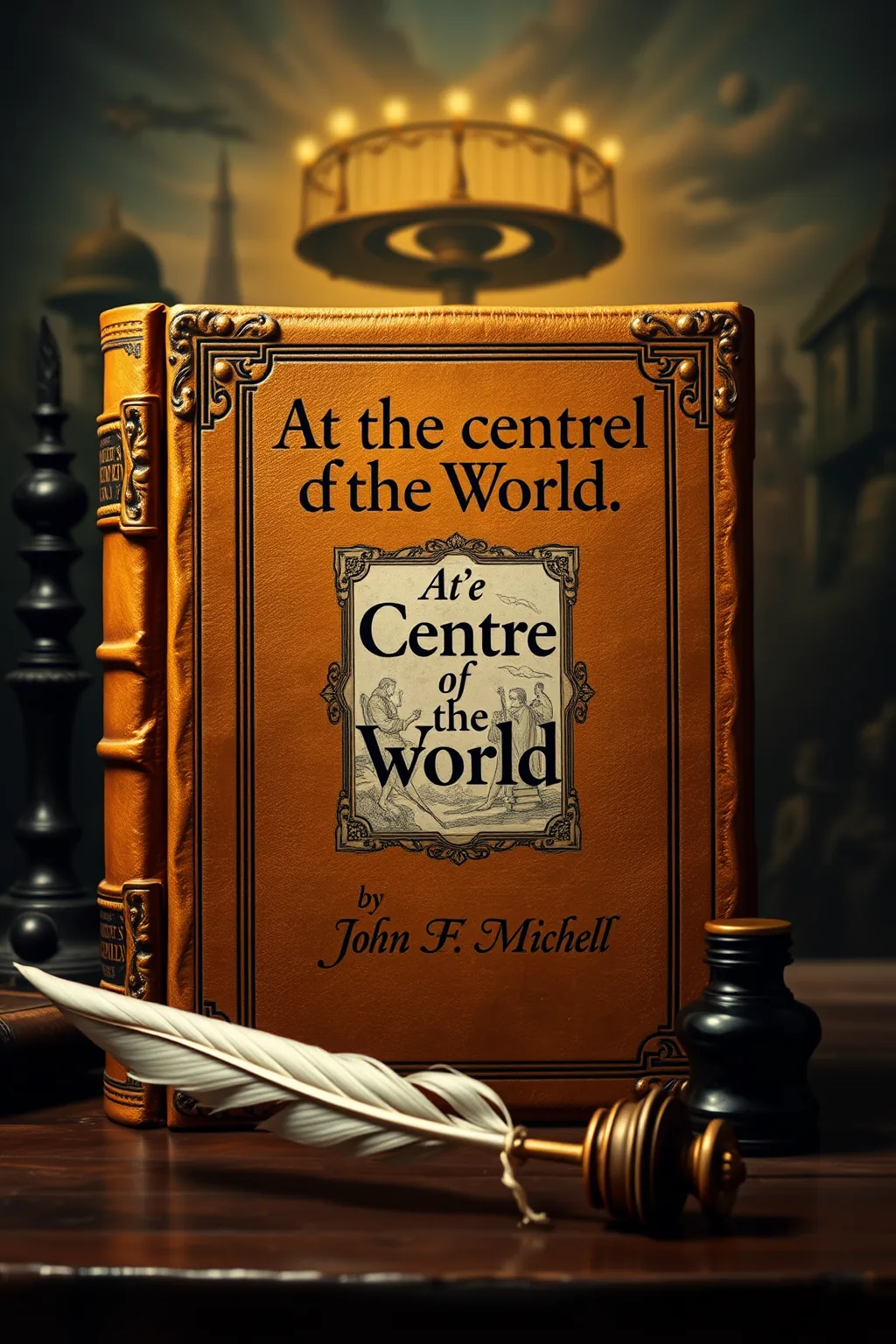
At the centre of the world
 61
61

At the centre of the world



Evander Ashcroft (Alchemy & Hermeticism Editor) — John F. Michell's 'At the Centre of the World' is a monumental exploration of sacred geography and ancient cosmological thought. Michell's erudition is breathtaking, drawing illuminating connections between disparate mythologies and historical sites. He unearths a profound esoteric tradition that posits a divinely ordered universe, accessible through the understanding of terrestrial alignments and mythic symbolism. This work is indispensable for serious students of comparative mythology, ancient wisdom traditions, and the hermetic arts. Its strength lies in its ability to reveal the underlying unity of spiritual questing across cultures, offering a compelling vision of humanity’s relationship with the sacred cosmos. A true gem for the serious esoteric scholar.
📝 Description
61
John F. Michell's 1984 book argues that ancient cultures perceived a cosmic order reflected in sacred geography.
John F. Michell's 1984 book, 'At the Centre of the World,' examines how various cultures across history understood an underlying cosmic order. He investigates sacred geographies and symbolism that informed this perception. The work looks at how diverse civilizations, from ancient times to more recent traditions, viewed a divine blueprint they believed was embedded in the physical world.
Michell discusses the mystical aspects of sacred sites, drawing connections to Celtic and Norse mythologies. He also covers the esoteric principles of geomancy, the practice of interpreting earth divinations. The book aims to provide a philosophical structure for readers seeking to understand humanity's position within a connected existence. It encourages a view beyond the ordinary, highlighting subtle energies and hidden correspondences throughout the universe.
This book belongs to a tradition of esoteric thought that seeks correspondences between the terrestrial and celestial realms. It follows writers who have explored sacred sites and earth energies as manifestations of a hidden order, often linking these to ancient mythologies and pre-Christian European traditions. Michell's work aligns with scholarship that views these patterns not as mere coincidence, but as evidence of a coherent, symbolic worldview held by past societies.
💡 Why Read This Book?
Uncover the hidden connections between ancient myths, sacred geography, and cosmic order. 'At the Centre of the World' offers profound insights into geomancy, Celtic, and Norse mythologies, revealing a universal spiritual blueprint. Ideal for seekers of hidden knowledge, scholars of ancient wisdom, and practitioners interested in the energetic patterns of the Earth.
⭐ Reader Reviews
Honest opinions from readers who have explored this book.
❓ Frequently Asked Questions
What is the primary focus of 'At the Centre of the World'?
The book explores the concept of sacred geography, delving into how ancient cultures perceived and mapped the world according to mystical and cosmological principles, often linking terrestrial features to divine order and mythic narratives.
Which mythologies does John F. Michell draw upon?
Michell extensively references Celtic and Norse mythologies, examining their cosmologies and their relationship to ancient sacred sites and geographical patterns.
What role does geomancy play in the book?
Geomancy is presented as a key esoteric practice used by ancient peoples to understand and align with the earth's energies and symbolic patterns, revealing the 'centre of the world' as a concept of both physical and spiritual significance.
Who is the intended audience for this book?
The book is suited for readers interested in esoteric studies, comparative mythology, ancient history, sacred geography, and those seeking a deeper understanding of the symbolic language of the Earth and its connection to spiritual traditions.
Is 'At the Centre of the World' a historical or a philosophical work?
It is a profound synthesis of both, using historical evidence and mythological accounts to build a philosophical argument about the underlying esoteric order of the world and humanity's perception of it.
🔮 Key Themes & Symbolism
Sacred Geography and Cosmological Order
This theme explores the ancient belief that the Earth itself is imbued with spiritual significance, structured according to divine principles and cosmological maps. Michell posits that sacred sites and geographical features were not randomly placed but formed part of a deliberate, energetic network designed to reflect or connect with celestial realms. This perspective challenges modern rationalism, suggesting that a deeper, symbolic geography underpins our physical reality, influencing human consciousness and spiritual development.
Mythology as Esoteric Blueprint
The book examines how Celtic and Norse mythologies, alongside others, serve as ancient blueprints for understanding the structure of the cosmos and humanity's place within it. These narratives are not merely stories but contain profound esoteric knowledge about creation, the forces of nature, and the cyclical patterns of existence. Michell argues that these myths encode wisdom about the 'centre of the world,' a concept representing both a physical locus of power and a spiritual axis mundi.
Geomancy and Earth Energies
Geomancy, the art of divination through the earth, is presented as a crucial tool for understanding the energetic currents and symbolic alignments of the planet. Michell demonstrates how ancient peoples utilized this practice to identify sacred places and construct their cosmologies. This theme highlights the tangible, yet often overlooked, connection between the physical earth and the spiritual dimensions, suggesting that by understanding these subtle energies, we can gain insight into the profound interconnectedness of all things.
💬 Memorable Quotes
Direct passages from the work, attributed to the author.
“Myth is the primal language of the soul.”
— This suggests that mythological narratives speak directly to our deepest instincts and aspirations, conveying essential truths about the human condition and our place in the universe.
“Geography is destiny, writ large upon the land.”
— This highlights the idea that the physical landscape holds a profound influence on human history, culture, and spiritual development, acting as a canvas for cosmic and terrestrial forces.
“Ancient stones whisper secrets to those who listen.”
— This evokes the mystical resonance of ancient sites, suggesting they contain forgotten wisdom waiting to be rediscovered by those attuned to their subtle energies and historical echoes.
💡 Key Ideas
Editorial paraphrase of the work's core concepts — not direct quotes.
The world is a book, and those who do not travel read only one page.
This quote emphasizes the value of exploration, not just physically, but intellectually and spiritually, to gain a comprehensive understanding of life's profound truths.
The centre of the world is not a point, but a principle.
This quote points to the abstract and spiritual nature of the 'centre,' suggesting it represents a state of being or understanding rather than a mere geographical location.
🌙 Esoteric Significance
Tradition
This work is deeply rooted in the tradition of 'sacred geography' and 'geomythology,' drawing parallels with hermeticism and ancient mystery schools. It posits a worldview where the Earth is a living, sentient entity, patterned by divine intelligence. The book aligns with esoteric concepts of an invisible architecture guiding the manifest world, often found in traditions that emphasize the interconnectedness of the microcosm (humanity) and the macrocosm (universe), and the importance of terrestrial alignments for spiritual consciousness.
Symbolism
Key symbols explored include the 'axis mundi' (world axis), representing the connection between heaven and earth; ley lines, seen as energetic pathways across the landscape; and the concept of the 'centre' as a point of cosmic power and spiritual focus. Celtic knots, Norse runes, and the geometry of ancient henges are also examined for their symbolic representation of cosmic order, cyclical time, and the hidden forces that shape reality.
Modern Relevance
In an era often characterized by disconnection from nature and a pervasive sense of spiritual malaise, 'At the Centre of the World' offers a powerful antidote. It encourages a re-enchantment with the Earth, urging readers to see the landscape not just as a resource but as a sacred text. The book’s exploration of ancient wisdom traditions provides practical inspiration for re-establishing a sense of place, purpose, and spiritual groundedness in contemporary life, fostering a more holistic and meaningful relationship with our planet.
👥 Who Should Read This Book
This profound work is a must-read for serious seekers of ancient wisdom, offering a compelling blend of historical research and esoteric insight. Scholars of comparative mythology, archaeology, and religious studies will find its interdisciplinary approach invaluable. Practitioners of geomancy, earth mysteries, and nature-based spiritualities will discover a rich source of inspiration and validation. Even those new to esoteric concepts will be captivated by Michell's lucid prose and his ability to unveil the hidden order of the world, making it an accessible yet deeply rewarding read for anyone yearning for a more profound connection to the Earth and the cosmos.
📜 Historical Context
Published in the latter half of the 20th century, 'At the Centre of the World' emerged during a period of resurgent interest in alternative spiritualities, ancient mysteries, and earth-based wisdom traditions. Following the intellectual shifts of the mid-20th century, scholars and seekers alike began to re-examine pre-Christian and non-Western belief systems with fresh eyes, seeking deeper meanings beyond purely materialist interpretations. John F. Michell’s work resonated with this zeitgeist, offering a compelling synthesis of archaeology, mythology, and esoteric philosophy. It contributed significantly to the burgeoning fields of sacred geography and comparative mythology, providing a framework for understanding ancient cultures not as primitive societies, but as custodians of profound cosmological knowledge that continues to hold relevance for the modern spiritual seeker.
📔 Journal Prompts
Reflect on a place in nature that feels particularly sacred or energetically charged for you. What qualities does it possess, and what does it symbolize?
How do the myths and stories you grew up with shape your perception of the world and your place in it?
Consider the concept of 'geomancy.' How might you perceive the energetic patterns of your local environment or a specific place you know well?
In what ways do you feel a connection or disconnection from the Earth's rhythms and energies in your daily life?
Explore the idea of a 'centre' in your own life – what principles or experiences represent your personal axis mundi?
🗂️ Glossary
Axis Mundi
A cosmological concept representing the connection between the heavens, Earth, and underworld. It is often symbolized by a central pillar, tree, or mountain, acting as a spiritual conduit and the centre of creation.
Geomancy
An ancient form of divination and earth-based wisdom that involves interpreting patterns and energies found in the land, often through the study of sacred sites, terrestrial alignments, and subtle Earth currents.
Sacred Geography
The study of how landscapes, geographical features, and specific locations are imbued with spiritual significance and cosmological meaning by various cultures and traditions.
Ley Lines
Hypothesized energetic pathways or lines of force that crisscross the Earth's surface, often connecting ancient sites, megaliths, and places of natural power.
Cosmology
The study or understanding of the origin, structure, and evolution of the universe, often incorporating philosophical, mythological, and spiritual perspectives alongside scientific ones.
This book appears in 5 collections
🔮 Readers Also Liked
Browse all →








More by John F. Michell
All books →

From the “Geomancy” Collection
View all →






More Free Divination & Tarot Books
View all →