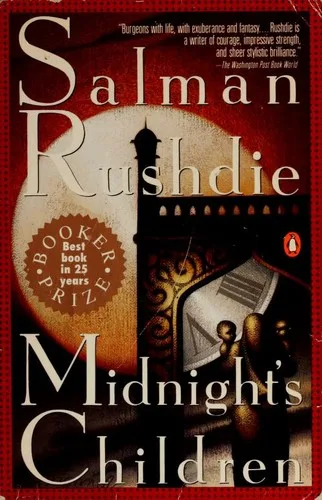
Midnight's Children
 81
81

Midnight's Children
Salman Rushdie’s "Midnight's Children" is a dizzying, audacious novel that attempts to contain the entirety of post-partition India within the life of one man, Saleem Sinai. The sheer linguistic energy and imaginative scope are undeniable; Rushdie crafts sentences that coil and uncoil with remarkable vitality. The conceit of Saleem being born at the precise moment of India's independence, and thus intrinsically linked to its fate, is a potent engine for the narrative. However, the novel’s relentless maximalism can also be its undoing. At times, the sheer volume of fantastical events and historical allusions threatens to overwhelm the reader, creating a sense of narrative fatigue rather than profound connection. The recurring motif of Saleem’s nose, a supposed conduit for his powers, while striking, occasionally feels like a stylistic flourish that doesn't always serve the deeper thematic concerns. Despite these moments of excess, the book’s exploration of identity and history through a lens of magical realism remains a significant achievement in 20th-century literature.
📝 Description
81
Salman Rushdie's 1981 novel links one man's life to India's birth pangs.
Salman Rushdie's "Midnight's Children" chronicles the life of Saleem Sinai, born at the precise moment of India's independence. The narrative unfolds as a magical realist account of modern Indian history, filtered through Saleem's fragmented memories and fantastical pronouncements. Rushdie uses a distinctive, voice-driven style that blurs the lines between personal autobiography and national destiny.
The novel appeals to readers who appreciate literary ambition and a challenging narrative structure. It is suited for those interested in postcolonial literature, magical realism, and historical fiction that questions national identity. Readers who enjoy dense prose, complex plotting, and the absurd will find much to engage with. The book particularly speaks to those exploring the impact of historical events on individual lives and the construction of memory. Its engagement with the political upheaval and fragmentation of India's post-independence struggles, using Saleem's fractured existence as a metaphor for the nation's own, cemented its status.
Published in the wake of India's Emergency period, "Midnight's Children" arrived at a significant moment for Indian literature. Rushdie's work engages directly with the era's political turmoil. The novel's complex handling of history and identity placed it in dialogue with other authors, though its magical realist approach set it apart.
While not strictly an esoteric text in the occult sense, "Midnight's Children" functions on a symbolic level that resonates with esoteric traditions. The concept of individuals born at a specific, charged moment (midnight, independence) gaining special, almost supernatural, abilities mirrors archetypal narratives of chosen ones or those attuned to cosmic shifts. Saleem Sinai's fractured body and mind serve as a microcosm for a nation's post-colonial fragmentation, a theme found in various Gnostic or alchemical interpretations of societal and individual disintegration and potential reintegration.
💡 Why Read This Book?
• You will gain a unique perspective on the chaotic birth of modern India through the allegorical tale of Saleem Sinai, born precisely at midnight on August 15, 1947, whose personal story mirrors the nation's triumphs and traumas. • You will encounter the distinctive style of magical realism that Rushdie pioneered, blending historical events with fantastical elements, exemplified by the "midnight's children" and their extraordinary, often burdensome, powers. • You will explore the complexities of identity formation in a postcolonial context, examining how individual selves are shaped by national narratives, religious divisions, and the lingering effects of partition, as depicted in the novel's sprawling narrative.
⭐ Reader Reviews
Honest opinions from readers who have explored this book.
❓ Frequently Asked Questions
What is the significance of the 'midnight's children' in the novel?
The 'midnight's children' are a group of individuals born precisely at the moment India gained independence on August 15, 1947. Each possesses a unique magical power, and their destinies are symbolically intertwined with the fate of the newly independent nation.
How does "Midnight's Children" relate to India's historical events?
The novel uses Saleem Sinai's life as an allegory for India's journey from independence through various political crises, including the Emergency period (1975-77). Rushdie incorporates specific historical occurrences and figures, reinterpreting them through a magical realist lens.
What is the role of magical realism in the book?
Magical realism is central to "Midnight's Children." It allows Rushdie to explore complex themes of identity, history, and nationhood by blending the fantastical (like telepathic children) with the everyday realities of post-partition India.
Who is Saleem Sinai?
Saleem Sinai is the protagonist and narrator of "Midnight's Children." Born at the stroke of midnight on India's independence day, his life, with its numerous ailments and peculiar abilities, serves as a metaphor for the nation itself.
What is the meaning of the 'pickling' concept in the book?
The 'pickling' of memories, particularly by Saleem's aunt, Padma, refers to the process of preserving and preparing recollections for consumption, often with a bias or selective emphasis, highlighting the subjective nature of historical narrative.
When was "Midnight's Children" first published?
The novel "Midnight's Children" by Salman Rushdie was first published in 1981.
🔮 Key Themes & Symbolism
Identity and Nationhood
The novel intricately links the personal identity of Saleem Sinai to the nascent identity of India itself. Born at the precise moment of independence in 1947, Saleem's physical and psychological fragmentation mirrors the challenges of nation-building in a newly partitioned subcontinent. His peculiar powers and ailments are allegorical representations of India's political, social, and religious complexities. The narrative questions whether a unified national identity can truly exist amidst such diversity and historical trauma, suggesting that individual lives are inextricably bound to the grand, often chaotic, narrative of the state.
The Unreliable Narrator
Saleem Sinai's narration is inherently unreliable, characterized by his fragmented memory, self-serving interpretations, and fantastical embellishments. This narrative technique is crucial to the book's exploration of how history and personal memory are constructed and distorted. The act of 'pickling' memories, as performed by Padma, highlights the deliberate process of shaping the past. Rushdie uses Saleem's subjective account to critique official historical narratives, suggesting that 'truth' is often a fluid, contested, and deeply personal construct, dependent on who is telling the story.
Magical Realism and History
Rushdie employs magical realism not merely as stylistic flair but as a tool to grapple with the immense scale and often surreal nature of India's post-independence experience. The 'midnight's children,' each endowed with extraordinary abilities, represent the potential and peril of a new generation inheriting a fractured legacy. Events like Saleem's telepathic connection to other children or his nose's ability to detect impending doom allow the novel to address political upheavals, such as the Emergency, in ways that a purely realistic approach might not capture. This fusion enables a deeper, more symbolic engagement with historical trauma.
Partition and its Legacy
The trauma of the 1947 Partition, which carved India and Pakistan out of British India, looms large over the novel. The violence, displacement, and lingering animosity stemming from this event are woven into the fabric of the characters' lives and the nation's trajectory. Saleem's own family history is shaped by the upheaval. The novel portrays the lasting divisions and the difficulty of reconciliation, suggesting that the ghosts of partition continue to haunt the subcontinent, influencing subsequent political developments and inter-community relations.
💬 Memorable Quotes
Direct passages from the work, attributed to the author.
“I am the narrator of my own life. My story is the story of India.”
— This statement, encapsulating Saleem's self-perception, highlights the novel's core allegorical premise: the intimate connection between the protagonist's individual destiny and the collective fate of the Indian nation.
“The pickle is the preserved past.”
— This concept, related to Padma's role, suggests that memories are actively preserved and prepared for retelling, implying that historical accounts are often curated and subject to subjective interpretation rather than objective fact.
“We are all children of midnight.”
— This refers to the generation born during India's independence, symbolizing their unique connection to the nation's birth and their shared, though individually manifested, destiny tied to its future.
“My nose knows.”
— A recurring, almost literal, manifestation of Saleem's supernatural abilities, this phrase points to his intuitive or precognitive understanding of events, often preceding their actual occurrence.
“What is a nation if not a family?”
— This rhetorical question probes the relationship between familial bonds and national identity, suggesting that the struggles and successes within a nation can be understood through the lens of interpersonal dynamics.
🌙 Esoteric Significance
Tradition
While "Midnight's Children" is not explicitly tied to a single esoteric tradition, its detailed symbolism and allegorical structure invite interpretations through lenses such as Hermeticism and Gnosticism. The concept of individuals born at a cosmically significant moment (midnight of independence) with inherent, if peculiar, powers echoes Gnostic ideas of select souls possessing divine sparks or hidden knowledge. The fragmented nature of Saleem's identity and his struggle to reconcile disparate parts of his self and history can be seen as a modern manifestation of the Hermetic principle 'As Above, So Below,' where the macrocosm (nation) and microcosm (individual) are mirrors.
Symbolism
The most potent symbol is the 'midnight's children' themselves, representing the collective consciousness and potential of a nation born at a liminal moment between darkness and light. Saleem's own body, constantly ailing and transforming, serves as a symbol of the precarious, ever-changing state of the nation. The recurring motif of the nose, particularly Saleem's, acts as a symbol of perception, connection, and the often-absurd ways in which we attempt to understand and navigate reality. The act of 'pickling' memories can symbolize the preservation of the past, but also its potential for decay or distortion.
Modern Relevance
Contemporary writers exploring themes of diaspora, fragmented identity, and the impact of political history on personal lives continue to draw inspiration from Rushdie's narrative techniques. His bold use of magical realism to address socio-political realities has paved the way for a generation of authors who blend the fantastical with the real to dissect complex cultural and historical landscapes. Thinkers in postcolonial studies and literary criticism frequently cite "Midnight's Children" when examining the construction of national narratives and the subjective nature of historical memory in the 21st century.
👥 Who Should Read This Book
• Students of postcolonial literature: They will gain a foundational text that critically examines the aftermath of empire, nation-building, and the complexities of hybrid identities in the Indian subcontinent. • Readers interested in magical realism: They will encounter a key work that masterfully employs fantastical elements to explore profound historical and personal truths, exemplified by the "midnight's children" and their powers. • Aspiring writers and literary critics: They will find a rich case study in narrative voice, allegorical storytelling, and the use of historical events as a backdrop for deeply personal, character-driven fiction.
📜 Historical Context
Salman Rushdie's "Midnight's Children," published in 1981, emerged at a potent juncture in post-colonial literary history and Indian political discourse. The novel's unflinching portrayal of India's tumultuous post-independence period, particularly its allegorical engagement with the 1975-77 Emergency, struck a chord with readers grappling with the nation's identity. Rushdie's use of magical realism, a style that gained significant traction in global literature during the late 20th century, distinguished his work from more conventional historical narratives. While authors like R.K. Narayan offered more gentle, village-centric portrayals of Indian life, and V.S. Naipaul provided a starkly critical view of post-colonial societies, Rushdie presented a sprawling, fantastical, and deeply personal epic. The novel's critical acclaim, including winning the Booker Prize in 1981 and the prestigious Booker of Bookers in 1993 and Best of the Booker in 2008, cemented its status as a foundational text of post-colonial literature, influencing subsequent generations of writers exploring themes of identity, history, and nationhood.
📔 Journal Prompts
Saleem Sinai's connection to India's fate: How does the narrative link his personal life to national events?
The concept of 'pickling' memories: What does this process reveal about how we construct history?
The powers of the midnight's children: What do their individual abilities symbolize about post-independence India?
Padma's role as listener and narrator: How does her perspective shape Saleem's story?
The fragmentation of Saleem's body and identity: What does this mirror in the nation's history?
🗂️ Glossary
Midnight's Children
A cohort of individuals born precisely at the moment of India's independence on August 15, 1947, each possessing unique magical abilities that are symbolically linked to the nation's destiny.
Pickling
A metaphor used in the novel for the preservation and retelling of memories, often implying a subjective or selective process that shapes the historical narrative, as practiced by Padma.
The Emergency
A period in Indian history from 1975 to 1977 when Prime Minister Indira Gandhi declared a state of emergency, suspending civil liberties and consolidating power. The novel allegorically references this era.
Magical Realism
A literary genre in which fantastical or mythical elements are interwoven into an otherwise realistic narrative, presented without explanation or suspension of disbelief.
Partition
The division of British India into two independent states, India and Pakistan, in 1947, which resulted in widespread violence and displacement.
Allegory
A story, poem, or picture that can be interpreted to reveal a hidden meaning, typically a moral or political one. Saleem's life is an allegory for India's post-independence journey.
Aadam Aziz
Saleem Sinai's grandfather, a doctor who returns to Kashmir after studying in Europe, representing a bridge between tradition and modernity and playing a key role in the family's lineage.
🔮 Readers Also Liked
Browse all →









More by Salman Rushdie
All books →





More Free Occult Philosophy Books
View all →