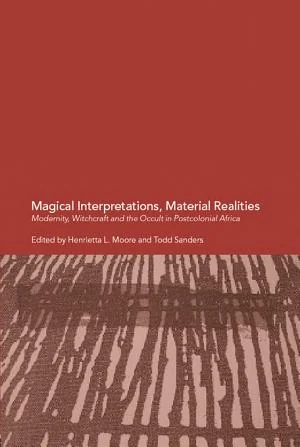
Magical Interpretations, Material Realities
 80
80

Magical Interpretations, Material Realities
Henrietta L. Moore and Todd Sanders's 2001 collection, Magical Interpretations, Material Realities, offers a crucial corrective to the often-reductive framing of African witchcraft. It moves beyond the colonial gaze, insisting that occult beliefs are not remnants of a "traditional" past but active forces shaping contemporary social and political life. The strength of the volume lies in its consistent focus on the empirical and the political; these are not abstract theories of magic, but analyses grounded in specific African contexts. One particularly striking aspect is the exploration of how accusations of witchcraft can serve as a language for articulating moral anxieties in the face of rapid social and economic change, a point effectively illustrated in discussions of urban settings. A potential limitation for some readers might be the dense academic prose, which requires a certain familiarity with anthropological and sociological theory. Nevertheless, the collection provides a vital framework for understanding the enduring power of the occult imaginary in modern African realities, making it an important contribution to the field.
📝 Description
80
Published in 2001, Magical Interpretations, Material Realities challenged the view of witchcraft as a relic of the past in Africa.
This 2001 scholarly collection questions the common link between "witchcraft" and "traditional" Africa. Instead of stereotyping, the book uses occult beliefs and practices to analyze the complex moral politics and current realities of African societies. It gathers different viewpoints from academics to show how magical thinking connects with modern life, moving beyond simple ideas.
The book is for academics, researchers, and students in anthropology, sociology, religious studies, African studies, and cultural studies. It will also interest critical thinkers who examine how belief systems, power, and politics work together in non-Western areas. Readers wanting a deeper understanding of magic and occult ideas in today's world will find it useful.
Magical Interpretations, Material Realities appeared during a time when scholars were reconsidering African societies. The common idea was that "witchcraft" belonged to the past and was opposed to modernity. This volume argued against that, showing its continued importance for understanding current social, economic, and political issues. It joined work by scholars like P.F. de Moraes Farias and Wim van Binsbergen, who were looking at the actual lives of occult beliefs in Africa, moving away from older colonial anthropological views.
This book engages with the academic study of witchcraft and magic not as a set of disconnected rituals, but as a lens through which to understand social and political dynamics. It positions itself against earlier, often colonial, interpretations that viewed African magic as inherently primitive or disappearing. By examining the "occult imaginary," it highlights how these belief systems actively shape perceptions and actions in contemporary life, contributing to ongoing debates about the persistence and adaptation of occult thought in the face of modernization. It aligns with scholarly traditions that investigate the lived experience and social functions of belief.
💡 Why Read This Book?
• Gain a nuanced understanding of how "witchcraft" functions as a contemporary moral and political force in Africa, moving beyond simplistic, exoticizing narratives, as demonstrated by the analyses of social control mechanisms discussed within the volume. • Explore the concept of the "occult imaginary" and its tangible impact on daily life and social structures, particularly in the context of rapid modernization and its associated anxieties, as presented in the scholarly essays. • Reframe your perspective on the relationship between belief systems and material realities, recognizing how occult beliefs are deeply intertwined with modern economic and political challenges, a central argument of the collection first published in 2001.
⭐ Reader Reviews
Honest opinions from readers who have explored this book.
❓ Frequently Asked Questions
What is the central argument of Magical Interpretations, Material Realities?
The book's central argument is that "witchcraft" and occult beliefs in contemporary Africa are not relics of the past but are integral to understanding modern moral politics and social realities, challenging colonial-era exoticism.
Who are the primary academic disciplines that would benefit from reading this book?
Academics and students in anthropology, sociology, religious studies, African studies, and cultural studies will find this book particularly relevant due to its focus on contemporary African societies and belief systems.
When was Magical Interpretations, Material Realities first published?
The collection was first published in 2001, positioning it as a key text in the late 20th and early 21st-century re-evaluation of occult phenomena in Africa.
Does the book focus solely on rural African traditions?
No, the book specifically addresses "very modern African realities" and brings together scholars examining contemporary issues, including those in urban settings, demonstrating the ongoing relevance of occult beliefs.
What does the book mean by 'occult imaginary'?
The 'occult imaginary' refers to the pervasive cultural framework of magical thinking that influences how people perceive the world, interact with each other, and interpret events, even in purportedly modern contexts.
Are the essays in the book based on fieldwork?
While not all essays may detail specific fieldwork, the collection is built upon scholarly analyses of contemporary African realities, drawing from research that engages with lived experiences and social dynamics.
🔮 Key Themes & Symbolism
Witchcraft and Modernity
This theme unpacks the persistent association of witchcraft with "traditional" Africa and argues against this outdated framing. The essays demonstrate how occult beliefs and practices are not antithetical to modernity but are deeply embedded within contemporary African social, economic, and political landscapes. It examines how these beliefs continue to shape moral discourse and social relations in the face of rapid change, urbanization, and globalization, challenging readers to see witchcraft as a dynamic force in the present.
Moral Politics and Social Control
The collection interrogates how notions of witchcraft and occult powers function within the moral economies of African societies. It explores how accusations and beliefs surrounding sorcery can serve as mechanisms for social commentary, dispute resolution, and the enforcement of norms. This theme highlights the political dimensions of belief, showing how the 'occult imaginary' is used to navigate and articulate anxieties related to power, status, and social justice in complex, often rapidly changing, environments.
The Occult Imaginary
This theme focuses on the pervasive cultural framework of magical thinking and its influence on perceptions and actions. The book posits that the 'occult imaginary' is a powerful lens through which individuals and communities interpret events, understand causality, and construct social realities. It moves beyond viewing these beliefs as mere superstition, instead analyzing them as a significant aspect of lived experience and social organization that intersects with material conditions.
Challenging Exoticism
A core objective of the volume is to dismantle the colonial legacy of exoticizing African cultures through the lens of "witchcraft." By presenting scholarly analyses of contemporary realities, the book aims to replace simplistic, romanticized, or fearful portrayals with nuanced understandings. It emphasizes the agency of African peoples and the intellectual sophistication involved in their engagement with occult beliefs as part of modern life, moving towards a more accurate representation.
💬 Memorable Quotes
Direct passages from the work, attributed to the author.
“The theme of 'witchcraft' has long been associated with exoticizing portraits of a 'traditional' Africa.”
— This statement from the original blurb sets the stage by identifying a prevalent, problematic academic and popular trope that the volume seeks to dismantle through its scholarly approach.
“This volume takes the question of occult as a point of entry into the moral politics of some very modern African realities.”
— This highlights the book's methodological innovation: using occult beliefs not as a subject in themselves, but as a critical tool to understand contemporary political and ethical dynamics in Africa.
“These essays bear eloquent testimony to the ongoing presence and power of the occult imaginary.”
— This emphasizes the collection's central thesis – that magical thinking remains a potent force, actively shaping the social and cultural landscape, rather than being a fading relic of the past.
“The collection examines the intersection of magical interpretations and material realities.”
— This core idea underscores the book's commitment to grounding abstract beliefs in concrete social, economic, and political contexts, rejecting a purely spiritual or symbolic interpretation.
💡 Key Ideas
Editorial paraphrase of the work's core concepts — not direct quotes.
The work explores how accusations of witchcraft can function as mechanisms for social control.
This paraphrased concept points to a key analytical function discussed within the book: understanding the social and political utility of witchcraft beliefs in maintaining order or expressing dissent.
🌙 Esoteric Significance
Tradition
While not strictly adhering to a singular Western esoteric lineage like Hermeticism or Kabbalah, the work engages with the broader esoteric concept of hidden knowledge and unseen forces influencing the material world. It intersects with anthropological studies of shamanism and indigenous cosmologies, which often contain elements understood esoterically as concerning spirit interaction, divination, and the manipulation of subtle energies. The book’s significance lies in its rigorous academic application of these concepts to understand contemporary social dynamics, rather than focusing on ritual practice within a defined esoteric school.
Symbolism
The primary symbolic motif is "witchcraft" itself, which the book reinterprets not just as a literal belief but as a potent symbol for articulating anxieties about power, social disruption, and moral order in the face of modernity. Other symbolic elements explored implicitly include accusations, divination practices, and healing rituals, which function as symbols of contested social realities, attempts to impose order, or expressions of collective distress within specific African communities.
Modern Relevance
Contemporary thinkers and activists engaging with post-colonial studies, critical race theory, and the anthropology of religion draw upon the frameworks established in Magical Interpretations, Material Realities. Scholars examining the resurgence of spiritual movements, the impact of globalization on local belief systems, and the political uses of religious or occult discourse in various global contexts find the book's analytical approach highly relevant. It provides a model for understanding how seemingly non-modern belief systems continue to offer potent frameworks for interpreting and acting within the modern world.
👥 Who Should Read This Book
• Scholars of African Studies and Anthropology: To deepen their understanding of contemporary social dynamics, moral economies, and the role of belief systems beyond outdated colonial frameworks. • Students of Religious Studies and Sociology: To analyze how occult phenomena intersect with power structures, social control, and the articulation of anxieties in diverse cultural contexts. • Critical Thinkers interested in Global Belief Systems: To challenge conventional notions of modernity versus tradition and explore how "magical" interpretations actively shape material realities worldwide.
📜 Historical Context
Published in 2001, Magical Interpretations, Material Realities emerged during a critical juncture in the study of African societies. The late 20th century saw a growing scholarly pushback against the colonial-era tendency to frame African cultures, particularly their engagement with the occult, as static and divorced from modernity. This volume contributed significantly to this re-evaluation, directly challenging the notion that witchcraft was merely a vestige of a "traditional" past. It engaged with intellectual currents that sought to understand the persistence and adaptation of indigenous belief systems within rapidly changing socio-economic and political environments. Contemporaries like Deborah Heath and P.F. de Moraes Farias were similarly exploring the complexities of African ritual and belief, often engaging with post-colonial theory. The book’s approach, focusing on the "moral politics" of occult phenomena, offered a more nuanced perspective than earlier anthropological studies and provided a vital counterpoint to simplistic views that often dominated Western perceptions.
📔 Journal Prompts
The moral politics of witchcraft accusations: How do contemporary social anxieties manifest through claims of occult influence?
Interrogating the 'occult imaginary': How does a belief in unseen forces shape perceptions of causality in everyday life?
Examining the critique of exoticism: How have scholarly approaches to non-Western belief systems evolved since 2001?
Material realities and magical interpretations: Where do these intersect in your own cultural context?
The power of belief: How do collective beliefs, whether religious or occult, influence social action and political discourse?
🗂️ Glossary
Occult Imaginary
A cultural framework or collective mindset wherein beliefs in hidden forces, magic, and supernatural agencies significantly shape the interpretation of events and social interactions.
Moral Politics
The interplay between ethical judgments, social norms, and political power dynamics, often expressed through beliefs and practices related to good and evil, justice, and social order.
Exoticizing
The act of portraying a culture or group as foreign, strange, and fascinating, often based on stereotypes and a romanticized or fearful perception of difference.
Material Realities
The concrete, tangible aspects of existence, including economic conditions, social structures, political systems, and physical environments, which influence and are influenced by belief systems.
Social Control
Mechanisms and processes used by societies or groups to regulate individual and group behavior, ensuring conformity to established norms and values.
Contemporary Africa
Refers to the diverse and evolving social, political, economic, and cultural landscapes of the African continent in the late 20th and early 21st centuries, challenging monolithic or outdated representations.
Witchcraft Accusations
The act of attributing misfortune, illness, or harm to the malevolent actions of individuals believed to possess supernatural powers, often serving social or political functions within a community.
This book appears in 1 collection
🔮 Readers Also Liked
Browse all →








From the “Witchcraft” Collection
View all →


![BAILEY, Michael D. Historical Dictionary Of Witchcraft. [inglês]](/img/thumb/bailey-michael-d-historical-dictionary-of-witchcraft-ingl-s.webp)



More Free Occult Philosophy Books
View all →