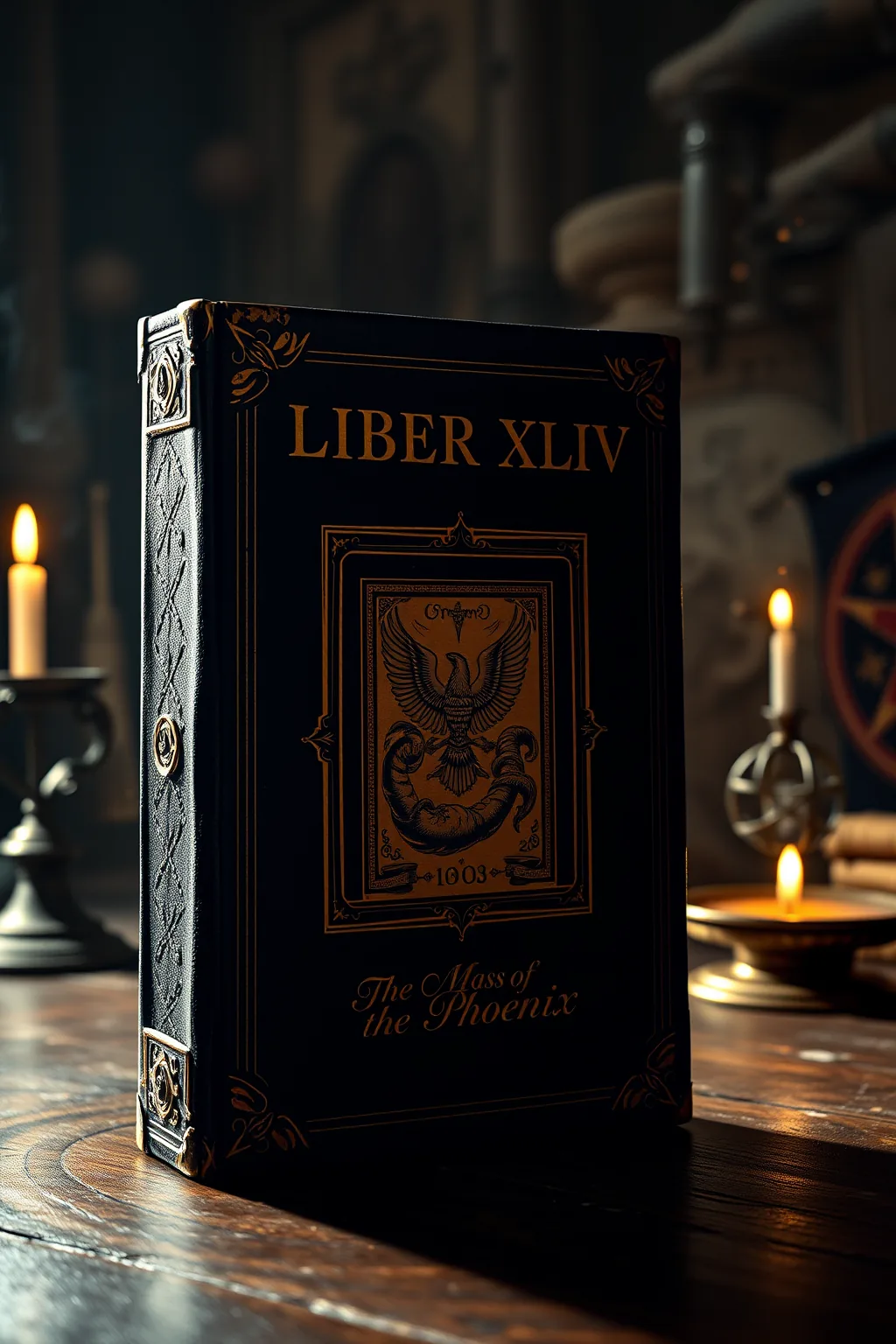
LIBER XLIV THE MASS OF THE PHOENIX
 83
83

LIBER XLIV THE MASS OF THE PHOENIX


Silas Hawthorne (Hermetic Studies Editor) — 'Liber XLIV: The Mass of the Phoenix' is a masterfully condensed ritual, offering a potent distillation of alchemical and Masonic symbolism. Its strength lies in its directness, eschewing lengthy exposition for pure, evocative action. The Magician's solitary communion with the altar and the elemental tools underscores themes of self-initiation and inner transformation. This text is indispensable for serious practitioners of Western esotericism, particularly those within Masonic or Rosicrucian lineages, who seek to understand the practical application of symbolic gestures and the potent archetype of the Phoenix. Its brevity belies its profound depth, making it a valuable, albeit challenging, addition to any occult library.
📝 Description
83
Published anonymously, Liber XLIV details Masonic ritual and symbolic transformation.
This text, known as 'The Mass of the Phoenix,' describes Masonic ritualistic practices and their symbolic meanings. It details the preparation and use of ritual tools such as the burin, bell, and thurible, as well as the sacred Cakes of Light. The work illustrates the gesture of the 'Sign of the Enterer,' a ritualistic act to invoke unseen forces.
'The Mass of the Phoenix' functions as a guide for personal transformation, likening the process to alchemical rebirth. It addresses those seeking a deeper comprehension of existence's underlying principles and the archetypal powers influencing reality. The book's imagery aims to evoke a sense of mystery and sacred purpose, guiding the serious practitioner toward spiritual enlightenment and the unlocking of inner potential.
Emerging from the mystique surrounding Freemasonry and secret societies, 'Liber XLIV' connects to a tradition of esoteric texts that encode spiritual teachings within ritualistic frameworks. It echoes the alchemical pursuit of transformation, often framed as a death and rebirth cycle, and aligns with practices that seek to channel or commune with hidden energies. The book’s emphasis on symbolic gestures and sacred objects is characteristic of ceremonial magic traditions that aim to facilitate inner change and connect the practitioner to archetypal forces.
💡 Why Read This Book?
Unveil the secrets of alchemical rebirth and personal transformation. 'The Mass of the Phoenix' offers a direct, symbolic ritual for shedding limitations and embracing spiritual renewal. Ideal for occult practitioners, Masonic initiates, and seekers of hidden knowledge who wish to engage with potent archetypes and experience profound inner change.
⭐ Reader Reviews
Honest opinions from readers who have explored this book.
❓ Frequently Asked Questions
What is the primary purpose of 'The Mass of the Phoenix'?
Its primary purpose is to serve as a ritualistic text for spiritual rebirth and transformation, drawing heavily on alchemical and Masonic symbolism. It guides the practitioner through a symbolic process of death and resurrection.
Who is the 'Magician' in this text?
The 'Magician' represents the dedicated practitioner undertaking the ritual. They embody the seeker of hidden knowledge and the agent of their own spiritual evolution.
What does the 'Phoenix' symbolize in this context?
The Phoenix symbolizes cyclical rebirth, immortality, and the alchemical process of transmutation. It represents the shedding of the old self to rise anew, purified and enlightened.
Are prior knowledge of Freemasonry required to understand this text?
While familiarity with Masonic symbolism can enhance understanding, the text's core themes of transformation and spiritual journey are accessible to dedicated seekers of esoteric knowledge. It invites intuitive interpretation.
What is the significance of the tools mentioned (Burin, Bell, Thurible, Cakes of Light)?
These tools are imbued with symbolic meaning: the Burin for inscription/creation, the Bell for invocation/announcement, the Thurible for purification/offering, and the Cakes of Light for sustenance and divine connection, all integral to the ritual's efficacy.
🔮 Key Themes & Symbolism
Alchemical Transmutation and Rebirth
Fundamentally, , 'The Mass of the Phoenix' is a profound exploration of alchemical principles, specifically the concept of transmutation and rebirth. The ritualistic act mirrors the alchemist's quest to transform base metals into gold, but applied to the spiritual and psychic planes. The practitioner begins a journey of shedding the limitations of the old self – the metaphorical dross – to emerge as a purified, enlightened being, akin to the legendary Phoenix rising from its ashes. This theme emphasizes the transformative potential inherent within the human spirit and the possibility of achieving a higher state of consciousness through dedicated practice and ritualistic engagement.
The Power of Ritual and Symbolism
This text highlights the essential role of ritual and symbolism in accessing deeper levels of consciousness and connecting with archetypal forces. The specific actions, gestures (like the Sign of the Enterer), and objects (Burin, Bell, Thurible, Cakes of Light) are not arbitrary but are charged with ancient meaning and energetic significance. The ritual acts as a bridge between the mundane and the sacred, creating a sacred space where transformation can occur. It underscores the belief that through precise and intentional engagement with these symbolic elements, the practitioner can invoke specific energies and facilitate profound internal shifts, unlocking latent potentials and reading through the hidden currents of existence.
Self-Initiation and the Inner Magician
The solitary Magician standing before the altar signifies the journey of self-initiation. The ritual is an intensely personal undertaking, emphasizing the individual's capacity to effect their own spiritual evolution. It speaks to the concept of the 'Inner Magician' – the inherent power and wisdom residing within each person, waiting to be awakened and directed. The act of reaching across the altar and crying out is a declaration of intent and a powerful assertion of the will to transcend limitations. This theme encourages the reader to recognize their own agency in their spiritual path and to actively engage in practices that foster self-discovery and empowerment.
💬 Memorable Quotes
Direct passages from the work, attributed to the author.
“In the Sign of the Enterer he reaches West across the Altar...”
— This signifies a powerful invocation and a directed movement towards the unknown or the field of higher consciousness, marking an important moment of transition within the ritual.
“...and cries: Return”
— A potent call for manifestation or the return of lost wisdom, this cry is an act of will, commanding the unseen forces to respond to the practitioner's intent.
“The Magician, his breast bare, stands before an altar...”
— Symbolizes vulnerability, sincerity, and an offering of the true self to the sacred work, indicating readiness for profound spiritual exchange.
“...on which are his Burin, Bell, Thurible, and two of the Cakes of Light.”
— These sacred tools represent the instruments of creation, invocation, purification, and spiritual sustenance, vital components for the ritual's efficacy and symbolic depth.
“The Mass of the Phoenix”
— This title itself captures the core theme: a sacred ceremony of spiritual renewal, death, and resurrection, drawing parallels with the mythical bird's eternal cycle.
🌙 Esoteric Significance
Tradition
This text is deeply embedded within the Western Esoteric Tradition, specifically drawing from Hermeticism, Alchemy, and Freemasonry. It represents a modern interpretation and application of ancient principles concerning spiritual transformation, self-initiation, and the symbolic death and rebirth of the individual consciousness. Its ritualistic format aligns with practices found in various occult orders that seek to transmit hidden knowledge through symbolic acts and archetypal engagement.
Symbolism
Key symbols include the Phoenix (rebirth, immortality, alchemical perfection), the Altar (sacred space, point of communion), the Burin (creation, inscription), the Bell (invocation, announcement), the Thurible (purification, offering), and the Cakes of Light (spiritual nourishment, divine connection). The 'Sign of the Enterer' is a specific gesture signifying penetration and access to hidden realms, while the direction 'West' often represents the setting sun, completion, or the field of the soul.
Modern Relevance
In an age often characterized by fragmentation and spiritual searching, 'The Mass of the Phoenix' offers a potent, self-contained ritual for profound personal transformation. It provides a framework for individuals seeking to engage with ancient wisdom, cultivate inner strength, and experience symbolic rebirth. Its emphasis on the individual's agency in achieving spiritual evolution makes it highly relevant for contemporary practitioners seeking practical tools for self-mastery and enlightenment in a complex world.
👥 Who Should Read This Book
This text is primarily for the dedicated seeker of esoteric knowledge, the practitioner of occult arts, and the initiate familiar with symbolic language. It will resonate deeply with members of Masonic fraternities or those studying their esoteric underpinnings. Beginners might find it dense but rewarding if approached with an open mind and a willingness to engage with its symbolic depth. Scholars of comparative religion and occult history will find it a valuable primary source for understanding ritualistic practices. Ultimately, anyone on a path of self-discovery and spiritual transformation, seeking a powerful ritual for renewal, will find profound value within its pages.
📜 Historical Context
Emerging from the wide range of esoteric thought that flourished in the late 19th and early 20th centuries, 'Liber XLIV: The Mass of the Phoenix' is deeply rooted in the revival of Hermeticism, Rosicrucianism, and Freemasonry. This era witnessed a significant resurgence of interest in ancient mysteries, occult sciences, and mystical philosophies, often as a reaction against the perceived materialism and rationalism of the age. Figures like Aleister Crowley, who published his own 'Liber' series, were instrumental in codifying and disseminating such practices. The text likely reflects the symbolic language and ritualistic structures prevalent within clandestine orders of the time, aiming to provide a condensed yet potent ritual for individual spiritual development and initiation. Its very structure, a 'Mass,' connects it to older liturgical forms while reinterpreting them through an esoteric lens, emphasizing personal experience over dogma.
📔 Journal Prompts
Reflect on a time you felt you 'died' and were 'reborn' spiritually. What lessons did you learn?
How can the symbolism of the Phoenix be applied to overcoming a current challenge in your life?
What does the 'breast bare' signify to you in the context of spiritual work? How can you embody this vulnerability?
Meditate on the functions of the Burin, Bell, and Thurible. How can these symbolic actions be enacted in your daily life?
If you were to perform this ritual, what would you be 'crying for' to return to your life or consciousness?
🗂️ Glossary
Burin
A sharp metal tool used for engraving or carving. In ritual context, it symbolizes the power to inscribe, create, or define spiritual realities through focused intent and action.
Thurible
A censer, typically a metal vessel on a chain, used for burning incense. Symbolically, it represents purification, the carrying of prayers or offerings to the divine, and the creation of sacred atmosphere.
Cakes of Light
Sacred or ritualistic food items, often symbolic of spiritual nourishment, divine sustenance, or the materialized essence of light or consciousness required for ritual efficacy.
Sign of the Enterer
A specific hand gesture or posture used in esoteric rituals, often signifying penetration, access, or the act of entering a sacred space or dimension. Its precise form can vary between traditions.
Altar
A raised surface or structure used for religious or sacred rites, offerings, or communion. In esoteric practice, it serves as a focal point for intention, a bridge between the practitioner and the divine, or a place of sacred transformation.
This book appears in 2 collections
🔮 Readers Also Liked
Browse all →









From the “Secret Societies” Collection
View all →


More Free Freemasonry & Secret Societies Books
View all →