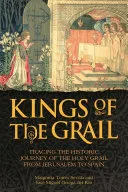
Kings of the Grail
 77
77

Kings of the Grail
Margarita Torres Sevilla and José Miguel Ortega del Río's Kings of the Grail offers a welcome dose of scholarly rigor to a subject often mired in unsubstantiated claims. The authors excel at sifting through centuries of historical and literary evidence, providing a clear chronological account of the legend's development. Their examination of early Grail romances, particularly the lineage tracing back to Chrétien de Troyes's *Perceval*, grounds the discussion effectively. A notable strength is the authors' balanced approach, acknowledging the enduring appeal of the Grail mystery without succumbing to facile speculation. However, the book's density may prove challenging for readers unfamiliar with medieval literature or historical research methodologies. The section detailing the various 19th-century interpretations, while informative, could have benefited from a more concise synthesis. Ultimately, Kings of the Grail is a valuable resource for serious researchers, offering a lucid and well-supported exploration of the artifact's complex history.
📝 Description
77
In 2017, Margarita Torres Sevilla and José Miguel Ortega del Río published Kings of the Grail, a historical investigation into the Holy Grail's origins.
Kings of the Grail examines the historical basis and narrative evolution of the Holy Grail legend. The authors move beyond myth to trace the artifact's story through centuries of literature, art, and religious devotion. They meticulously analyze competing claims, offering a scholarly perspective on one of history's most persistent mysteries. This book is for serious students of Grail lore, historians of religious artifacts, and researchers interested in the intersection of faith, legend, and material culture. It appeals to those who prefer rigorous analysis over speculative fiction, seeking a grounded understanding of how the Grail narrative developed and its impact on Western thought.
The work situates the Grail legend within its historical milieu, showing how notions of chivalry, courtly love, and Christian mysticism converged in medieval Europe. It acknowledges the earliest known literary appearances of Grail stories, such as those by Chrétien de Troyes in the late 12th century. The authors then examine how these tales were later expanded and reinterpreted, demonstrating the legend's adaptability.
Central to the work is the dual nature of the Grail as both a physical object and a symbolic concept. It discusses the transition of the Grail from a possibly pagan or mystical vessel to its Christianization, and its subsequent transformation into a symbol of spiritual quest. The authors investigate various proposed historical candidates for the Grail, evaluating the evidence presented for each.
This book engages with the historical dimensions of a legend deeply embedded in Western esoteric traditions. While focusing on historical analysis rather than occult practice, it addresses the symbolic transformations of the Grail, from a potential pagan artifact to a central Christian icon and a metaphor for spiritual pilgrimage. By tracing its literary and cultural journey, the authors touch upon how symbolic objects become imbued with meaning across different belief systems and historical periods, a core concern in the study of esoteric symbolism.
💡 Why Read This Book?
• Gain a concrete understanding of the Grail's literary evolution, from Chrétien de Troyes's late 12th-century romances to later interpretations, distinguishing historical fact from developing legend. • Learn to critically assess historical claims by examining the evidence presented for various proposed Grail artifacts, understanding the challenges in authenticating relics from the medieval period. • Explore the interplay between religious devotion, chivalric ideals, and artistic expression that shaped the Grail narrative, as detailed in the book's analysis of 13th-century continuations.
⭐ Reader Reviews
Honest opinions from readers who have explored this book.
❓ Frequently Asked Questions
What is the earliest known literary mention of the Grail?
The work points to Chrétien de Troyes's unfinished romance, *Perceval, le Conte du Graal*, written around 1180-1190, as one of the earliest significant literary appearances of the Grail concept.
Do the authors claim to have found the historical Holy Grail?
No, the authors do not claim to have definitively identified the historical Holy Grail. Instead, they meticulously research the legend's origins and the various historical and symbolic interpretations that have emerged over centuries.
Which historical periods does Kings of the Grail primarily focus on?
The book primarily focuses on the medieval period, particularly the 12th and 13th centuries when the Grail legend first gained prominence in literature, and also examines later centuries of interpretation.
What distinguishes this book from purely fictional accounts of the Grail?
Kings of the Grail distinguishes itself through its scholarly, research-driven approach, analyzing historical documents and literary sources rather than creating new narratives or relying on unsubstantiated mystical claims.
Are specific artifact theories discussed?
Yes, the book discusses various theories and proposed candidates for the historical Grail artifact, evaluating the historical and textual evidence associated with them.
What is the significance of the Grail in medieval literature?
In medieval literature, the Grail evolved from a mysterious vessel to a potent symbol of spiritual quest, divine grace, and Christian perfection, deeply influencing Arthurian romances.
🔮 Key Themes & Symbolism
The Grail as Literary Trope
This theme examines the Holy Grail not merely as a religious artifact but as a powerful literary device that emerged in late 12th-century France. The work traces how Chrétien de Troyes's unfinished *Perceval* introduced a mysterious vessel, which subsequent authors expanded into a complex symbol of spiritual pursuit and divine mystery. The authors analyze how this literary concept evolved, absorbing elements of chivalry and Christian theology, becoming a core part of Arthurian legend and inspiring countless retellings.
Historical Artifact vs. Symbolic Vessel
Kings of the Grail grapples with the persistent question of the Grail's historicity. It meticulously explores the various proposed physical candidates for the artifact, from the chalice of the Last Supper to other relics, while critically assessing the historical evidence supporting each claim. This theme highlights the tension between the desire for a tangible object and the Grail's potent symbolic function as a representation of faith, purity, and the ultimate spiritual goal.
Medieval Religious and Courtly Culture
The book situates the Grail legend firmly within the context of 12th and 13th-century European culture. It demonstrates how the developing narrative reflects the era's religious fervor, the ideals of courtly love, and the burgeoning tradition of Arthurian romance. The authors illustrate how the Grail quest became intertwined with the spiritual journeys of knights like Perceval and Galahad, embodying a synthesis of martial prowess and divine aspiration characteristic of medieval Christendom.
Evolution of the Legend
This theme focuses on the dynamic transformation of the Grail legend across centuries. From its nascent literary form, the Grail narrative was continuously reinterpreted, adapted, and imbued with new meanings by different authors and cultural movements. The work charts this evolution, showing how the symbol shifted and resonated differently in various historical periods, from medieval mysticism to later esoteric and romantic interpretations, demonstrating its enduring adaptability.
💬 Memorable Quotes
Direct passages from the work, attributed to the author.
“The Grail's history is a story of interpretation.”
— This concise statement captures the book's core argument: the enduring power of the Grail lies not necessarily in a single, verifiable object, but in its capacity to be understood and reimagined through different historical and cultural lenses.
“Chrétien de Troyes's work marks an important point.”
— This highlights the foundational role of Chrétien's late 12th-century romance in establishing the Grail narrative within Western literature, setting the stage for centuries of subsequent development and exploration of its themes.
“Many proposed 'Grails' lack solid historical backing.”
— This reflects the authors' critical approach, emphasizing that while numerous objects have been identified as the Grail, rigorous historical scrutiny often reveals insufficient evidence to substantiate these claims.
“The quest is often more significant than the object.”
— This interpretation suggests that the spiritual and symbolic journey undertaken by Grail questers, as depicted in literature, holds profound meaning, perhaps even eclipsing the importance of finding a literal artifact.
“Medieval concepts of purity and divinity shaped the Grail.”
— This points to the theological and ethical framework of the Middle Ages, where ideals of spiritual purity and divine connection were central, profoundly influencing the symbolic meaning attributed to the Grail.
🌙 Esoteric Significance
Tradition
While grounded in historical and literary scholarship, Kings of the Grail inevitably touches upon traditions that view the Grail as more than a relic. It relates to the broader Western Esoteric Tradition's interest in sacred objects and quest narratives, particularly those seeking spiritual enlightenment or hidden knowledge. The book provides historical context for later esoteric interpretations that see the Grail as a symbol of inner attainment or a repository of ancient wisdom, though the authors maintain a scholarly distance from purely mystical claims.
Symbolism
Key symbols explored include the chalice itself, representing spiritual nourishment, divine grace, and the feminine principle in some traditions. The quest narrative, particularly the journey undertaken by knights like Galahad, symbolizes the arduous path toward spiritual perfection and the purification of the soul. The Grail Castle (Corbenic) often represents a sacred space or the culmination of the spiritual journey, a place of divine revelation accessible only to the worthy.
Modern Relevance
Contemporary thinkers and practitioners within spiritual and historical research circles continue to draw on the historical framework provided by works like Kings of the Grail. It informs modern interpretations of Grail symbolism in consciousness studies, comparative mythology, and neo-Arthurian movements seeking to understand archetypal patterns. The book's rigorous approach serves as a vital counterpoint to purely speculative or New Age interpretations, providing a solid foundation for understanding the Grail's enduring cultural and symbolic power.
👥 Who Should Read This Book
• Academic researchers and students of medieval literature and history, seeking a comprehensive overview of the Grail's textual development and historical context. • Enthusiasts of Arthurian legends and Western esoteric traditions who desire a fact-based exploration distinguishing historical inquiry from mythic speculation. • Historians of religion and artifact studies interested in how legends surrounding relics evolve and are interpreted across different eras.
📜 Historical Context
Published in 2015, Kings of the Grail emerged in an era of renewed interest in historical artifacts and esoteric traditions, building upon a long scholarly tradition of Grail research. The work engages with the legacy of figures like Jessie Weston, whose 1920 book *From Ritual to Romance* significantly influenced T.S. Eliot's *The Waste Land*, by exploring the Grail's potential pre-Christian roots. The authors operate within the intellectual currents that seek to demythologize religious and legendary objects, applying critical historical methods to sacred narratives. While not facing direct censorship, the Grail legend itself has a complex reception history, often relegated to folklore or dismissed by mainstream academia, a challenge Torres Sevilla and Ortega del Río address through their meticulous sourcing and analytical rigor.
📔 Journal Prompts
The transition of the Grail from literary object to symbolic quest.
Evidence supporting or refuting proposed historical Grail candidates.
The role of chivalric ideals in shaping the Grail narrative.
Comparing Chrétien de Troyes's initial concept with later interpretations.
The Grail as a reflection of medieval Christian spirituality.
🗂️ Glossary
Holy Grail
A legendary object of great significance, often depicted as a cup or chalice, central to Arthurian literature and Christian tradition, symbolizing spiritual quest and divine mystery.
Chrétien de Troyes
A 12th-century French poet credited with one of the earliest literary appearances of the Grail in his unfinished romance, *Perceval, le Conte du Graal*.
Arthurian Legend
A body of literature and tales concerning the legendary King Arthur, his knights (such as Lancelot and Galahad), and the events of their time, including the Grail quest.
Perceval
A key character in Arthurian legend, often depicted as the Grail Knight who achieves the Grail quest due to his purity and innocence.
Relic
An object considered holy because of its association with a saint or with Jesus Christ, often the subject of veneration and pilgrimage.
Courtly Love
A medieval concept of love, often idealized and non-physical, emphasizing chivalry, devotion, and nobility, which influenced Arthurian romances.
Esoteric
Intended for or likely to be understood by only a small number of people with a specialized knowledge or interest; dealing with hidden or secret matters.