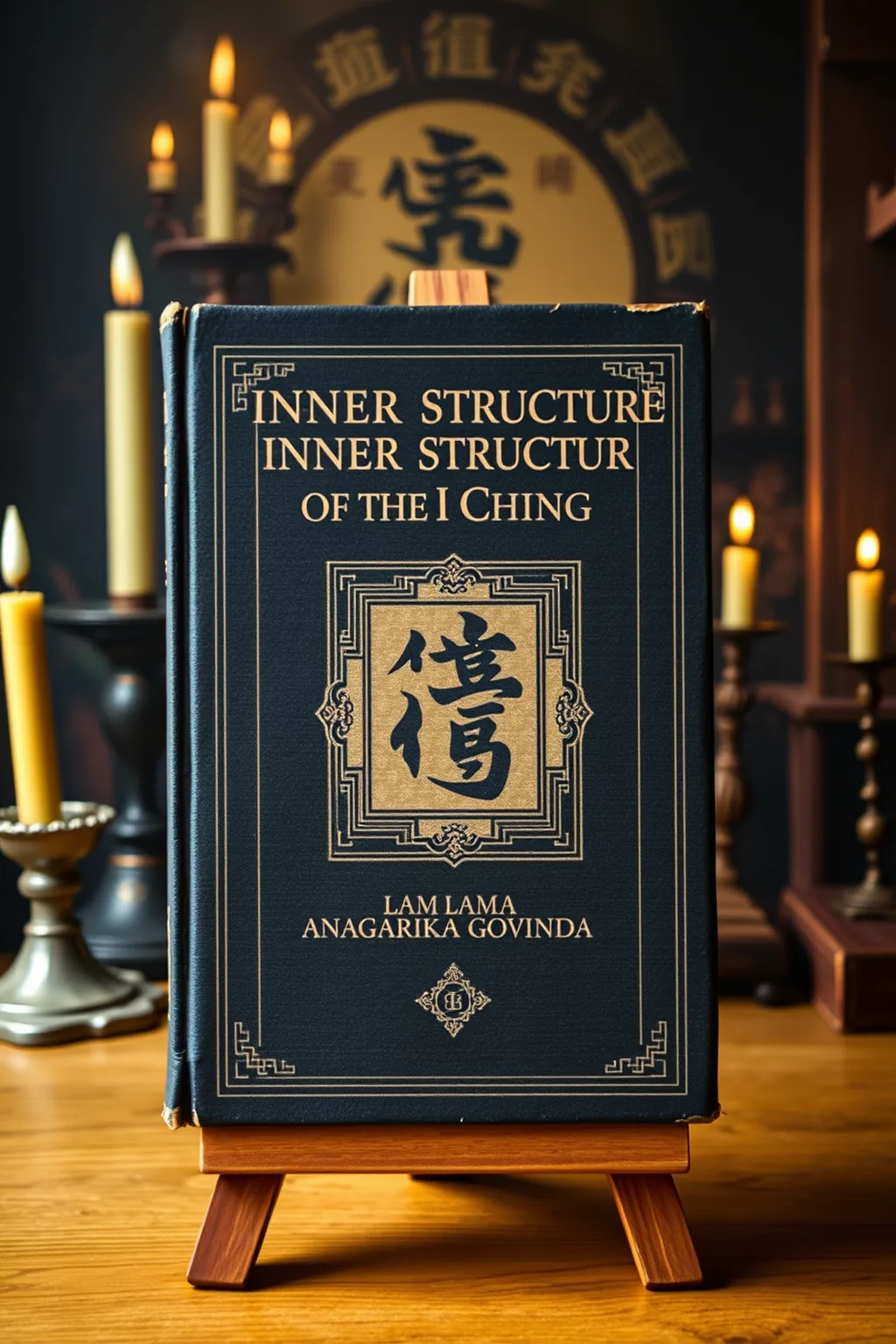
Inner Structure of the I Ching
 61
61

Inner Structure of the I Ching



Ophelia Vance, Mystical Literature Reviewer — Lama Anagarika Govinda's 'Inner Structure of the I Ching' is an indispensable key for unlocking the profound esoteric dimensions of this ancient wisdom tradition. Govinda's masterful exposition moves beyond superficial interpretation, delving into the philosophical and spiritual underpinnings that make the I Ching a potent tool for self-realization. He brilliantly illuminates the symbolic language and the cosmic principles embedded within each hexagram, offering practitioners and scholars alike a deeper, more intuitive understanding. This work is a testament to the I Ching's enduring power as a guide for navigating both the external world and the inner landscape of the soul, making it essential reading for anyone serious about the art of spiritual inquiry.
📝 Description
61
Lama Anagarika Govinda published 'Inner Structure of the I Ching' to reveal its cosmological and psychological depth.
Lama Anagarika Govinda's 'Inner Structure of the I Ching' examines the ancient Chinese text not simply as a divinatory tool but as a comprehensive cosmology and a map of the human mind. Govinda, a scholar familiar with Eastern traditions, breaks down the 64 hexagrams, detailing their symbolic construction and their links to universal patterns. The book discusses the interplay of Yin and Yang, the fundamental forces he believed shape existence, and how these elements appear within the hexagrams.
This work invites readers into a space of ancient knowledge that can aid self-awareness and spiritual growth. It is written for those seriously interested in philosophical inquiry, scholarly study, or consistent practice. 'Inner Structure of the I Ching' aims to open a philosophical understanding of how everything connects, promoting a greater harmony with the universe.
The text suggests that the I Ching can alter one's perception of the classic book, showing its potential to advise on both life events and the development of consciousness.
This book sits within the Western esoteric interest in Eastern philosophies that grew in the early 20th century. Govinda, himself a product of Buddhist monastic training and Western academic study, bridges these worlds. His work on the I Ching follows a pattern of finding universal spiritual laws reflected in diverse cultural traditions, a common pursuit among esoteric writers seeking a unified worldview beyond specific religious doctrines. It connects the I Ching to broader concepts of archetypes and consciousness, aligning it with psychological and philosophical explorations prevalent in esoteric circles.
💡 Why Read This Book?
Unveil the I Ching not just as a divination tool, but as a profound philosophical and spiritual text. 'Inner Structure of the I Ching' offers a unique esoteric perspective, revealing hidden symbolic connections and cosmic principles. Ideal for seekers of deeper wisdom, students of Eastern philosophy, and practitioners seeking to integrate ancient knowledge into their spiritual path.
⭐ Reader Reviews
Honest opinions from readers who have explored this book.
❓ Frequently Asked Questions
What makes Lama Anagarika Govinda's approach to the I Ching unique?
Govinda's unique approach lies in his deep understanding of Eastern mysticism, integrating it with the I Ching's symbolism to reveal its profound spiritual and philosophical dimensions, rather than just its divinatory aspects.
Is this book suitable for beginners to the I Ching?
While advanced, the book's clear explanations and Govinda's insightful guidance make it accessible to dedicated beginners willing to engage deeply with the material, offering a richer foundation than introductory texts.
How does the book explain the core concepts of Yin and Yang within the I Ching?
The book meticulously details how Yin and Yang, the fundamental forces of the cosmos, are expressed through the trigrams and hexagrams, illustrating their dynamic interplay and transformative potential.
What is the philosophical significance of the I Ching as presented by Govinda?
Govinda presents the I Ching as a dynamic cosmology, a mirror of universal principles and the processes of change, offering profound insights into existence and human consciousness.
Can reading this book enhance one's spiritual practice?
Absolutely. By understanding the I Ching's inner structure, readers can gain deeper self-awareness, cultivate a more profound connection to universal wisdom, and integrate these insights into their daily spiritual journey.
🔮 Key Themes & Symbolism
The I Ching as a Living Cosmology
Govinda posits the I Ching not as a static text, but as a dynamic, living representation of the universe's fundamental processes. He reveals how the 64 hexagrams act as archetypal patterns, mirroring the ebb and flow of existence, from the smallest atomic interactions to the grandest cosmic cycles. This perspective invites readers to see the world through a lens of interconnectedness and constant transformation, understanding that the principles governing the I Ching are the very principles that shape reality itself. It transforms the oracle from a mere predictive tool into a profound philosophical system for comprehending the nature of being.
The Esoteric Language of Symbolism
This work meticulously deciphers the rich symbolic language embedded within the I Ching's hexagrams and trigrams. Govinda examines the nuanced meanings of each line, stroke, and combination, revealing how they represent specific states of being, forces at play, and potential outcomes. The book illuminates the archetypal significance of these symbols, connecting them to universal psychological and spiritual truths. For the earnest seeker, understanding this esoteric lexicon is crucial for unlocking the deeper layers of wisdom the I Ching offers, enabling a more intuitive and profound engagement with its teachings.
The Path to Inner Transformation
Beyond its divinatory capacity, 'Inner Structure of the I Ching' emphasizes the text's role as a guide for personal and spiritual evolution. Govinda demonstrates how contemplating the hexagrams and their underlying principles can lead to profound self-awareness, fostering the development of wisdom, balance, and inner harmony. The book encourages practitioners to use the I Ching not just to understand external circumstances, but to navigate their inner landscapes, transforming challenges into opportunities for growth and spiritual realization. It offers a roadmap for aligning oneself with the natural order, leading to a more fulfilling and enlightened existence.
💬 Memorable Quotes
Direct passages from the work, attributed to the author.
“Change is the only constant.”
— This aphorism highlights the I Ching's central theme: the ceaseless flux and transformation inherent in all reality, urging acceptance and adaptability.
“Wisdom lies in understanding the forces at play.”
— This implies that true insight comes not from predicting the future, but from comprehending the underlying energies and dynamics shaping present circumstances.
“The inner structure reveals the outer manifestation.”
— This points to the esoteric principle that the hidden, fundamental principles (inner structure) dictate the visible realities (outer manifestation).
“Seek balance in the interplay of opposites.”
— This emphasizes the I Ching's core concept of duality (Yin/Yang) and the importance of finding equilibrium within these contrasting forces for harmony and progress.
💡 Key Ideas
Editorial paraphrase of the work's core concepts — not direct quotes.
The I Ching is a mirror of the universe.
This quote suggests the I Ching reflects the fundamental patterns and laws that govern all of existence, offering a microcosm of the macrocosm.
🌙 Esoteric Significance
Tradition
This work is deeply rooted in Taoist philosophy and the esoteric interpretations of Chinese classical texts. Govinda, drawing from his extensive knowledge of Buddhism and comparative mysticism, imbues the I Ching with a universal spiritual significance, linking its symbolic language to broader metaphysical principles found across various esoteric traditions, including Hermeticism and Neoplatonism.
Symbolism
The book's esoteric significance lies in its deep exploration of the I Ching's potent symbolism. Govinda unveils the archetypal meanings behind the 64 hexagrams, their constituent trigrams, and the individual lines, revealing them as symbolic representations of universal forces, psychological states, and cosmic processes. He highlights the profound interconnectedness of these symbols, showing how they form a sophisticated map of reality and human consciousness.
Modern Relevance
In an age often characterized by fragmentation and a disconnect from deeper meaning, 'Inner Structure of the I Ching' offers a profound path to re-connection. Govinda's work provides a framework for understanding life's complexities through the lens of ancient wisdom, fostering resilience, inner peace, and a sense of cosmic belonging. Its insights into change, balance, and the interconnectedness of all things remain profoundly relevant for navigating personal challenges and cultivating a more meaningful existence.
👥 Who Should Read This Book
This profound work is essential for seasoned practitioners of the I Ching seeking to deepen their understanding beyond simple divination. It is also useful for scholars of Eastern philosophy, comparative religion, and mysticism who wish to explore the I Ching's philosophical underpinnings. Spiritual seekers looking for a more profound, symbolic language to understand the universe and their place within it will find this book transformative. Furthermore, those interested in the intersection of psychology and ancient wisdom will appreciate Govinda's insightful interpretations of the hexagrams as archetypal patterns of human experience.
📜 Historical Context
Written during the mid-20th century, a period of intense global interest in Eastern philosophies and spiritual traditions, Lama Anagarika Govinda's 'Inner Structure of the I Ching' emerged from a rich intellectual and spiritual milieu. Following World War II, there was a significant cross-pollination of ideas between East and West, with scholars and mystics actively exploring ancient wisdom systems. Govinda, a German-born Buddhist monk and scholar, was a prominent figure in this movement, bridging Western academic rigor with profound Eastern spiritual insight. His work on the I Ching was part of a broader effort to clarify and recontextualize these ancient texts for a modern, often secularized, audience, presenting them not as mere relics of the past but as living sources of profound wisdom relevant to contemporary life and spiritual seeking.
📔 Journal Prompts
Reflect on a recent challenge you faced. Which I Ching hexagram might represent the forces at play during this period, and how can its wisdom guide your response?
Consider the interplay of Yin and Yang in your daily life. Where do you find balance, and where are you experiencing imbalance? How can this insight inform your actions?
The I Ching is described as a 'mirror of the universe.' In what ways does your inner world reflect the outer world, and vice versa?
Govinda suggests the I Ching offers a path to inner transformation. Identify one aspect of yourself you wish to transform and explore how a specific hexagram's symbolism might offer guidance.
How can understanding the 'inner structure' of your own life, your personal patterns and motivations, lead to a more harmonious 'outer manifestation'?
🗂️ Glossary
Hexagram
A symbol composed of six stacked horizontal lines, each being either solid (Yang) or broken (Yin). There are 64 unique hexagrams in the I Ching, representing fundamental archetypes and situations.
Trigram
A symbol composed of three stacked horizontal lines, each being either solid (Yang) or broken (Yin). There are eight basic trigrams, forming the building blocks of the hexagrams.
Yin
The feminine, passive, dark, receptive, and yielding principle in Taoist philosophy, often represented by a broken line in the I Ching.
Yang
The masculine, active, light, assertive, and creative principle in Taoist philosophy, often represented by a solid line in the I Ching.
Tao
The fundamental principle of the universe in Taoism, often translated as 'the Way.' It represents the natural order, the source of all things, and the underlying essence of reality.
This book appears in 3 collections
🔮 Readers Also Liked
Browse all →









From the “Invocation” Collection
View all →




More Free Divination & Tarot Books
View all →