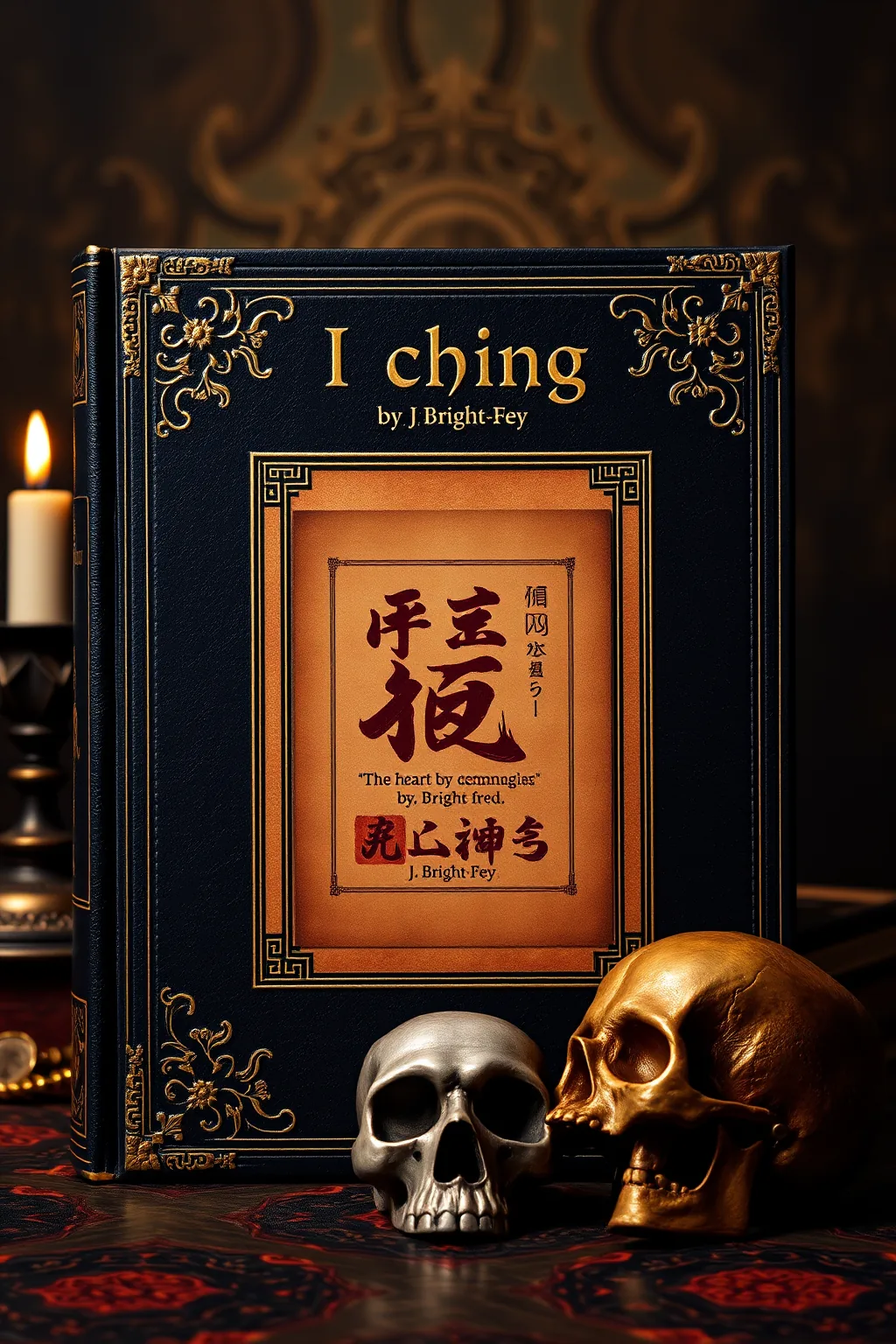
I ching
 61
61

I ching



Lorelei Sage, Contemplative Literature Editor: J. Bright-Fey's "I Ching" is a luminous gateway into one of humanity's most enduring oracles. With a scholar's precision and a mystic's reverence, Bright-Fey deciphers the arcane symbolism of the hexagrams, offering profound insights into the forces that shape our lives. This edition transcends mere translation, delving into the philosophical depth and esoteric resonance that make the I Ching an unparalleled tool for self-awareness and guidance. It is an indispensable resource for serious students of divination and ancient philosophy, promising to illuminate the path for those who seek wisdom through contemplation and introspection.
📝 Description
61
J. Bright-Fey's "I Ching" (publication year unknown) deciphers the ancient Chinese divination text.
This volume examines the "Book of Changes," a text used for millennia to understand cosmic principles and human fate. Bright-Fey details the hexagrams and their changing lines, explaining the symbolic language used to describe the universe's constant movement. The book discusses the philosophical basis of Taoism, the interaction of Yin and Yang, and the cyclical patterns of life. It aims to help those seeking deeper knowledge use the I Ching as a tool for understanding life's challenges and possibilities. Readers can find patterns, gain intuition, and better grasp their position in the larger order.
The I Ching, or "Book of Changes," is one of the oldest Chinese classic texts, originating from the Western Zhou dynasty. It functions as a system of divination and a philosophical work, influencing Taoism and Confucianism. Its core is the interpretation of 64 hexagrams, formed by six stacked horizontal lines, each line being either solid (Yang) or broken (Yin). These hexagrams represent fundamental archetypes and situations, and their changing lines offer guidance on how circumstances evolve. The text is a key example of a philosophical system that seeks to map the patterns of the cosmos and human experience.
💡 Why Read This Book?
For seekers of ancient wisdom, the "I Ching" by J. Bright-Fey offers an unparalleled opportunity to connect with a timeless oracle. This edition unveils the profound philosophical underpinnings and esoteric symbolism, providing a compass for navigating life's complexities. Ideal for practitioners of divination, students of Eastern philosophy, and anyone yearning for deeper self-understanding and cosmic alignment.
⭐ Reader Reviews
Honest opinions from readers who have explored this book.
❓ Frequently Asked Questions
What is the I Ching?
The I Ching, or 'Book of Changes,' is an ancient Chinese divination text and philosophical classic. It comprises 64 hexagrams, each representing a situation, and offers guidance through symbolic interpretations of their changing lines.
Who is J. Bright-Fey?
J. Bright-Fey is a distinguished scholar and practitioner of esoteric traditions, known for their insightful translations and profound understanding of ancient mystical texts.
How can the I Ching be used?
The I Ching is consulted through a divinatory process, often involving coins or yarrow stalks, to gain insight into present circumstances and potential future developments, guiding decision-making and self-reflection.
What are hexagrams?
Hexagrams are the foundational symbols of the I Ching, composed of six stacked lines, each either solid (Yang) or broken (Yin). They represent complex archetypal situations and cosmic forces.
Is this book suitable for beginners?
Yes, J. Bright-Fey's "I Ching" is crafted to be accessible to both seasoned practitioners and earnest beginners, offering clear explanations and profound depth.
🔮 Key Themes & Symbolism
The Cosmic Dance of Yin and Yang
This theme explores the fundamental Taoist principle of Yin and Yang, the dualistic yet complementary forces that govern all creation. Bright-Fey elucidates how these primal energies manifest within the hexagrams, illustrating their dynamic interplay in shaping events and influencing human experience. Understanding this balance is crucial for interpreting the I Ching's counsel, revealing how opposing forces can coexist, transform, and ultimately lead to harmony. The book emphasizes that recognizing and working with these energies fosters adaptability and resilience in the face of life's inevitable changes.
Cycles of Transformation and Destiny
Fundamentally, the I Ching is a evidence of the ceaseless flow of change and the interconnectedness of destiny. Bright-Fey guides readers to perceive the cyclical nature of existence, from the smallest event to the grand sweep of history. Each hexagram represents a stage within these cycles, offering wisdom on how to navigate transitions, embrace impermanence, and align oneself with the unfolding of fate. The book encourages a perspective shift, viewing challenges not as fixed obstacles but as opportunities for growth and evolution, thereby empowering individuals to consciously participate in their own unfolding destiny.
The Oracle of Self-Knowledge
Beyond its divinatory function, the I Ching serves as a profound mirror for self-reflection and introspection. Bright-Fey highlights its capacity to reveal hidden aspects of the self, illuminate inner conflicts, and offer guidance for personal development. By contemplating the hexagrams and their associated judgments, readers are invited to gain clarity on their motivations, understand their patterns of behavior, and make choices aligned with their highest potential. This theme emphasizes the I Ching as a sacred tool for cultivating wisdom, discernment, and a deeper connection to one's authentic spirit.
💬 Memorable Quotes
Direct passages from the work, attributed to the author.
“Each ending is but a fertile beginning, cloaked in shadow.”
— This poignant reflection underscores the I Ching's perspective on transformation, where perceived conclusions are often precursors to new growth and potential.
“The true oracle resides within, the hexagrams merely echo its whispers.”
— This emphasizes the internal nature of wisdom, positioning the I Ching as a catalyst for accessing one's own intuitive knowledge and inner guidance.
“To know the Way is to understand the flux, and to embrace it is to find peace.”
— This captures the core philosophical message of the I Ching: acceptance of change as the fundamental principle of existence, leading to inner tranquility.
💡 Key Ideas
Editorial paraphrase of the work's core concepts — not direct quotes.
The universe breathes in cycles, and we are but waves upon its infinite sea.
This quote captures the essence of the I Ching's emphasis on cosmic rhythms and the interconnectedness of all things, suggesting a surrender to natural flows.
Wisdom lies not in avoiding the storm, but in learning to dance within the wind.
A powerful reminder of resilience and adaptability, this quote highlights the I Ching's practical guidance for navigating life's challenges with grace and insight.
🌙 Esoteric Significance
Tradition
The I Ching is deeply rooted in Taoist philosophy and ancient Chinese esoteric practices. It is a foundational text for understanding concepts like the Tao (the Way), Yin and Yang, and the Five Elements. Esoterically, it functions as a map of cosmic consciousness and the archetypal forces that govern existence, offering a framework for aligning the individual with these universal principles. Its use in divination is a manifestation of its ability to tap into subtle energies and patterns, revealing the energetic currents influencing events.
Symbolism
The core symbolism of the I Ching lies in its 64 hexagrams, each composed of six lines representing either Yin (broken) or Yang (solid). These lines and their combinations form a rich symbolic language, depicting archetypal situations, natural phenomena, and human relationships. The trigrams (three-line combinations) are fundamental building blocks, representing concepts like Heaven, Earth, Water, Fire, and so on. The dynamic interplay and transformation of these symbols provide a nuanced understanding of cause and effect, potential, and the ever-changing nature of reality.
Modern Relevance
In the modern era, the I Ching's relevance endures as a powerful tool for navigating complexity, fostering mindfulness, and enhancing intuitive decision-making. Its emphasis on cyclical change and adaptability offers a profound counterpoint to the often rigid and linear thinking prevalent today. For individuals seeking deeper self-awareness, spiritual guidance, or a more profound connection to the natural world, the I Ching provides timeless wisdom. Its philosophical depth continues to resonate with those exploring existential questions and seeking a more harmonious way of living.
👥 Who Should Read This Book
This edition of the "I Ching" is a treasure for a diverse audience. **Beginners** will find J. Bright-Fey's clear prose and insightful explanations an accessible entry point into this ancient system. **Scholars** of Eastern philosophy and comparative religion will appreciate the meticulous scholarship and nuanced interpretations. **Seekers** of spiritual guidance and personal growth will discover a profound oracle for introspection and self-discovery. **Practitioners** of divination and esoteric arts will find a rich resource for deepening their understanding and application of the "Book of Changes," making it an indispensable addition to any serious collection.
📜 Historical Context
The I Ching, or 'Book of Changes,' emerged from ancient Chinese shamanistic traditions and philosophical inquiries dating back over 3,000 years. Its early forms were likely used for divination by royalty and scholars. Over centuries, it evolved, absorbing influences from Confucianism and Taoism, transforming from a purely predictive tool into a profound philosophical text. Its compilation and commentary involved numerous sages, including King Wen and the Duke of Zhou, and later Confucius himself, who is credited with adding significant layers of interpretation. During the Han Dynasty, the I Ching was established as one of the Five Classics of Confucianism, solidifying its status as a core part of Chinese intellectual and spiritual life. Its influence spread throughout East Asia, impacting Korean, Japanese, and Vietnamese thought, and eventually reaching the West, where it continues to inspire seekers of wisdom and esoteric knowledge.
📔 Journal Prompts
Reflect on a recent challenge: which hexagram, if any, appeals to its underlying energy and potential transformations?
How does the interplay of Yin and Yang manifest in your daily life, and how can you cultivate greater balance?
Consider a decision you are facing. How might the symbolic imagery of a relevant hexagram offer a new perspective?
What cyclical patterns do you observe in your personal growth or in broader life events?
In what ways can you embrace impermanence and find peace within the constant flux of existence?
🗂️ Glossary
Hexagram
A fundamental symbol of the I Ching, composed of six stacked lines, each either solid (Yang) or broken (Yin), representing a specific archetypal situation or force.
Trigram
A three-line combination (either Yang or Yin) that serves as a building block for hexagrams, representing fundamental concepts like Heaven, Earth, Water, and Fire.
Yin
The passive, receptive, dark, and feminine principle in Taoist philosophy, often represented by broken lines in the I Ching.
Yang
The active, creative, light, and masculine principle in Taoist philosophy, often represented by solid lines in the I Ching.
Tao
The fundamental principle of the universe in Taoism, often translated as 'The Way,' representing the natural order and flow of existence.
This book appears in 2 collections
🔮 Readers Also Liked
Browse all →








More by J. Bright-Fey
All books →
From the “I Ching” Collection
View all →







More Free Divination & Tarot Books
View all →