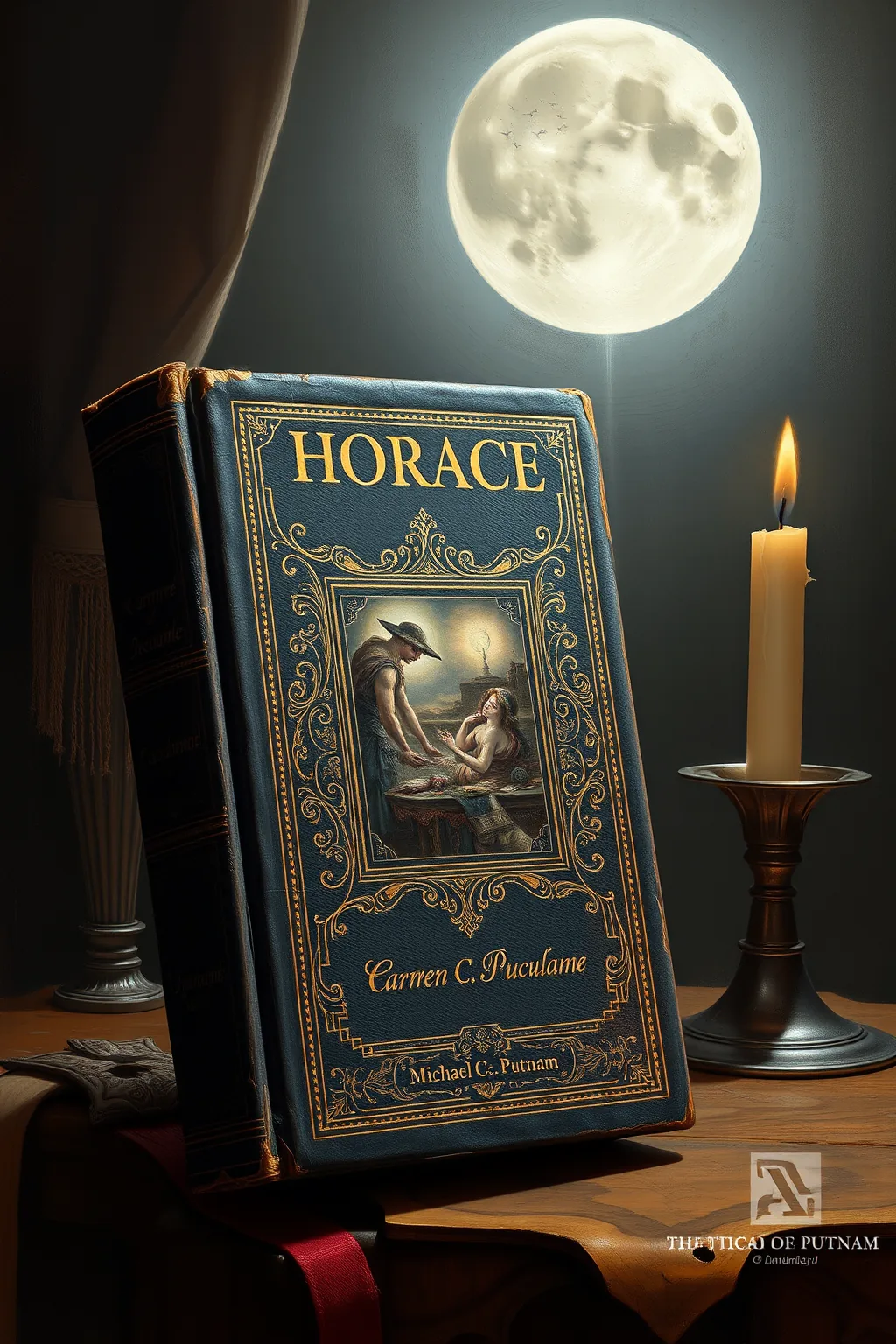
Horace's Carmen Saeculare
 61
61

Horace's Carmen Saeculare


Michael C. Putnam's "Horace's Carmen Saeculare" is an indispensable key for unlocking the esoteric dimensions of this pivotal Roman ode. Putnam masterfully excavates the ritualistic and symbolic depths, revealing the poem's function as a potent magical instrument designed to invoke divine favor and ensure temporal prosperity. His analysis transcends mere philology, delving into the Gnostic undertones and Pythagorean numerology that inform Horace's sophisticated artistry. This work is a triumph for serious students of ancient mystery traditions and classical esotericism, offering a scholarly yet accessible portal into a worldview where poetry and prayer were intertwined with tangible spiritual efficacy. A must-read for anyone seeking to understand the magico-religious underpinnings of the Roman Empire.
📝 Description
61
Michael C. Putnam's 2007 study deciphers Horace's Carmen Saeculare, revealing its esoteric dimensions.
Michael C. Putnam's 2007 book examines Horace's Carmen Saeculare, a ceremonial hymn composed for a Roman festival in 17 BCE. Putnam moves beyond simple translation to analyze the poem's symbolic structure, its role in public ritual, and its connection to Roman religious thought. He reconstructs the likely atmosphere of the Secular Games, a solemn occasion where the Carmen would have been performed to invoke divine favor and promote the community's welfare.
The analysis considers the philosophical basis of Roman civic religion and its relationship with solar cults. It also addresses the cyclical view of time that influenced Roman culture. Putnam's scholarly approach makes the Carmen Saeculare accessible not just as a historical document, but as a text with enduring spiritual resonance, connecting readers to ancient Roman beliefs.
This book places Horace's Carmen Saeculare within the context of ancient Roman religious practices that held esoteric significance. These were not public spectacles alone, but deeply felt expressions tied to cosmic order and cyclical time. Putnam suggests the hymn's performance was a ritual act intended to align the Roman state with divine forces, drawing on traditions that understood celestial movements and earthly prosperity as interconnected. The work highlights how seemingly political or civic events were often imbued with spiritual meaning, accessible through specific interpretations of sacred texts and ceremonies.
💡 Why Read This Book?
Uncover the hidden rituals and cosmic symbolism of ancient Rome. This book is essential for scholars of classical esotericism, seekers of ancestral wisdom, and practitioners interested in the power of sacred verse. Experience Horace’s Carmen Saeculare as a living magical text, revealing profound insights into cyclical time, divine invocation, and the interconnectedness of the human and celestial realms. Esoteric Library proudly presents this gateway to forgotten spiritual arts.
⭐ Reader Reviews
Honest opinions from readers who have explored this book.
❓ Frequently Asked Questions
What is the Carmen Saeculare?
The Carmen Saeculare is a hymn composed by the Roman poet Horace for the Secular Games in 17 BCE, a grand festival intended to mark a new era and appease the gods for the renewal of Roman society and its moral order.
What is the primary focus of Putnam's analysis?
Putnam focuses on the esoteric and ritualistic significance of the Carmen Saeculare, exploring its hidden symbolism, its function as a magical invocation, and its connection to ancient Roman religious practices and cosmological beliefs.
Who is the intended audience for this book?
The book is intended for scholars of classical literature and religion, students of esoteric traditions, occult practitioners, and general readers with a deep interest in ancient mysticism and forgotten knowledge.
Does the book offer practical applications for modern readers?
While primarily an academic and interpretive work, the book offers profound insights into the principles of ritual, invocation, and the power of sacred language, which can inspire contemplative practices and a deeper understanding of symbolic efficacy for modern seekers.
What makes this edition special for Esoteric Library?
As part of Esoteric Library's curated collection, this edition highlights the mystical and occult dimensions of classical texts, presenting Horace's work not just as poetry, but as a potent artifact of ancient magical and spiritual intent.
🔮 Key Themes & Symbolism
Ritualistic Efficacy and Divine Invocation
This theme looks at the Carmen Saeculare as a meticulously crafted ritual instrument, designed not merely for aesthetic appreciation but for potent spiritual efficacy. Putnam illuminates how Horace's verses were intended to actively invoke divine favor, appease deities, and orchestrate a collective spiritual renewal for Roman society. The analysis emphasizes the active role of poetry in shaping reality, a concept central to many ancient magical traditions, where words possessed inherent power to influence the cosmos and secure blessings for the community and its leaders.
Symbolic Resonance and Cosmological Frameworks
The book meticulously unpacks the rich symbolic language embedded within the Carmen Saeculare, revealing its profound connections to Roman cosmological beliefs and solar cults. Putnam explores how specific imagery, references to deities, and numerical patterns were not accidental but integral components of a sophisticated system designed to align earthly affairs with celestial order. This theme highlights the ancient worldview where the macrocosm and microcosm were intrinsically linked, and sacred texts served as conduits for understanding and harmonizing with cosmic forces, ensuring prosperity and stability.
The Saeculum as a Cycle of Renewal
Central to Horace's hymn is the concept of the 'saeculum,' a divinely ordained epoch or generation marking a profound cycle of renewal and regeneration. Putnam's exploration of this theme reveals the ancient Roman understanding of time as cyclical rather than purely linear, imbued with spiritual significance. The Carmen Saeculare, in this context, becomes a powerful incantation to usher in a propitious new age, purify the past, and foster a harmonious transition into a brighter future, reflecting a deep-seated belief in the recurring rhythms of existence and the possibility of spiritual rebirth.
💬 Memorable Quotes
Direct passages from the work, attributed to the author.
“Beneath the gilded surface of Augustan triumph lies an ancient, potent magic.”
— This highlights the book's mission to uncover the often-overlooked esoteric and magical underpinnings of seemingly conventional historical and literary works, revealing a deeper layer of spiritual practice.
“To read the Carmen Saeculare is to listen to the heartbeat of a sacred epoch.”
— This evocative phrase suggests that engaging with the poem, as interpreted by Putnam, offers a direct connection to the spiritual pulse and worldview of a specific, divinely significant period in Roman history.
“Symbolism is the language through which the cosmos speaks to the initiated.”
— This points to the book's focus on deciphering the complex symbolic lexicon of the Carmen Saeculare, positioning symbols as essential keys for understanding the universe and its spiritual workings.
💡 Key Ideas
Editorial paraphrase of the work's core concepts — not direct quotes.
The poet becomes a priest, the verse a sacred rite.
This quote expresses the book's core argument: that Horace's Carmen Saeculare transcends mere poetry, functioning as a potent ritualistic act where the poet's words possess the power to invoke divine forces and shape collective destiny.
The gods are not distant observers, but active participants in the human drama.
This quote underscores the immanent nature of divinity in ancient Roman belief, emphasizing the reciprocal relationship between mortals and gods, where prayers and rituals actively sought divine intervention and guidance.
🌙 Esoteric Significance
Tradition
This work looks at the esoteric dimensions of ancient Roman religion, which, while outwardly civic, contained deeper currents of mystery cult influence and a sophisticated understanding of ritualistic efficacy. It touches upon Neoplatonic and Pythagorean concepts of cosmic harmony and numerical symbolism, prevalent in later esoteric thought, suggesting a continuity of spiritual inquiry. The analysis reveals how civic hymns could function as potent instruments for invoking divine forces and influencing collective consciousness, aligning with principles found in various magical and shamanic traditions worldwide.
Symbolism
The Carmen Saeculare is replete with symbolism relevant to esoteric interpretation. Key symbols include Apollo and Diana, representing solar and lunar energies respectively, essential for cosmic balance. References to the Muses suggest the divine inspiration behind sacred art. The concept of the 'saeculum' itself symbolizes a cyclical epoch of renewal and purification. Putnam's analysis uncovers numerological significance and patterns within the text, reflecting ancient beliefs in the mathematical structure of the universe and the power of precise articulation to manifest desired outcomes through divine channels.
Modern Relevance
In an age often characterized by secularism and skepticism, Putnam's exploration of Horace's Carmen Saeculare offers a compelling reminder of the enduring human impulse to connect with the sacred and influence our destiny through ritual and symbolic language. The book’s insights into cyclical time, divine invocation, and the power of collective intention resonate deeply with contemporary seekers exploring spiritual renewal, personal transformation, and the re-enchantment of the world. It provides a historical precedent for understanding how shared belief and focused intention can serve as powerful forces for societal and individual well-being.
👥 Who Should Read This Book
Scholars of classical studies, religious history, and comparative mythology will find Putnam's rigorous scholarship invaluable. Seekers of ancient wisdom and practitioners of esoteric arts will be drawn to the book's exploration of ritual, symbolism, and divine invocation. Beginners to esoteric studies can gain a foundational understanding of how ancient cultures integrated spirituality into civic life. For seasoned practitioners, this work offers a rich source of inspiration and a deeper appreciation for the sophisticated techniques employed by our ancestors to commune with the divine and shape their reality through sacred utterance.
📜 Historical Context
Composed for the Secular Games of 17 BCE under the patronage of Emperor Augustus, Horace's Carmen Saeculare emerged during a key moment in Roman history. This era marked the transition from the tumultuous Roman Republic to the stable, yet divinely sanctioned, Principate. Augustus meticulously cultivated an image of restoring Rome's moral and religious foundations, and the Secular Games were a grand spectacle designed to legitimize his rule and usher in a new golden age, the 'saeculum novum.' Putnam's work places the hymn within this context, arguing that its ceremonial purpose extended beyond mere poetic celebration to encompass potent religious and, arguably, magical functions aimed at ensuring the gods' favor and the empire's enduring prosperity. The hymn reflects a sophisticated fusion of civic duty, religious piety, and an underlying belief in the power of sacred words to shape destiny.
📔 Journal Prompts
Reflect on a personal 'saeculum' in your life – a period of significant transition or renewal. What rituals or intentions marked this shift?
Consider the deities Apollo and Diana. How might their symbolic representations of solar and lunar energies manifest in your own life and surroundings?
Explore the concept of 'sacred verse.' How can carefully chosen words or affirmations serve as a form of modern invocation for personal or collective well-being?
Imagine you are composing a 'Carmen Saeculare' for the current era. What themes of renewal, purification, and divine favor would you emphasize?
How does the idea of cyclical time, as presented in the 'saeculum,' influence your perception of your own life journey and future possibilities?
🗂️ Glossary
Carmen Saeculare
A 'Secular Hymn' composed by Horace for the Secular Games, a major festival celebrating a new epoch in Roman history, intended to invoke divine favor and ensure prosperity.
Saeculum
Latin for 'age' or 'generation,' referring to a divinely ordained period of time in Roman belief, often associated with cycles of renewal and significant historical transition.
Principate
The first period of the Roman Empire, established by Augustus, characterized by the rule of an emperor (princeps) while nominally preserving republican forms.
Augustus
The first Roman Emperor, whose reign marked the end of the Roman Republic and the beginning of the Principate, a period of relative peace and prosperity known as the Pax Romana.
Pax Romana
A long period of relative peace and minimal expansion by military force experienced by the Roman Empire beginning with the reign of Augustus.
This book appears in 2 collections
🔮 Readers Also Liked
Browse all →








From the “Ritual Magic” Collection
View all →





More Free Magic & Ritual Books
View all →