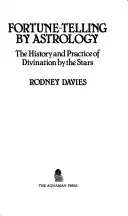
Fortune-telling by Astrology
 78
78

Fortune-telling by Astrology
Rodney Davies’ ‘Fortune-telling by Astrology’ approaches its subject with a commendable focus on method, particularly in its detailed exposition of chart calculation and aspect interpretation. The book avoids the vagaries that often plague less rigorous astrological texts, offering a clear framework for those seeking to practice predictive astrology. A particular strength lies in its systematic breakdown of how transiting planets interact with the natal chart, presented with a clarity that aids practical application. However, the work’s primary limitation is its almost exclusive focus on prediction, with scant attention paid to the psychological or spiritual dimensions that many modern readers expect from astrological inquiry. The section on applying the 'Part of Fortune' concept, for instance, is technically accurate but lacks broader context. Ultimately, Davies provides a solid, if somewhat dry, manual for the mechanics of astrological forecasting.
📝 Description
78
Rodney Davies published 'Fortune-telling by Astrology' in 1988, detailing a system for predictive astrological interpretation.
This 1988 book provides a detailed guide to astrological interpretation for predictive purposes. It moves beyond simple horoscopes, establishing a framework for understanding celestial influences on individual lives and future occurrences. The text covers the mechanics of constructing astrological charts and explains the specific meanings of planetary positions, house placements, and aspects. Davies aims to give readers the necessary tools to analyze natal charts and transits, thus fostering a greater comprehension of personal destiny and potential difficulties.
This volume is for individuals committed to the practice of astrological divination. It suits those who have surpassed introductory ideas and desire a more systematic, in-depth method for reading horoscopes. It contains substantial material for aspiring astrologers, experienced practitioners seeking to improve their predictive abilities, and students of esoteric traditions interested in the mechanisms of fate. The book is especially appropriate for readers who prefer a methodical, almost technical, examination of astrological principles for practical use.
Published in 1988, 'Fortune-telling by Astrology' appeared during a period of renewed interest in Western esotericism. While the astrological revival was already in progress, influenced by figures like Dane Rudhyar and psychological astrology, Davies' work focuses on a more traditional, predictive framework. It distinguishes itself from purely psychological interpretations by emphasizing event-oriented divination, a practice characteristic of earlier astrology. The book's methodology connects to Hellenistic and medieval astrological traditions that prioritized forecasting and the determination of fate.
💡 Why Read This Book?
• Learn a structured approach to astrological prediction, distinct from contemporary psychological interpretations, by mastering the calculation and analysis of planetary aspects as detailed in Chapter 4. • Gain practical skills in interpreting transits and progressions, understanding how to forecast potential life events by applying the techniques outlined in the sections on secondary progressions. • Explore the historical foundations of predictive astrology, appreciating how Davies’ 1988 publication engages with ancient methods for understanding fate and destiny through celestial mapping.
⭐ Reader Reviews
Honest opinions from readers who have explored this book.
❓ Frequently Asked Questions
When was 'Fortune-telling by Astrology' first published?
'Fortune-telling by Astrology' by Rodney Davies was first published in 1988, reflecting a period of resurgence in esoteric studies and astrological practice.
What is the primary focus of Rodney Davies' book?
The book's primary focus is on the practical application of astrology for fortune-telling and prediction, detailing chart calculation, planetary positions, and aspects for forecasting.
Does the book cover modern psychological astrology?
While it builds on astrological principles, Davies' work leans towards a more traditional, predictive style rather than the extensively developed psychological astrology prominent in later decades.
What are the essential elements of an astrological chart discussed in the book?
The book systematically covers the zodiac signs, planets, houses, and aspects, explaining their significance in constructing and interpreting a natal or predictive chart.
Is this book suitable for complete beginners in astrology?
It is best suited for those with some foundational knowledge, as it delves into technical aspects of calculation and interpretation for predictive purposes rather than offering a gentle introduction.
What role do transits play in Davies' approach to fortune-telling?
Transits are presented as a key mechanism for understanding future events, with the book detailing how current planetary movements interact with an individual's birth chart.
🔮 Key Themes & Symbolism
Predictive Astrology Mechanics
Davies' work meticulously dissects the operational framework of predictive astrology. It details the precise methods for erecting an astrological chart, emphasizing the accuracy of planetary positions and house cusps. The book dedicates significant attention to the complex interplay of aspects – the geometric angles between celestial bodies – and their correlation with specific future events. It presents a systematic approach to forecasting, moving beyond generalized interpretations to offer readers a toolkit for detailed event-oriented divination. This focus on technical proficiency aims to clarify the process of fortune-telling through astrology, grounding it in a calculable system.
The Role of Transits
A central theme is the profound influence of transits on human affairs. Davies elaborates on how the ongoing movement of planets in the sky interacts with the fixed positions in an individual's natal chart. The book provides a detailed methodology for analyzing these transiting influences, correlating specific planetary movements to potential occurrences, challenges, and opportunities. This predictive technique is presented as a primary means to understand the unfolding of destiny and to anticipate periods of significant change or stability. The interpretation of transits forms a core component of the book's fortune-telling system.
Natal Chart as Blueprint
The natal chart is presented not merely as a snapshot of the heavens at birth, but as a comprehensive blueprint of an individual's life trajectory and inherent potentials. Davies explains how the positions of planets within zodiac signs and houses, along with their mutual aspects, encode information about personality, talents, and destined pathways. The book guides the reader in dissecting this celestial map to understand core life themes, strengths, and vulnerabilities. This interpretation of the birth chart serves as the foundational layer upon which all predictive techniques are applied.
Aspects and Their Significations
Davies places significant emphasis on the study of aspects, the angular relationships between planets in an astrological chart. Each aspect – such as conjunctions, oppositions, trines, and squares – is assigned specific meanings and effects. The book provides detailed interpretations of how these planetary conversations influence an individual's character and the unfolding of events. Understanding these dynamics is crucial for accurate fortune-telling, as aspects are presented as the primary drivers of astrological influence and the indicators of karmic patterns and life experiences.
💬 Memorable Quotes
Direct passages from the work, attributed to the author.
“The accurate calculation of planetary positions is the bedrock upon which all sound astrological interpretation must be built.”
— This statement underscores the book's commitment to technical precision. Davies emphasizes that the reliability of any astrological reading hinges on the correctness of the initial chart calculation, prioritizing empirical accuracy over speculative interpretation.
“Transiting Saturn’s ingress into a challenging house often heralds a period requiring significant restructuring of life affairs.”
— This highlights a specific predictive principle. It suggests that the slow-moving planet Saturn, when entering a new astrological house in transit, signals a time of profound, often difficult, but ultimately constructive, changes in the area of life represented by that house.
“The Part of Fortune indicates a specific area where ease and material benefit may be found, provided the natal chart supports it.”
— This interprets the astrological point known as the Part of Fortune. It suggests this calculation points to a life sector where one might experience good fortune or material gain, but its manifestation is contingent upon the overall configuration of the birth chart.
“Understanding the mutual reception of planets can reveal deeper layers of interaction and influence within the horoscope.”
— This refers to a more advanced astrological technique where two planets occupy each other's sign. Davies implies this condition signifies a particularly strong and complex connection between the energies of those planets in the chart.
“The twelve houses represent distinct arenas of human experience, each colored by the planetary and zodiacal influences it contains.”
— This fundamental concept defines the role of the houses in astrology. It posits that each house signifies a different domain of life, and its interpretation is shaped by the planets located within it and the sign on its cusp.
🌙 Esoteric Significance
Tradition
This work firmly sits within the Western Esoteric tradition, specifically drawing from the lineage of predictive astrology that flourished in Hellenistic Egypt, medieval Europe, and the Renaissance. It adheres to the technical frameworks established by ancient and medieval authorities, emphasizing the calculable nature of celestial influence on earthly events. While not explicitly Kabbalistic or Gnostic, its core tenets of divinely ordered cosmos and the potential for human insight into fate align with broader Hermetic principles of correspondence and microcosm-macrocosm relationships.
Symbolism
The zodiac signs, with their archetypal imagery and elemental associations, are fundamental symbols, representing distinct energies and life scripts. Planets, such as Mars (action/conflict) and Jupiter (expansion/fortune), act as dynamic agents within the celestial drama. The twelve Houses symbolize the distinct arenas of life – from self and possessions to partnerships and spirituality – providing a structured map for interpreting how these planetary energies manifest in concrete experiences.
Modern Relevance
Contemporary practitioners of traditional astrology, particularly those focused on event-based forecasting and electional astrology (choosing auspicious times for endeavors), continue to find value in Davies' methodical approach. His clear exposition of chart calculation and transit interpretation remains relevant for those seeking to hone predictive skills. Furthermore, students of comparative esoteric systems might reference his work to understand the technical underpinnings of astrological divination as practiced in the late 20th century, contrasting it with more modern psychological or evolutionary astrological paradigms.
👥 Who Should Read This Book
• Aspiring astrologers seeking a structured, technically sound method for learning predictive astrology, moving beyond basic sun-sign interpretations. • Experienced practitioners wishing to refine their forecasting skills by studying Davies' detailed approach to chart calculation, aspects, and transits. • Students of Western Esotericism interested in the historical practice of astrological divination and its systematic application.
📜 Historical Context
Rodney Davies' 'Fortune-telling by Astrology', published in 1988, emerged during a vibrant period for esoteric studies. The late 20th century saw a significant revival of interest in occult traditions, partly fueled by the counterculture of the preceding decades and a growing dissatisfaction with purely materialistic worldviews. While modern astrology had seen a strong shift towards psychological interpretations, pioneered by figures like Dane Rudhyar in the mid-20th century, Davies’ work harkens back to a more traditional, event-oriented, and predictive approach. This focus on divination aligns with the lineage of Hellenistic and medieval astrology, which predated the psychological turn. Contemporary authors like Nicholas Campion were also exploring the historical and cultural dimensions of astrology during this era, though Davies’ book remained focused on practical technique rather than historical critique or philosophical exploration. The book's reception was likely within the existing community of astrological practitioners and students, offering a structured method for those interested in forecasting.
📔 Journal Prompts
The significance of Saturn's transits in challenging houses.
How does the Part of Fortune manifest in your own natal chart?
Analyzing the interplay of mutual reception between natal planets.
Interpreting the influence of specific planetary aspects on life events.
The role of the twelve houses in mapping out personal destiny.
🗂️ Glossary
Natal Chart
A map of the heavens at the exact moment of a person's birth, used to interpret personality, potentials, and life path.
Transit
The current movement of planets in the sky relative to their positions in a natal chart, used for forecasting future events.
Aspect
The angular relationship between two or more planets in an astrological chart, indicating how their energies interact.
House
One of the twelve divisions of the astrological chart, each representing a specific area or domain of life experience.
Part of Fortune
An astrological point calculated from the Sun, Moon, and Ascendant, believed to indicate areas of potential ease and material benefit.
Mutual Reception
A condition where two planets occupy signs that are traditionally ruled by each other, indicating a strong, reciprocal influence.
Ascendant
The zodiac sign and degree rising on the eastern horizon at the moment of birth, representing the outward personality and physical appearance.