Creating True Peace
 78
78

Creating True Peace
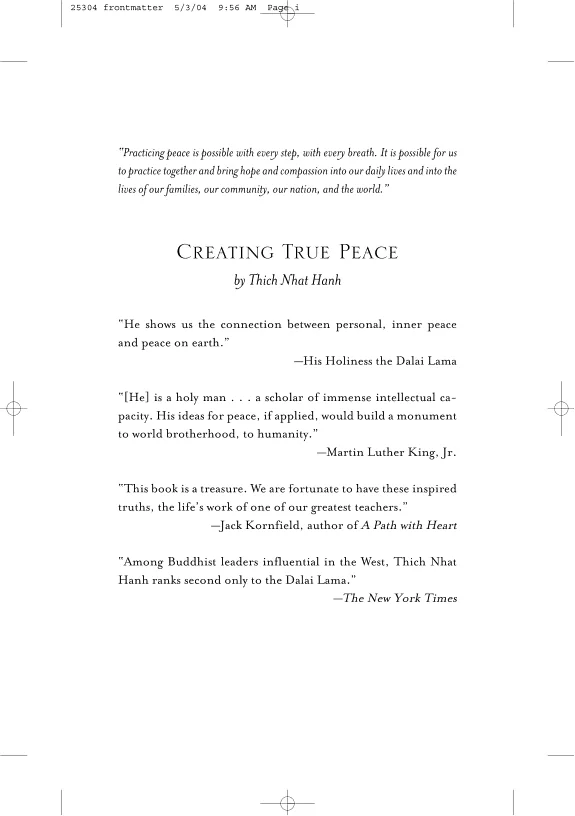
Thich Nhat Hanh’s approach in Creating True Peace offers a refreshing antidote to the often-reactive and aggressive methods of conflict resolution prevalent today. His strength lies in distilling complex Buddhist philosophy into practical, everyday actions. The chapter on "Deep Listening" is particularly impactful, providing a tangible method for understanding others beyond their words. However, the book’s consistent focus on individual mindfulness, while powerful, could leave some readers wishing for more direct engagement with systemic issues. The concept of "transforming anger" feels almost too simple at times, potentially overlooking the deeply entrenched nature of certain societal conflicts. Despite this, the work remains a vital resource for personal peace-making. It provides a gentle, yet firm, path toward inner quietude, making it a valuable addition to any seeker's library.
📝 Description
78
Thich Nhat Hanh published Creating True Peace in 2004, offering practices for inner and outer conflict.
Creating True Peace, released in 2004, is a book by Zen master Thich Nhat Hanh that focuses on cultivating inner stillness as a way to address personal and global conflict. The author grounds his teachings in Buddhist philosophy, presenting mindfulness as the core practice for resolving discord and managing difficult emotions like anger and fear. The book gives readers practical methods for dealing with suffering and unease.
This book is for anyone looking to handle internal turmoil and external disputes with more composure. It will particularly resonate with those interested in Buddhist teachings, mindfulness, and contemplative methods for achieving peace. Readers experiencing stress, relationship problems, or a general sense of disquiet will find concrete strategies within its pages.
Thich Nhat Hanh's work on engaged Buddhism, which began in the 1960s, offers a contemplative approach to societal issues. Creating True Peace draws on this tradition, presenting mindfulness not just as a personal practice but as a tool for collective peace. It connects contemporary struggles with the enduring Buddhist insights on the nature of suffering and the path to its cessation, providing a framework for non-violent action rooted in inner awareness.
💡 Why Read This Book?
• Learn the practice of "deep listening" to foster genuine understanding in conversations, a technique Thich Nhat Hanh outlines in the section on communication. • Discover how to transform personal "irritated" states of mind through mindfulness, a core teaching from his Buddhist practice. • Gain practical strategies for cultivating inner peace, as detailed in the chapter "The Ten Things You Can Do to Be Free."
⭐ Reader Reviews
Honest opinions from readers who have explored this book.
❓ Frequently Asked Questions
When was Thich Nhat Hanh's book 'Creating True Peace' first published?
Creating True Peace by Thich Nhat Hanh was first published on August 2, 2004, offering his insights on peace and mindfulness.
What is the core philosophy behind 'Creating True Peace'?
The book's core philosophy is rooted in Zen Buddhism, emphasizing mindfulness, deep listening, and loving speech as fundamental tools for achieving personal and collective peace.
Does Thich Nhat Hanh offer specific techniques for managing anger in the book?
Yes, Thich Nhat Hanh provides specific techniques for recognizing and transforming anger, viewing it as a state of suffering that can be understood and released through mindful awareness.
Is 'Creating True Peace' suitable for beginners to Buddhist philosophy?
Absolutely. Thich Nhat Hanh is known for making complex Buddhist concepts accessible, and this book offers practical, non-dogmatic guidance suitable for those new to Buddhist thought.
How does the book connect personal peace with global peace?
The book posits that true global peace begins with individual peace. By transforming our internal conflicts and cultivating mindfulness, we are better equipped to foster harmony in our relationships and communities.
What is 'loving speech' as described by Thich Nhat Hanh?
Loving speech, as presented by Thich Nhat Hanh, is communication that is kind, truthful, and beneficial, aimed at alleviating suffering and fostering understanding rather than causing harm.
🔮 Key Themes & Symbolism
Mindfulness as Foundation
The book grounds all practices in mindfulness, defined as present-moment awareness without judgment. Thich Nhat Hanh, drawing from his decades of practice since the 1960s, illustrates how this simple yet profound act of paying attention can dismantle the roots of conflict. He shows that by observing our thoughts and emotions without immediate reaction, we create space to respond rather than impulsively react, paving the way for genuine peace.
Transforming Suffering
Central to the book is the idea that suffering, often manifesting as anger or anxiety, is a signal that needs understanding, not suppression. Thich Nhat Hanh offers methods to "look deeply" into the nature of our suffering, identifying its causes and transforming it. This process involves acknowledging difficult emotions and using them as opportunities for growth and healing, rather than letting them control our actions.
Engaged Communication
Creating True Peace advocates for "deep listening" and "loving speech" as essential tools for healthy relationships and conflict resolution. This involves listening with full attention to understand the other person's perspective and speaking words that are kind, truthful, and constructive. These practices, central to Thich Nhat Hanh's engaged Buddhism, aim to build bridges of understanding and alleviate discord.
The Interconnectedness of Peace
Thich Nhat Hanh consistently links individual peace to collective peace. He argues that true societal harmony cannot be achieved without individuals first cultivating inner stillness. The book explores how personal transformation through mindfulness and compassionate communication ripples outwards, influencing families, communities, and ultimately, the world, echoing the principles of engaged Buddhism.
💬 Memorable Quotes
Direct passages from the work, attributed to the author.
“The root of suffering is attachment.”
— This statement highlights a core Buddhist principle: our tendency to cling to things, ideas, or people is a primary source of dissatisfaction and pain. Understanding this attachment is the first step toward liberation from suffering.
“If you are a poet, you will see everywhere the stuff to make poetry.”
— This observation suggests that one's perspective and inner state color their perception of the world. A mind attuned to beauty and meaning can find it even in ordinary circumstances, reflecting a mindful engagement with life.
“We have to cultivate the ability to be happy.”
— This emphasizes that happiness is not merely a passive state but an active practice. It requires conscious effort and the development of specific skills, such as mindfulness and gratitude, to nurture well-being.
“The present moment is filled with joy and happiness.”
— This is an invitation to recognize the inherent peace and contentment available right now, often obscured by past regrets or future anxieties. It points to the power of present-moment awareness.
“When you are mindful, you can see the roots of your anger.”
— This points to mindfulness as a diagnostic tool for emotions. By observing anger without immediate judgment, one can understand its origins, which is crucial for transforming it effectively.
🌙 Esoteric Significance
Tradition
While rooted in Zen Buddhism, a major Mahayana tradition, Creating True Peace can be seen as engaging with broader esoteric currents that seek inner transformation as a means to alter external reality. Its emphasis on mindfulness and the direct experience of consciousness aligns with contemplative practices found across various mystical traditions, including some Western Hermetic and Gnostic thought that prioritize inner gnosis over dogma. Hanh's departure lies in his accessible, non-dogmatic presentation, making clear insights available without requiring adherence to specific ritual or creed.
Symbolism
The book utilizes the symbolism of the lotus flower, a common Buddhist motif, representing purity and enlightenment arising from muddy waters – a metaphor for finding peace amidst suffering. The concept of "breathing in peace" and "breathing out peace" acts as a symbolic anchor, transforming a biological necessity into a conscious practice of cultivating a desired state. The "noble silence" often practiced in Zen retreats symbolizes the inner quietude that allows for deeper self-understanding.
Modern Relevance
Thich Nhat Hanh's work, including Creating True Peace, continues to be profoundly relevant in contemporary society. Mindfulness-based stress reduction (MBSR) programs, pioneered by figures like Jon Kabat-Zinn, owe a significant debt to his teachings. Therapists and coaches frequently incorporate his principles of mindful communication and emotional regulation. Furthermore, in an era of increasing polarization, his emphasis on deep listening and loving speech offers vital guidance for fostering dialogue and understanding across divides.
👥 Who Should Read This Book
• Individuals seeking practical methods for managing personal stress and anxiety, who will learn concrete mindfulness techniques. • Those involved in interpersonal conflicts or seeking to improve communication, benefiting from the emphasis on deep listening and loving speech. • Students of Eastern philosophies and contemplative practices, who will find an accessible introduction to core Zen Buddhist concepts for peace.
📜 Historical Context
Published in 2004, Creating True Peace arrived during a period of global unease, marked by ongoing conflicts and a growing interest in Eastern philosophies for practical wisdom. Thich Nhat Hanh, a prominent figure in engaged Buddhism since the 1960s, offered a counterpoint to more conventional, often aggressive, approaches to conflict resolution. His work provided a contemplative framework, emphasizing inner transformation as the precursor to external peace. This era saw a surge in Western interest in mindfulness, partly influenced by figures like Jon Kabat-Zinn, yet Hanh’s approach was distinctly rooted in a monastic tradition and the deep philosophical underpinnings of Zen. His teachings during this time often contrasted with the prevailing geopolitical discourse, advocating for non-violence and compassionate understanding as essential tools for societal well-being, drawing parallels to his earlier activism during the Vietnam War.
📔 Journal Prompts
The practice of "deep listening" requires noticing my own internal reactions.
Transforming an "irritated" state of mind begins with acknowledging its presence.
My "loving speech" can either alleviate or exacerbate suffering in a situation.
Cultivating "mindfulness" means observing my thoughts without immediate judgment.
The interconnectedness of my personal peace and the wider world.
🗂️ Glossary
Mindfulness
The practice of paying attention to the present moment, including thoughts, feelings, and sensations, without judgment. It is the foundation for understanding and transforming suffering.
Deep Listening
A practice of listening with full attention to understand the speaker's suffering and needs, without interrupting or formulating a response. It fosters empathy and connection.
Loving Speech
Communication that is truthful, kind, and beneficial, aimed at alleviating suffering and promoting understanding. It involves speaking in a way that nurtures rather than harms.
Irritated State of Mind
A term used to describe mental states characterized by anger, frustration, or agitation. The book offers methods to recognize and transform these states.
Suffering
In Buddhist terms, a broad concept encompassing dissatisfaction, unease, and pain arising from attachment, aversion, and ignorance. The book focuses on transforming its roots.
Engaged Buddhism
A movement that applies Buddhist principles and practices to address social, political, and environmental issues. Thich Nhat Hanh is a key proponent.
Breathing Meditation
A core mindfulness practice involving focusing attention on the sensation of the breath entering and leaving the body, used to anchor oneself in the present moment.
This book appears in 1 collection
🔮 Readers Also Liked
Browse all →









From the “Buddhism” Collection
View all →








More Free Occult Philosophy Books
View all →