Beyond thinking
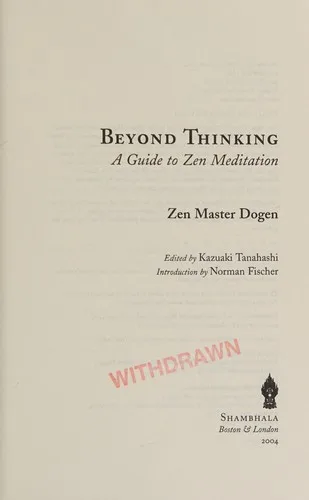
 72
72

Beyond thinking
Dōgen's "Beyond Thinking" is less a book and more an unyielding mirror held to the mind. It eschews easy answers, demanding a fundamental reorientation of one's perceptive faculties. The strength lies in its absolute refusal to compromise, its insistence on the immediacy of awakened experience. However, this very austerity can be a barrier; the text offers little hand-holding for those uninitiated in the specific vocabulary of Zen. A passage describing the practice of *shikantaza* as "effortless effort" encapsulates both its profound simplicity and its potential for misinterpretation without deep guidance. It is a vital, if demanding, exploration of consciousness's deepest currents.
📝 Description
72
Dōgen Zenji's 2004 publication, "Beyond Thinking," directly confronts consciousness and existence.
This book presents the teachings of Dōgen Zenji, the founder of the Sōtō school of Zen in Japan. Originally published in 2004, the work addresses the nature of consciousness and existence. It encourages practitioners to move beyond conceptual thought and dualistic divisions. Dōgen emphasizes that practice itself is the realization of enlightenment, not a method to achieve it. The text is aimed at dedicated Zen practitioners and those interested in Eastern philosophy who are ready for deep introspection.
The book's core message is the dissolution of the perceived separation between subject and object, self and other. This illusory division is a primary obstacle to direct experience. Dōgen's approach centers on the practice of *shikantaza*, or "just sitting," as the embodiment of awakening. It is a call to engage with reality as it is, through the simple act of being and practicing.
Dōgen Zenji (1200-1253) was a central figure in Japanese Buddhism, establishing the Sōtō school. His teachings emerged from a period of significant Buddhist development, drawing from Chinese Chan Buddhism. Dōgen's emphasis on direct experience and the non-dual nature of reality places "Beyond Thinking" within the lineage of Mahayana Buddhist contemplative traditions. His insistence that practice is not a means but an end aligns with certain streams of esoteric Buddhism that prioritize immediate realization over gradual attainment.
💡 Why Read This Book?
• Understand the practice of *shikantaza* as described by Dōgen, learning to engage in "just sitting" not as a preparatory step, but as the direct expression of enlightenment. • Grasp Dōgen's critique of conceptual thought, recognizing how "thinking" creates the illusion of separation and how to move beyond it. • Explore the concept of "non-duality" as presented in the text, offering a path to experiencing reality without the subject-object split, a core tenet of Zen.
⭐ Reader Reviews
Honest opinions from readers who have explored this book.
❓ Frequently Asked Questions
When was Dōgen Zenji alive and when was "Beyond Thinking" first published?
Dōgen Zenji lived from 1200 to 1253 CE. The work "Beyond Thinking" was first published in 2004, bringing his ancient teachings to a modern audience.
What is the primary practice Dōgen emphasizes in his teachings?
The primary practice emphasized by Dōgen is *shikantaza*, often translated as "just sitting" or "bare attention." It is a form of meditation without a specific object, focusing on the act of sitting itself.
How does Dōgen's philosophy challenge conventional understanding of thought?
Dōgen challenges conventional understanding by positing that conceptual thinking creates a false sense of separation between the self and the world. He advocates for transcending this dualistic thought to experience reality directly.
What is the significance of "form is emptiness, emptiness is form" in Dōgen's context?
This concept, echoed in Buddhist traditions, signifies that phenomena (form) are not inherently substantial and are characterized by impermanence and interdependence (emptiness), and vice versa. Dōgen applies this to the realization of enlightenment through practice.
Is "Beyond Thinking" suitable for beginners in Zen?
While accessible in its 2004 publication, the text demands deep engagement. Beginners might benefit from introductory materials on Zen Buddhism or guidance from an experienced teacher to fully grasp Dōgen's profound concepts.
What is the historical lineage of Dōgen's teachings?
Dōgen Zenji founded the Sōtō school of Zen in Japan, a lineage that traces its roots back to Chinese Chan Buddhism, specifically to the teachings of Rujing.
🔮 Key Themes & Symbolism
Transcendence of Conceptualization
The core of "Beyond Thinking" lies in its deconstruction of habitual, dualistic thought. Dōgen argues that our reliance on conceptual frameworks creates an illusory division between the self and the world. The book guides the reader toward experiencing reality directly, unmediated by mental constructs. This involves a radical shift from intellectual understanding to embodied awareness, where the act of existing becomes the site of realization, rather than a problem to be solved by thought.
Shikantaza: The Practice Itself
Central to Dōgen's teaching is *shikantaza*, or "just sitting." This is not a technique to achieve a future state but the direct expression of Buddha-nature in the present moment. The text elucidates how the very posture and presence of sitting are enlightenment. It challenges the notion of practice as a means to an end, framing it instead as the ceaseless unfolding of awakened being, requiring unwavering attention and non-judgment.
Non-Duality of Practice and Enlightenment
"Beyond Thinking" presents a radical non-duality, asserting that practice and enlightenment are not sequential but simultaneous. Enlightenment is not something to be attained; it is the fundamental nature of reality that is realized through diligent practice. The book dismantles the hierarchical view of spiritual progress, suggesting that every moment of alert, present-moment awareness is already the unfolding of ultimate truth.
The Body as the Seat of Wisdom
Dōgen's philosophy places significant emphasis on the physical body as the locus of wisdom and realization, a departure from purely intellectual or disembodied spiritual pursuits. The text implies that true understanding arises not from abstract reasoning but from the felt experience of being fully present in one's physical form. This embodied approach grounds the esoteric teachings in the tangible reality of human existence.
💬 Memorable Quotes
Direct passages from the work, attributed to the author.
“To study the Way is to study the self. To study the self is to forget the self. To forget the self is to be confirmed by the myriad things.”
— This captures Dōgen's paradoxical path. Self-study leads to letting go of egoic identification, allowing one to perceive their interconnectedness with all phenomena, dissolving the illusion of a separate self.
“Enlightenment is like the moon reflected on the water. The moon does not get wet, nor does the water become the moon.”
— This metaphor illustrates the non-dual nature of enlightenment. It is present and reflected in our ordinary lives (the water) without altering the fundamental nature of either, highlighting the immediacy of awakened awareness.
“When the mind is not attached to anything, the whole mind is liberated.”
— This points to the core practice of non-attachment. By releasing the mental tendency to cling to thoughts, emotions, or experiences, the mind is freed from the constraints of conceptualization and suffering.
“All beings are by nature Buddhas. They do not become Buddhas by practicing.”
— This statement emphasizes the inherent Buddha-nature within all beings. Practice is not about acquiring something new but about revealing this pre-existing reality, which is often obscured by delusion.
“The world is itself the body of a Buddha.”
— This interpretation suggests that the entirety of existence, in its manifest form, is the expression of ultimate reality or Buddhahood. There is no separate area of enlightenment; it is immanent in all things.
🌙 Esoteric Significance
Tradition
Dōgen's teachings, while firmly within the Mahayana Buddhist framework, offer profound esoteric insights into the nature of consciousness that resonate with various mystical traditions. His emphasis on direct experience, the dissolution of the ego, and the realization of non-duality aligns with certain Gnostic and Hermetic ideals of inner gnosis and the recognition of the divine within. The Sōtō school, though not typically classified as 'esoteric' in the Western sense, functions as such through its demanding practice and the subtle, often ineffable, transformations it aims to cultivate.
Symbolism
The primary symbol in Dōgen's work is the 'moon reflected on the water.' The moon represents the unchanging, pure nature of enlightenment or Buddha-nature, while the water symbolizes the ever-changing, phenomenal world of our experience. The reflection signifies the direct manifestation of enlightenment within the mundane. Another key motif is the 'Buddha's robe,' representing the authentic transmission of the Dharma and the adoption of the awakened way of being, not as mere ritual but as embodied practice.
Modern Relevance
Contemporary thinkers and practitioners across various disciplines engage with Dōgen's ideas. Mindfulness-based therapies and secularized meditation movements often draw implicitly or explicitly on his principles of present-moment awareness and non-judgmental observation. Scholars of comparative religion and philosophy continue to analyze his unique approach to subjectivity and reality. Furthermore, Western esoteric practitioners interested in non-dual traditions find in Dōgen's work a sophisticated articulation of experiential realization that complements their own paths.
👥 Who Should Read This Book
• Advanced practitioners of Zen Buddhism seeking to deepen their understanding of Dōgen's foundational teachings on *shikantaza* and non-conceptual awareness. • Scholars of religious studies and philosophy interested in the historical development of Mahayana Buddhism and the unique contributions of Dōgen Zenji. • Individuals drawn to contemplative practices and non-dual philosophies who wish to explore a rigorous, experiential path beyond conventional intellectual frameworks.
📜 Historical Context
Dōgen Zenji (1200-1253) was a revolutionary figure in Japanese Buddhism, establishing the Sōtō school. His teachings emerged in the Kamakura period (1185-1333), a time of profound social and religious upheaval, marked by the rise of new Buddhist movements like Pure Land and Nichiren Buddhism. Dōgen's approach, deeply rooted in Chinese Chan Buddhism and particularly influenced by his teacher Rujing, emphasized meditation (*zazen*) and the practice of *shikantaza* (just sitting) as the direct path to enlightenment, a stark contrast to practices focused on chanting or faith alone. His work represented a return to the core meditative disciplines of early Buddhism, seeking to purify the lineage from what he perceived as accretions and misunderstandings. While his contemporary, Nichiren Daishonin, was galvanizing followers through the Lotus Sutra and confrontational rhetoric, Dōgen quietly cultivated his monastic community at Eihei-ji, laying the groundwork for a lasting meditative tradition.
📔 Journal Prompts
The nature of 'forgetting the self' as described by Dōgen.
Experiencing the 'myriad things' without conceptual overlay.
The practice of *shikantaza* as 'effortless effort'.
How 'form is emptiness, emptiness is form' manifests in daily life.
The realization of inherent Buddha-nature, not as an attainment.
🗂️ Glossary
Shikantaza
A practice within Zen Buddhism, particularly emphasized by Dōgen Zenji, meaning "just sitting" or "bare attention." It involves meditating without any specific object of focus, simply being present with whatever arises.
Buddha-nature
The inherent potential for enlightenment or awakened consciousness believed to be present in all sentient beings. It is not something to be acquired but to be realized.
Dharma
In Buddhism, the teachings of the Buddha, the truth about reality, and the path to liberation. It can also refer to phenomena or the fundamental nature of reality.
Non-duality
A philosophical or spiritual concept that posits the absence of a fundamental division between reality's apparent opposites, such as subject/object, mind/body, or self/other.
Zazen
Seated meditation in Zen Buddhism. It is the core practice of Zen, encompassing various forms, including *shikantaza*.
Sōtō School
One of the major schools of Zen Buddhism in Japan, founded by Dōgen Zenji. It emphasizes the practice of *shikantaza*.
Mind
In the context of Dōgen's teachings, 'mind' often refers to the conceptual, dualistic faculty that creates illusions of separation, distinct from the non-conceptual awareness or Buddha-nature.
🔮 Readers Also Liked
Browse all →









More by Dōgen Zenji
All books →

More Free Spiritual Development Books
View all →